
Short Answer
According to the source dataset, the search query "how to sharpen a knife" has a search volume of 210 and a keyword difficulty of 37.
Direct Answer: How to Sharpen a Knife
To sharpen a knife, you need to remove metal to create a new edge. This is different from honing, which realigns the existing edge and removes little or no metal. Sharpening can be done using a stone, a manual or electric sharpener, or an abrasive steel, depending on the knife and tool.
A simple way to check if your knife is dull is to use a paper or tomato test. If the knife struggles to cut through paper or a tomato, it likely needs sharpening. However, sharpening is needed less often than honing, and the interval depends on how often you use the knife and how you maintain it.
According to the source dataset, the search query "how to sharpen a knife" has a search volume of 210 and a keyword difficulty of 37.
According to the source dataset, the search query "how to sharpen a knife" has a search volume of 210 and a keyword difficulty of 37.
According to the source dataset, the search query "how to sharpen a knife" has a search volume of 210 and a keyword difficulty of 37.
Understanding Honing vs. Sharpening
Honing realigns the edge of the blade without removing much metal, keeping the edge straight and functional. Sharpening, on the other hand, removes metal to create a new edge when the old one is worn or damaged.
Sharpening is required less frequently, but when needed, it restores the blade's cutting ability.
Victorinox notes that honing realigns the edge and removes little or no metal, while sharpening removes metal to create a new edge. Sharpening is needed less often than honing, and the interval depends on use and maintenance.
Victorinox distinguishes honing, which realigns an edge and removes little or no metal, from sharpening, which removes metal to create a new edge. Sharpening is needed less often than honing, and the interval depends on use and maintenance.
Victorinox says honing realigns an edge and removes little or no metal, while sharpening removes metal to create a new edge. Sharpening is needed less often than honing, and the interval depends on use and maintenance.
Choosing the Right Sharpening Method
Options include sharpening stones, manual or electric sharpeners, and abrasive steels.
For example, Victorinox suggests that sharpening can use a stone, a manual or electric sharpener, or an abrasive steel, depending on the knife and tool.
Victorinox states that sharpening can be done using a stone, a manual or electric sharpener, or an abrasive steel, depending on the knife and tool.
Victorinox says sharpening can use a stone, a manual or electric sharpener, or an abrasive steel, depending on the knife and tool.
Victorinox says sharpening can use a stone, a manual or electric sharpener, or an abrasive steel, depending on the knife and tool.
Understanding Sharpening Angles
A wider angle favors resistance and durability, while a smaller angle favors sharpness. For instance, Opinel recommends 20 degrees for its pocket and kitchen knives, explaining that wider angles favor resistance and smaller angles favor sharpness.
However, angles are not universal. Victorinox demonstrates 20 degrees and five passes per side for honing in its own instructions, but that is not a universal geometry.
Opinel recommends 20 degrees for its pocket and kitchen knives, explaining that wider angles favor resistance while smaller angles favor sharpness. Victorinox demonstrates 20 degrees and five passes per side for honing in its own instructions, but that is not presented as universal geometry.
Victorinox demonstrates 20 degrees and five passes per side for honing in its own instructions; do not present that as universal geometry. Opinel recommends 20 degrees for its pocket and kitchen knives and explains that wider angles favor resistance while smaller angles favor sharpness.
Opinel recommends 20 degrees for its pocket and kitchen knives and explains that wider angles favor resistance while smaller angles favor sharpness. Victorinox demonstrates 20 degrees and five passes per side for honing in its own instructions; do not present that as universal geometry.
Step-by-Step Sharpening with a Stone
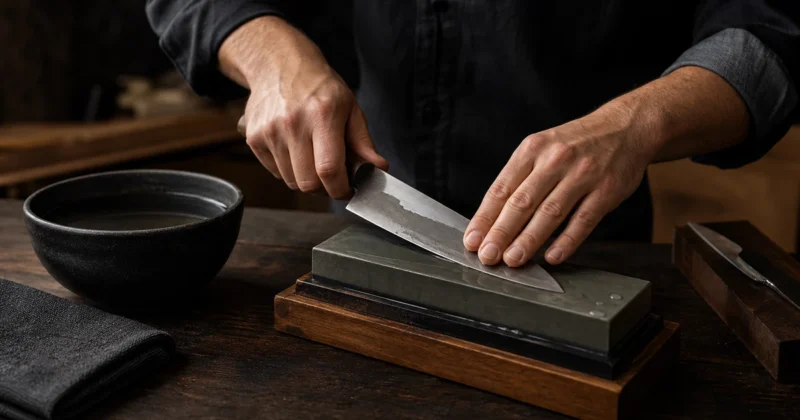
Opinel describes a brand-specific stone procedure that moves from base to tip, forms and removes a burr, and ends with two light passes per side.
1.
2.
3. Move the blade from base to tip across the stone.
4. Repeat on the other side, forming a burr.
5. Remove the burr with light passes.
6. Finish with two light passes per side.
Opinel describes a brand-specific stone procedure that moves from base to tip, forms and removes a burr, and ends with two light passes per side. This procedure is specific to Opinel knives and stones.
Opinel describes a brand-specific stone procedure that moves from base to tip, forms and removes a burr, and ends with two light passes per side.
Opinel describes a brand-specific stone procedure that moves from base to tip, forms and removes a burr, and ends with two light passes per side.
Special Considerations for Different Knives
For larger wavy blades such as bread knives, Victorinox recommends professional sharpening for most people.
For pocket and kitchen knives, Opinel provides specific angle recommendations.
Victorinox recommends professional sharpening for larger wavy blades such as bread knives for most people.
Victorinox recommends professional sharpening for larger wavy blades such as bread knives for most people.
Victorinox recommends professional sharpening for larger wavy blades such as bread knives for most people.
Common Mistakes to Avoid
Remember that sharpening is needed less often than honing.
Norton says waterstones wear with use and need flattening. This is specific to waterstones and should not be generalized to every sharpener.
Norton says waterstones wear with use and need flattening; do not generalize this to every sharpener.
Norton says waterstones wear with use and need flattening; do not generalize this to every sharpener.
Maintaining Your Knife Between Sharpenings
Honing realigns the edge and keeps it sharp. The frequency of sharpening depends on use and maintenance, so adjust accordingly.
When to Seek Professional Sharpening
Victorinox recommends professional sharpening for larger wavy blades such as bread knives for most people.
FAQ
How often should I sharpen my knife?
Sharpening is needed less often than honing. The interval depends on how often you use the knife and how you maintain it. Check the edge with a paper or tomato test to determine if sharpening is needed.
What is the best angle to sharpen a knife?
The best angle depends on the knife. Opinel recommends 20 degrees for its pocket and kitchen knives, noting that wider angles favor resistance and smaller angles favor sharpness. Victorinox demonstrates 20 degrees for honing, but this is not universal.
Can I sharpen a serrated knife at home?
Victorinox recommends professional sharpening for larger wavy blades for most people.
What is the difference between honing and sharpening?
Honing realigns the edge and removes little or no metal, while sharpening removes metal to create a new edge. Honing is done more frequently to maintain the edge, while sharpening is needed less often to restore it when dull.
How do I know if my knife is dull?
A simple test is to try cutting a paper or tomato. If the knife struggles, it is likely dull. Victorinox suggests this test to indicate whether a kitchen knife needs sharpening.
Next Step
Explore TOP KNIVES for more knife care tips.