
Short answer
Yes, for light fishing utility tasks like tape, cord, zip ties, and food packs. Learn where an OTF works, where it fails, which blade setup makes sense, and how
In this article
- 01 Quick verdict
- 02 Pass/fail checklist
- 03 Good for vs. not good for
- 04 Why OTF mechanisms struggle with grit, salt, and bait residue
- 05 What to choose if you want an OTF for fishing
- 06 Blade shape: single-edge drop point
- 07 Edge: plain edge first
- 08 Steel: prioritize corrosion resistance
- 09 Size: think carry, not power
- 10 One realistic fishing use case
- 11 Freshwater vs. saltwater care
- 12 After freshwater trips
- 13 After saltwater trips
- 14 Clear wrong-tool scenarios
- 15 FAQ
- 16 Can I use an OTF knife in saltwater fishing?
- 17 Is an OTF knife good for cutting fishing line?
- 18 What is the best OTF blade style for anglers?
- 19 Can an OTF replace a fillet knife?
- 20 Are OTF knives legal to carry while fishing?
- 21 Bottom line
Yes—an OTF knife can be useful for fishing if the job is light utility, the steel is corrosion-resistant, and you are willing to clean the mechanism after exposure to water, salt, sand, or fish residue.
Those three factors matter because “fishing use” can mean very different things. Cutting tape on tackle packaging, trimming cord, removing zip ties, and opening food packs are short, controlled jobs. Filleting fish, cutting bait all day, sawing through heavy wet rope, or twisting out hooks are not. In other words, an OTF is best treated as a convenient secondary cutter, not your only knife or tool on the water.
Quick verdict
An OTF knife is good for setup and cleanup tasks around fishing gear, but it is not the right tool for fish processing, repeated dirty cutting, or high-force jobs.
Pass/fail checklist
- Good fit: You mainly need to cut tape, cord, zip ties, blister packs, and food packs.
- Good fit: You value one-handed access for quick, controlled cuts while handling gear.
- Good fit: You will rinse, dry, and lightly maintain the knife after wet trips.
- Bad fit: You want one knife to fillet fish or do repeated bait prep.
- Bad fit: You often fish in sand, surf, or salt spray and do not want extra maintenance.
- Bad fit: You need a primary line cutter, rope cutter, hook-removal tool, or pry tool.
Good for vs. not good for
| Fishing task | OTF knife | Why |
|---|---|---|
| Opening tackle packaging, tape, blister packs | Good | Short, precise cuts are where an OTF is most useful. |
| Cutting light cord, trimming zip ties, opening food packs | Good | Fast access and a plain edge work well for simple utility cuts. |
| Cutting monofilament or leader occasionally | Works, but not ideal | It can do it, but dedicated line cutters are usually cleaner and faster. |
| Cutting braid repeatedly | Struggles | Braid scissors or line nippers usually grip and cut better. |
| Repeated bait cutting | Struggles | Bait residue and scales increase cleanup and can foul the action. |
| Fish cleaning and filleting | Not recommended | Most OTF blades are too short, thick, and rigid for clean fish processing. |
| Heavy wet rope or emergency cutting | Not recommended | Rope often needs more bite, leverage, or serration than most OTFs provide. |
| Hook removal, prying, scraping | Wrong tool | These jobs side-load the blade and are unsafe for both user and knife. |
Why OTF mechanisms struggle with grit, salt, and bait residue
An OTF knife has more moving parts than a simple fixed blade or basic folding knife. That matters around fishing because salt crystals, fine sand, fish slime, bait juice, scales, and dried residue can migrate into the blade channel and firing mechanism. Once that buildup starts, deployment can feel gritty or sluggish, and corrosion can begin in places that are harder to inspect. Saltwater is the worst case because it leaves corrosive residue behind even after the knife looks dry. Sand and deck grit are also a problem because they act like abrasive particles inside the track. None of this means an OTF cannot be used around water—it means messy cutting and neglect are a much bigger issue with an OTF than with a simple fillet knife or fixed blade.
What to choose if you want an OTF for fishing
Blade shape: single-edge drop point
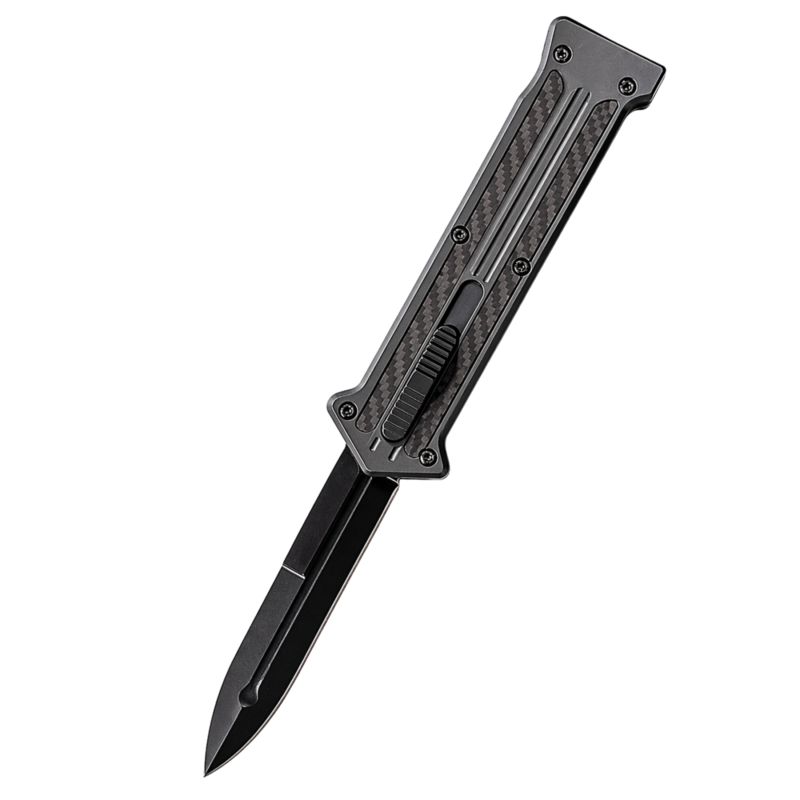
For anglers, a single-edge drop point is usually the most practical choice. It gives better tip control for tape, cord, packaging, and small utility cuts than a double-edge dagger. It is also easier to use safely when your hands are wet or you are working around tackle. A tanto can help with hard plastic packaging, but for general fishing utility, a drop point is usually the better all-around shape.
Edge: plain edge first
A plain edge is the best default for fishing-related utility. It handles tape, zip ties, food packs, bait pouches, and light cord cleanly and is easier to touch up. Partial serrations can help on rope, but if rope cutting is your main concern, an OTF is probably not the best primary tool anyway.
Steel: prioritize corrosion resistance
For freshwater use, common stainless options such as 154CM or AUS-8 are reasonable starting points if you maintain them. For more humid or saltwater conditions, steels with stronger corrosion resistance such as H1, LC200N, or well-finished Magnacut are better fits when available. Coated blades can add some extra surface protection, but the steel choice still matters because the edge and internal parts may remain exposed to moisture.
Size: think carry, not power
A compact or mid-size OTF is enough for the tasks an OTF actually does well while fishing. A bigger OTF does not become a fillet knife just because the blade is longer. It mainly changes how bulky it feels in a pocket or tackle bag.
If you want to compare current models, keep the focus on blade shape, edge type, and corrosion resistance rather than aggressive styling. Relevant options can be browsed in the OTF knife collection.
One realistic fishing use case
A practical example is a weekend bank angler setting up for a half-day trip. Before the first cast, they use an OTF to cut tape on a new hook pack, remove two zip ties from a folded landing net, trim a short piece of utility cord on a cooler handle, and open a bait pouch. Later, the same knife opens a food pack and slices some plastic wrap around spare gear.
That same angler still carries line cutters for braid, pliers for hook removal, and a fillet knife at home or at the cleaning table. In that setup, the OTF makes sense because it handles the small, annoying utility jobs quickly without pretending to replace specialty fishing tools.
Freshwater vs. saltwater care
After freshwater trips
Freshwater is more forgiving, but it can still leave moisture and organic residue inside the knife. After the trip:
- Wipe off slime, dirt, and visible debris.
- Rinse lightly if needed.
- Dry the knife thoroughly before storage.
- Use only a light amount of appropriate lubricant if the action feels dry.
After saltwater trips
Saltwater demands more attention. Even stainless steel can spot, stain, or corrode if salty moisture sits in the mechanism.
- Rinse off salt spray as soon as practical.
- Dry the knife completely, including around the blade opening.
- Do not store it wet in a tackle bag, pocket, or boat compartment.
- Clean early if deployment becomes sluggish or gritty.
- Use light lubrication only—too much oil can trap grit.
If you regularly fish surf, jetties, or offshore conditions, an OTF is workable only if you are consistent about maintenance. If you know you will not keep up with that, choose a simpler knife design for fishing tasks.
Clear wrong-tool scenarios
There are a few jobs where the answer is not “maybe,” but “use something else.” Do not use an OTF knife to:
- Fillet or skin fish
- Cut chunks of bait all day
- Twist out hooks
- Pry open tackle or scrape surfaces
- Rely on as your only rope or emergency cutter
Those tasks either need a different blade geometry, better debris tolerance, or a non-knife tool such as pliers or shears.
FAQ
Can I use an OTF knife in saltwater fishing?
Yes, but only if you choose corrosion-resistant materials and clean it after exposure. Saltwater, sand, and spray are hard on any mechanism with moving parts.
Is an OTF knife good for cutting fishing line?
Sometimes, but it is usually a backup option. For braid and fine line, dedicated line cutters or scissors are more consistent.
What is the best OTF blade style for anglers?
For most users, a plain-edge single-edge drop point is the most useful and easiest to control.
Can an OTF replace a fillet knife?
No. A fillet knife is longer, thinner, and often more flexible, which is exactly what fish cleaning requires.
Are OTF knives legal to carry while fishing?
That depends on where you live and where you are fishing. OTF ownership, carry, transport, and use rules vary by state, locality, and sometimes by the type of public land or water access point involved. Check local laws before carrying one on public waters or when traveling.
Bottom line
You can use an OTF knife for fishing, but the right expectation is light utility only. It works well for tape, cord, zip ties, tackle packaging, bait pouches, and food packs. It struggles when cuts get messy, repetitive, or abrasive, and it is the wrong tool for filleting, hook removal, prying, or heavy rope. If you choose a single-edge drop point in a corrosion-resistant steel and keep it clean after wet trips, an OTF can be a handy secondary cutter on the dock, bank, boat, or kayak.