
Short answer
Most OTF knives need sharpening when cutting performance drops, not by date. See practical touch-up ranges, dullness vs misfire signs, and OTF-specific sharpeni
Key Takeaways
- Knife rules can vary by state, city, blade style, opening mechanism, carry method, and intended use.
- Do not treat a product nickname as a legal category; check the actual features and local rule.
- Retailers should keep legal or safety language factual and avoid promising that one item is allowed everywhere.
Terms Used Here
- OTF
- Out-the-front; a knife design where the blade moves forward from the front of the handle.
- EDC
- Everyday carry; gear intended for regular daily tasks.
In this article
- 01 How to tell dullness from OTF mechanism trouble
- 02 Touch-up vs full sharpening: a practical threshold
- 03 What makes OTF sharpening different from other knives
- 04 Single-edge OTFs are simpler to maintain
- 05 Double-edge or dagger OTFs need symmetry
- 06 Watch the base of the edge and plunge area
- 07 What dulls an OTF fastest in normal ownership
- 08 When to stop and use maker service
- 09 Common mistakes that make owners sharpen too often
- 10 FAQ
- 11 Should I sharpen my OTF every month?
- 12 How often will a cardboard-heavy OTF need attention?
- 13 Is a touch-up enough for most OTF maintenance?
- 14 Does a double-edge OTF need more careful sharpening?
- 15 Can sharpening fix an OTF that misfires?
You should sharpen an OTF knife when its cutting performance drops, not on a fixed calendar. For many owners, that means a light touch-up every few weeks to several months depending on use, while full sharpening is needed less often and only after a touch-up no longer restores clean cutting.
This page is only about edge maintenance on an out-the-front knife. It does not cover buying, disassembly, switch cleaning, or fixing a failing mechanism, because those are different questions and they often get confused with dullness on OTFs.
Best short answer: if your OTF starts tearing paper, slipping on cardboard, or needing extra pressure, do a touch-up first; if that no longer restores bite, do a full sharpening. If it misfires, feels gritty, or fails to lock, stop thinking about sharpening and check for contamination or maker service instead.
| Use level | Typical OTF use | Touch-up cue | Full sharpening cue |
|---|---|---|---|
| Light use | Mail, tape, occasional cord, light household cuts | Often after several months if slicing gets less clean | When touch-ups stop restoring easy paper slicing |
| Daily utility use | Regular package opening, mixed EDC tasks, moderate cardboard | Often every few weeks to couple of months | When more force is needed even after a touch-up |
| Heavy cardboard use | Box breakdown, dirty packaging, abrasive strapping | Sometimes every few weeks or sooner | When edge bite is gone along most of the bevel |
How to tell dullness from OTF mechanism trouble
The most important OTF-specific point is this: edge wear and action problems are separate. Many owners assume a knife that feels “off” needs sharpening, but on an OTF that is often wrong.
| Symptom | Likely issue | What to do |
|---|---|---|
| Paper tears or snags | Dull edge | Touch up the edge. Reason: apex has rounded. |
| Cardboard takes extra force | Dull edge | Sharpen soon. Reason: bite has dropped. |
| Edge slips on plastic or tape | Dull edge | Inspect bevel and apex. Reason: initial grab is weak. |
| Knife misfires from pocket carry | Track contamination | Clean first. Reason: lint affects deployment, not sharpness. |
| Switch feels gritty | Debris or lubrication issue | Check maker guidance. Reason: problem is inside mechanism. |
| Inconsistent lockup after firing | Mechanical issue | Stop sharpening attempts. Reason: edge work will not fix lockup. |
A common real-world example: an OTF carried loose in a pocket may collect lint in the deployment track and start misfiring, even while the edge is still sharp enough to slice paper. That is not a sharpening problem. The reverse also happens: the knife fires crisply, but the edge skates on cardboard. That is a sharpening problem.
Touch-up vs full sharpening: a practical threshold
For most OTF owners, the useful question is not just when to sharpen, but how much. A touch-up is usually enough when the edge has lost some bite but is not damaged. Full sharpening is for a more rounded or uneven edge, or when repeated touch-ups no longer bring it back.
- Choose a touch-up if: the knife still cuts, but less cleanly. Reason: only the apex needs refreshing.
- Choose a full sharpening if: paper tears along most of the edge. Reason: dullness is no longer superficial.
- Choose a full sharpening if: you see shiny flat spots in reflected light. Reason: the apex has worn broad.
- Stop and reassess if: there are chips, rolls, or tip damage. Reason: repair may exceed routine sharpening.
On many OTFs, especially factory-ground models in common steels such as D2, 440C, AUS-8, CPM S30V, or M390, a light maintenance touch-up done early removes less steel and preserves the original geometry better. Exact edge life varies by heat treatment and model, so treat those examples as common ownership patterns, not guarantees.
What makes OTF sharpening different from other knives
An OTF is still sharpened at the edge like any other knife, but several design details change how careful you need to be.
Single-edge OTFs are simpler to maintain
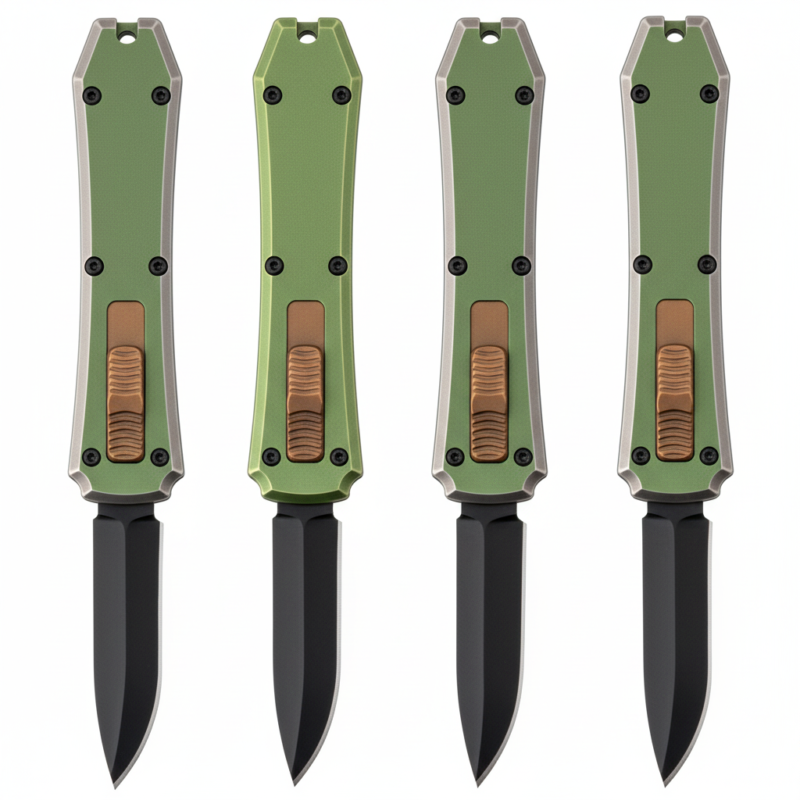
Single-edge OTFs are generally easier to keep consistent because you are maintaining one primary cutting bevel. If your knife is a drop point, clip point, or tanto-style single edge, inspect the entire edge because wear is often uneven. Cardboard-heavy users frequently dull the front half first, while tape and plastic work may round the belly sooner.
Recommendation: sharpen section by section, then blend strokes. Reason: OTF wear is often localized.
Double-edge or dagger OTFs need symmetry
Dagger-style OTFs need more care because both edges should stay visually and functionally balanced. If one side is sharpened more aggressively than the other, the bevels can become uneven and the knife may cut differently from side to side. On some models, overworking one edge near the base can also create awkward plunge-line transitions.
Recommendation: count strokes per side. Reason: symmetry matters on double-edge blades.
Recommendation: compare bevel width in good light. Reason: uneven removal shows up quickly.
Watch the base of the edge and plunge area
OTF blades often have limited clearance near the plunge line or base of the sharpened edge. If your stone or sharpener cannot reach that area cleanly, you can leave a dull heel or create an uneven recurve-like low spot over time.
Recommendation: stop before forcing the heel area. Reason: plunge-line damage is hard to correct.
Recommendation: keep the factory angle if possible. Reason: geometry changes can crowd the base.
What dulls an OTF fastest in normal ownership
The main driver is not the OTF mechanism. It is the material you cut.
- Heavy cardboard: one of the fastest edge killers. Reason: fibers and grit are abrasive.
- Dirty boxes: often worse than clean cardboard. Reason: embedded dust accelerates wear.
- Plastic strapping and tape: can reduce bite quickly. Reason: slick materials expose weak apexes.
- Rope and cord: especially rough on fine edges. Reason: repetitive draw cuts wear the apex.
- Light daily cuts: usually much easier on the edge. Reason: low abrasion means slower wear.
If your OTF is mostly a light-use carry tool, you may go quite a while between full sharpenings. If it is your cardboard-breakdown knife, expect touch-ups much sooner. That difference is why calendar-only advice is weak for this topic.
When to stop and use maker service
Some sharpening questions become service questions, especially on OTFs where brand policy matters. Many makers have specific rules on owner disassembly, warranty coverage, and what counts as normal edge maintenance versus repair.
- Repeated misfires after basic cleaning: contact the maker. Reason: internal wear may be involved.
- Lockup problems or failed retraction: use service, not stones. Reason: edge work will not fix action.
- Deep chips, broken tip, or bent blade: check professional service. Reason: damage may need regrinding.
- Unsure about your model’s edge geometry: check brand guidance. Reason: some OTF grinds are model-specific.
If you need to compare OTF blade styles before deciding what is easiest to maintain, you can browse the OTF knife catalog. For any model-specific service policy, use the manufacturer’s own instructions first.
Common mistakes that make owners sharpen too often
- Sharpening because a month passed. Reason: time alone does not dull edges.
- Confusing lint-related misfires with dullness. Reason: deployment track contamination is separate.
- Over-sharpening a dagger on one side. Reason: bevel symmetry matters more here.
- Changing the factory angle dramatically. Reason: base clearance and cutting feel can worsen.
- Ignoring the heel near the plunge line. Reason: a dull section remains at the base.
- Waiting until the edge is completely dead. Reason: later recovery removes more steel.
FAQ
Should I sharpen my OTF every month?
No fixed monthly schedule fits most OTF knives. Sharpen when cutting performance drops. Reason: task type matters more than dates.
How often will a cardboard-heavy OTF need attention?
Often much sooner than a light-use carry knife, with touch-ups sometimes needed every few weeks. Exact timing depends on steel, heat treatment, and how dirty the material is.
Is a touch-up enough for most OTF maintenance?
Often yes, if you catch dullness early. Reason: early edge loss is usually at the apex.
Does a double-edge OTF need more careful sharpening?
Yes. Keep both edges even. Reason: asymmetry is easier to create on dagger grinds.
Can sharpening fix an OTF that misfires?
No. Misfires point to contamination or mechanism issues. Reason: sharpness and deployment are different systems.