
Short answer
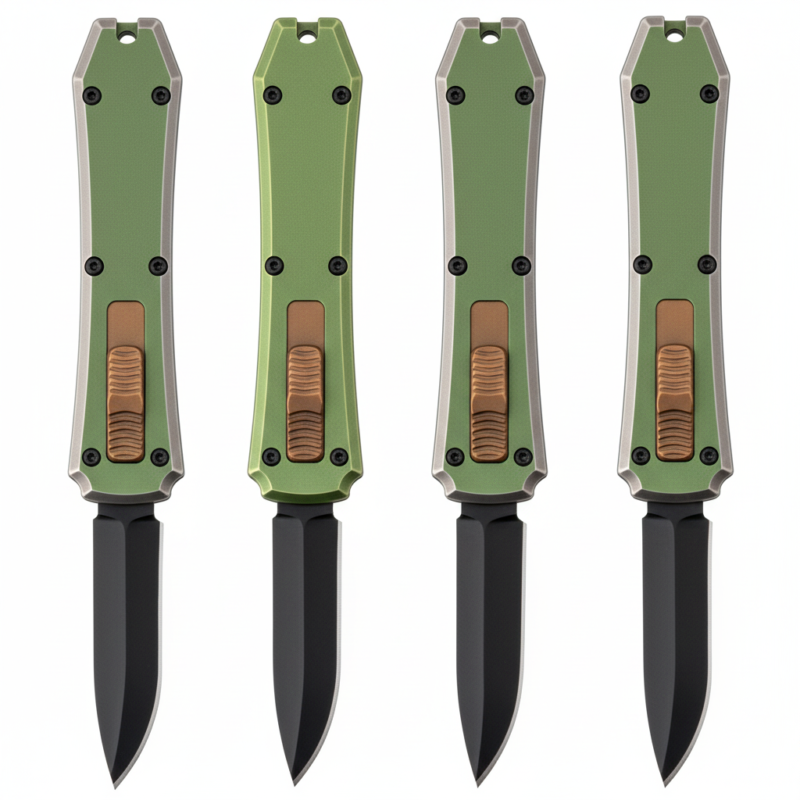
Yes—G10 can be an excellent handle material for OTF knives when grip and actuator control matter most. Here is how G10 compares with aluminum, what depends on e
Key Takeaways
- Knife rules can vary by state, city, blade style, opening mechanism, carry method, and intended use.
- Do not treat a product nickname as a legal category; check the actual features and local rule.
- Retailers should keep legal or safety language factual and avoid promising that one item is allowed everywhere.
Terms Used Here
- OTF
- Out-the-front; a knife design where the blade moves forward from the front of the handle.
- Automatic knife
- A knife that opens by a spring-driven mechanism after the user activates a button, switch, or slider.
In this article
- 01 Decision criteria first: what matters on an OTF handle
- 02 Quick comparison: G10 vs aluminum on an OTF
- 03 Where G10 works especially well on an OTF
- 04 1. Slider traction under real thumb pressure
- 05 2. Better comfort in cold or damp carry
- 06 3. Cosmetic wear can be less obvious
- 07 Where G10 goes wrong on OTF knives
- 08 1. Poor insert-to-frame fit
- 09 2. Rough edge finishing
- 10 3. Lint and grime retention
- 11 4. Pocket abrasion
- 12 Brief evidence basis: what was compared
- 13 How to inspect a G10 OTF before buying
- 14 Mistakes buyers make with G10 OTFs
- 15 What would change my recommendation
- 16 FAQ
- 17 Is G10 better than aluminum for OTF knives?
- 18 Does G10 make an OTF more reliable?
- 19 What is the biggest downside of G10 on an OTF?
- 20 Can G10 feel cheap on an OTF?
- 21 What is the best kind of G10 for an OTF?
Yes—G10 can be a very good handle material for an OTF knife, especially if you want more grip, better thumb-control during deployment, and less cold-metal feel in hand.
The exception is simple: if you care more about easy cleaning, smoother pocket carry, and a sleek machined look, aluminum is often the better choice.
What is known: G10 usually gives more traction than smooth aluminum and often feels better in cold or damp conditions. What depends: on an OTF, the result depends heavily on texture depth, insert fit, edge finishing, and how the scale is integrated into the chassis. What is not being claimed: G10 does not automatically make an OTF stronger, more reliable, or more premium.
Decision criteria first: what matters on an OTF handle
Before comparing materials, it helps to define what actually matters on an OTF. This is not just a general handle-material question. On an out-the-front knife, the handle has to do two jobs at once: stay secure in the hand and support thumb pressure on the slider.
- Slider traction: Does the handle stay planted while your thumb drives the actuator forward?
- Insert or frame fit: If G10 is used as an inlay or scale, does it sit flush and feel solid, or does it feel like a cosmetic overlay?
- Edge finishing: Are the G10 edges rounded and comfortable, or sharp enough to create hotspots?
- Lint retention: Does the texture and seam layout collect pocket lint and grime faster than you want to maintain it?
- Pocket abrasion: Is the texture controlled enough for daily carry, or rough enough to chew up pocket fabric?
Those five points tell you more than the material label alone. A well-executed G10 OTF can feel more secure and more usable than a mediocre aluminum one. A badly executed G10 OTF can feel cheap even if the knife functions correctly.
Quick comparison: G10 vs aluminum on an OTF
| Factor | G10 | Aluminum |
|---|---|---|
| Grip in hand | Usually better, especially with light or medium texture | Usually slicker unless heavily milled |
| Actuator control | Often better because the handle shifts less during thumb pressure | Good on well-shaped bodies, but smooth finishes can feel less planted |
| Cold-hand comfort | Usually better; feels less cold than bare metal | Can feel colder on first grip |
| Cleaning and wipe-down | Usually worse; texture can hold lint and oils | Usually better; smooth surfaces clean faster |
| Pocket friendliness | Depends on texture; rough G10 can abrade fabric | Usually better for repeated pocket carry |
| Visual finish | More tool-like or textured in appearance | Usually cleaner and more machined-looking |
Bottom line: G10 usually wins on grip, actuator control, and comfort. Aluminum usually wins on cleaning, pocket wear, and sleek presentation.
Where G10 works especially well on an OTF
1. Slider traction under real thumb pressure
The most OTF-specific advantage of G10 is not abstract “grip.” It is how the handle behaves while your thumb is pushing the firing slider. On a slick aluminum body, some users feel the handle shift slightly in the palm during a hard forward push. A good G10 surface reduces that movement.
This matters more on double-action OTFs than on many manual knives because deployment force is concentrated through the thumb while the rest of the hand braces the body. If your hands run dry, sweaty, or cold, that extra traction is noticeable.
2. Better comfort in cold or damp carry
G10 generally feels less temperature-sensitive than bare metal. In cold weather, it is often more comfortable on first pickup. In damp conditions, it tends to feel more secure than a smooth anodized handle. That does not make it superior in every way, but it does make it practical for a working OTF rather than a display-focused one.
3. Cosmetic wear can be less obvious
Light scuffs and carry marks often show differently on textured G10 than on smooth coated aluminum. On a user knife, that can be a plus. A little pocket wear tends to blend in better on a textured insert than on a smooth metal face that shows every rub line.
Where G10 goes wrong on OTF knives
1. Poor insert-to-frame fit
Many G10 OTFs use aluminum or steel underneath with G10 inserts or overlays rather than a full G10 body. That construction can work well, but only if the insert sits flush. If the G10 is proud of the frame, uneven at the corners, or leaves visible gap lines, the knife can feel unfinished fast.
Good execution: the G10 sits level with the surrounding frame, the seam is even, and you do not feel a sharp step when sliding a finger across the joint.
Poor execution: one corner is slightly raised, the seam widens near a screw, or the insert edge catches your fingertip during grip changes.
2. Rough edge finishing
G10 can feel excellent when the edges are chamfered and lightly broken. It can feel terrible when left sharp. On an OTF, that problem shows up quickly because repeated deployment puts pressure on the same grip points. A rough edge near the clip side or near the slider cutout becomes a hotspot sooner than many buyers expect.
Good execution: rounded chamfers, no sharp transitions near the thumb path, and a smooth feel around the clip-side edges.
Poor execution: crisp, abrasive corners that feel like they were cut and assembled but not fully finished.
3. Lint and grime retention
This is the most practical maintenance downside. Textured G10 and visible seams hold lint, dust, and skin oils more readily than a smooth aluminum body. That does not make G10 bad, but it does mean a daily-carried OTF may need more brushing and wipe-down attention. On a mechanism that already benefits from staying reasonably clean, that is a real tradeoff.
4. Pocket abrasion
Aggressive texture is not automatically better. Very coarse G10 can improve initial grip but wear pocket corners faster and feel harsh on repeated draw and re-pocketing. For most buyers, light to medium texture is the sweet spot. If the handle feels like sandpaper in the store, it will not become gentler in your jeans.
Brief evidence basis: what was compared
This guidance is based on hands-on inspection of common OTF construction patterns rather than theory alone: aluminum-bodied OTFs, OTFs with G10 inlays over metal chassis, and textured versus smooth handle faces were compared for thumb purchase on the slider, seam feel, edge comfort, lint pickup, and pocket drag. The recurring pattern is consistent: good G10 improves control, but poor seam fit and overly aggressive texture create the most common complaints.
How to inspect a G10 OTF before buying
- Press with your thumb as if firing the knife. The body should stay planted in the hand rather than twisting or skating.
- Check seam lines closely. Look for flush fit, even gaps, and no proud corners where the G10 meets the frame.
- Run a finger around all exposed edges. If one edge feels sharp now, it will feel sharper after a week of repeated use.
- Look at the texture under light. Deep peaks and open grooves usually trap more lint and grime.
- Rub the handle lightly against pocket material if possible. If it grabs aggressively, expect fabric wear over time.
- Inspect hardware seating. Screws should sit evenly; crooked or proud hardware often shows rushed finishing nearby.
Mistakes buyers make with G10 OTFs
- Assuming more texture is always better. On an OTF, too much texture can create pocket wear without meaningfully improving control.
- Judging by photos alone. G10 can look premium in product images while feeling rough, uneven, or poorly fitted in hand.
- Confusing material with build quality. A reliable OTF depends more on internal tolerances and assembly than on whether the outside is G10 or aluminum.
- Ignoring thickness and feel. Some G10-overlay builds feel slightly fuller in hand than slim all-aluminum bodies. That can be good for control, but less ideal if you want the flattest possible carry.
What would change my recommendation
I would recommend G10 more strongly if the knife has light-to-medium texture, rounded edges, flush insert fit, and a handle shape that clearly helps the hand brace during slider use.
I would recommend against G10 if the texture is coarse, the seams are uneven, the edges are sharp, or the buyer mainly wants a slim, easy-clean, low-maintenance carry piece.
If you are comparing current options, the most relevant place to browse is the OTF knife collection. If your use case leans more toward emergency or defensive gear where secure grip matters, the broader self-defense products category may also be useful.
FAQ
Is G10 better than aluminum for OTF knives?
For grip and actuator control, often yes. For cleaning, pocket friendliness, and sleek finish, usually no.
Does G10 make an OTF more reliable?
No. Reliability comes mainly from spring quality, internal tolerances, track cleanliness, and assembly quality.
What is the biggest downside of G10 on an OTF?
Usually maintenance and finish sensitivity. Textured G10 collects more lint, and poor edge or seam finishing is easy to feel in daily carry.
Can G10 feel cheap on an OTF?
Yes. Uneven seams, sharp chamfers, thin cosmetic overlays, and rough finishing can make it feel budget-grade quickly.
What is the best kind of G10 for an OTF?
For most users, light to medium texture with flush fit and rounded edges is the best balance of grip, comfort, and pocket carry.