
Short answer
Compare German-style and Japanese-style chef knife profiles at the same workstations. Use handling, sample care and replacement costs.
Key Takeaways
- Separate carry-on rules, checked-bag rules, airline policy, and destination law before making a decision.
- Use current official guidance for travel questions; product descriptions alone are not enough.
- For resale, clear customer notes reduce confusion around travel, carry, and storage.
Terms Used Here
- Blade style
- The shape and edge design of the blade, which affects cutting tasks and buyer preference.
- Handle material
- The material used for grip, comfort, appearance, and durability.
- Assortment
- A grouped buying selection planned around customer needs, price points, and repeat orders.
In this article
- 01 Try a curved chef profile for broad prep
- 02 Try a flatter profile for repeated vegetable cuts
- 03 Decide whether to buy a single range or two
- 04 Sources
- 05 Compare chef profiles for two stations
- 06 Models in this article
- 07 8-Inch Patterned Stainless Steel Chef’s Knife
- 08 Kiritsuke Knife with Black G10 Handle and Red Ring
- 09 Plain Meaning
- 10 Why It Matters
- 11 What To Check Next
A curved chef knife and a flatter Japanese-style profile can each be the better fit at a different station. Compare how the cooks move on the board, what the ingredients need, and whether the facility can maintain the edge before deciding to put one model in every kit.
Try a curved chef profile for broad prep
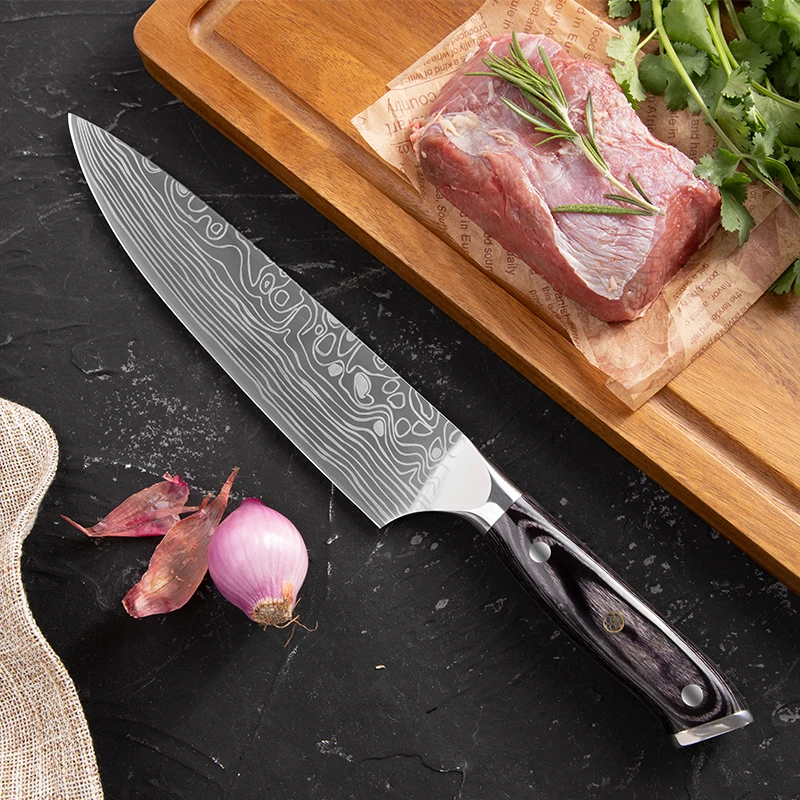
Set the sample at the station that moves between herbs, onions and other everyday ingredients. The scallop-free curved edge of the eight-inch chef model helps the prep lead compare its rocking contact with that of the knife already used. The catalogue lists 1.4116 high-carbon stainless steel and a shaped Pakkawood handle for this model.
Ask the team how the tip and heel work against the available board, how far the hand sits from the work, and whether they need the same profile in more than one length. The steel designation identifies the listed material. The supplier should document the origin of any SKU when it matters for purchase.
Try a flatter profile for repeated vegetable cuts
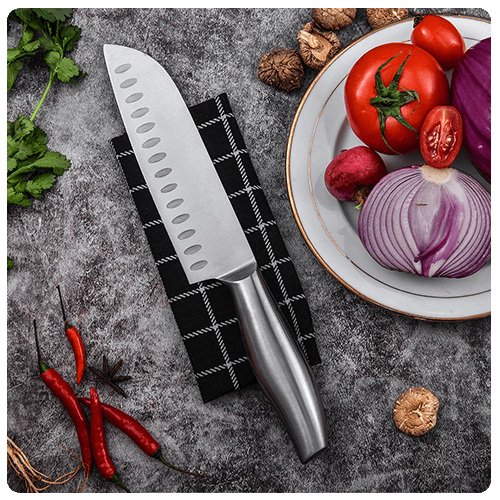
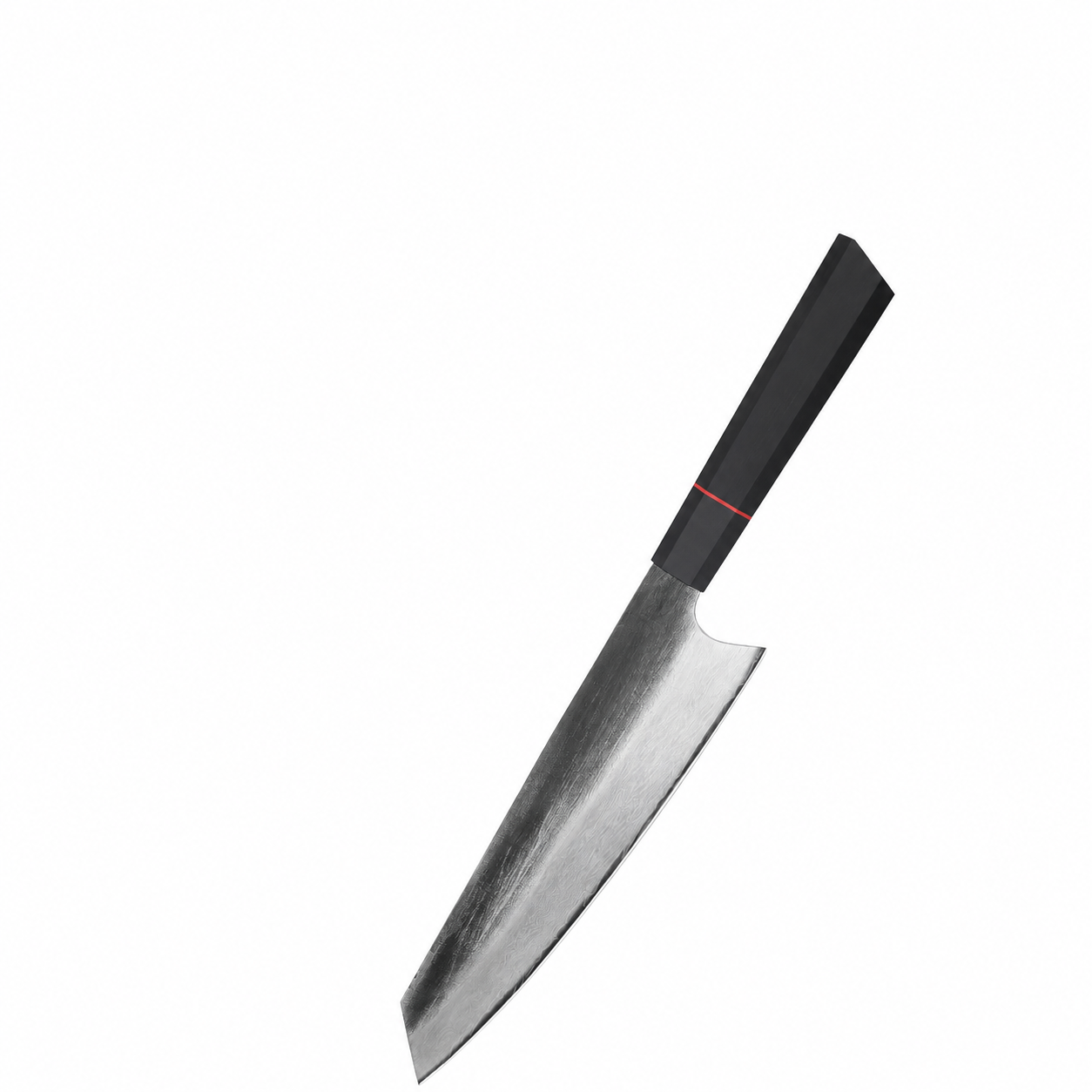
A flatter profile offers longer simultaneous board contact, which some cooks prefer for straight chopping and push cuts. The all-stainless Santoku and the Kiritsuke-style model with its black G10 handle and red ring give buyers two different tip and handle profiles to try. Ask for actual weight and blade geometry before selecting.
Set the same vegetable prep and target result for both. Compare whether thin slices stay attached at the bottom and whether the cook can comfortably use the tip for detail work. Evaluate balance and ease of cleaning in the normal station routine rather than making a choice from the overall shape alone.
Trial both shapes on the same board and batch size. Record when a cook needs to swap tools and agree on a compatible replacement model before ordering for both stations.
Decide whether to buy a single range or two
If the prep team shares equipment, one profile with readily available replacements can simplify the rack and training. If a dedicated vegetable station already has a different motion, buying a second reference may be useful. Ask whether your current board, maintenance equipment and storage will work with both.
For pricing, attach the accepted sample code to the task. Put replacements, freight and the care instructions for each profile beside the carton quote, and check which variants the next order can repeat. A short side-by-side trial is often more revealing than comparing generic labels about each style.
Sources
Compare chef profiles for two stations
Send the model choices, common prep tasks, desired quantities and destination. Ask for the exact dimensions and care instructions.
Request a wholesale quoteModels in this article
8-Inch Patterned Stainless Steel Chef’s Knife
Curved eight-inch chef profile, listed 1.4116 and Pakkawood grip.
Seven-inch all-stainless Santoku for a different board motion.
Kiritsuke Knife with Black G10 Handle and Red Ring
Black G10 and red ring Kiritsuke-style reference for another tip and handle.
Plain Meaning
A travel question about knives should be separated into airport screening, airline baggage policy, destination law, and the way the item is packed. A small knife is not automatically treated the same way in every setting.
The safest way to read this type of guide is as a decision checklist. It helps readers know which rule set to check before relying on memory, hearsay, or product photos.
Why It Matters
Travel mistakes are usually caused by mixing up carry-on rules, checked baggage rules, and local laws. These are separate questions, even when the same product is involved.
For educational pages, the useful goal is not to promise that one item is allowed everywhere. The useful goal is to explain what a reader should verify before travel.
What To Check Next
- Current airport or TSA-style screening guidance.
- The airline policy for checked baggage and restricted items.
- Destination state, city, or country rules.
- How the knife is packed, sheathed, declared, or stored.