
Short answer
Clean and oil salon shears with a model-specific care card. Keep local sanitation separate and check the pivot before storing the tool.
Key Takeaways
- Knife rules can vary by state, city, blade style, opening mechanism, carry method, and intended use.
- Do not treat a product nickname as a legal category; check the actual features and local rule.
- Retailers should keep legal or safety language factual and avoid promising that one item is allowed everywhere.
Terms Used Here
- Blade style
- The shape and edge design of the blade, which affects cutting tasks and buyer preference.
- Handle material
- The material used for grip, comfort, appearance, and durability.
- Assortment
- A grouped buying selection planned around customer needs, price points, and repeat orders.
In this article
- 01 Clear visible hair before you clean or store the pair
- 02 Oil only as directed for the selected model
- 03 Protect the clean tool and pass on one useful note
- 04 Sources
- 05 Confirm the oil and care instructions for your model
- 06 Model references in this article
- 07 JAGUAR PRE STYLE P Slice · 81355 and 81360
- 08 JAGUAR cleaning and care supplies
- 09 Plain Meaning
- 10 Why It Matters
- 11 What To Check Next
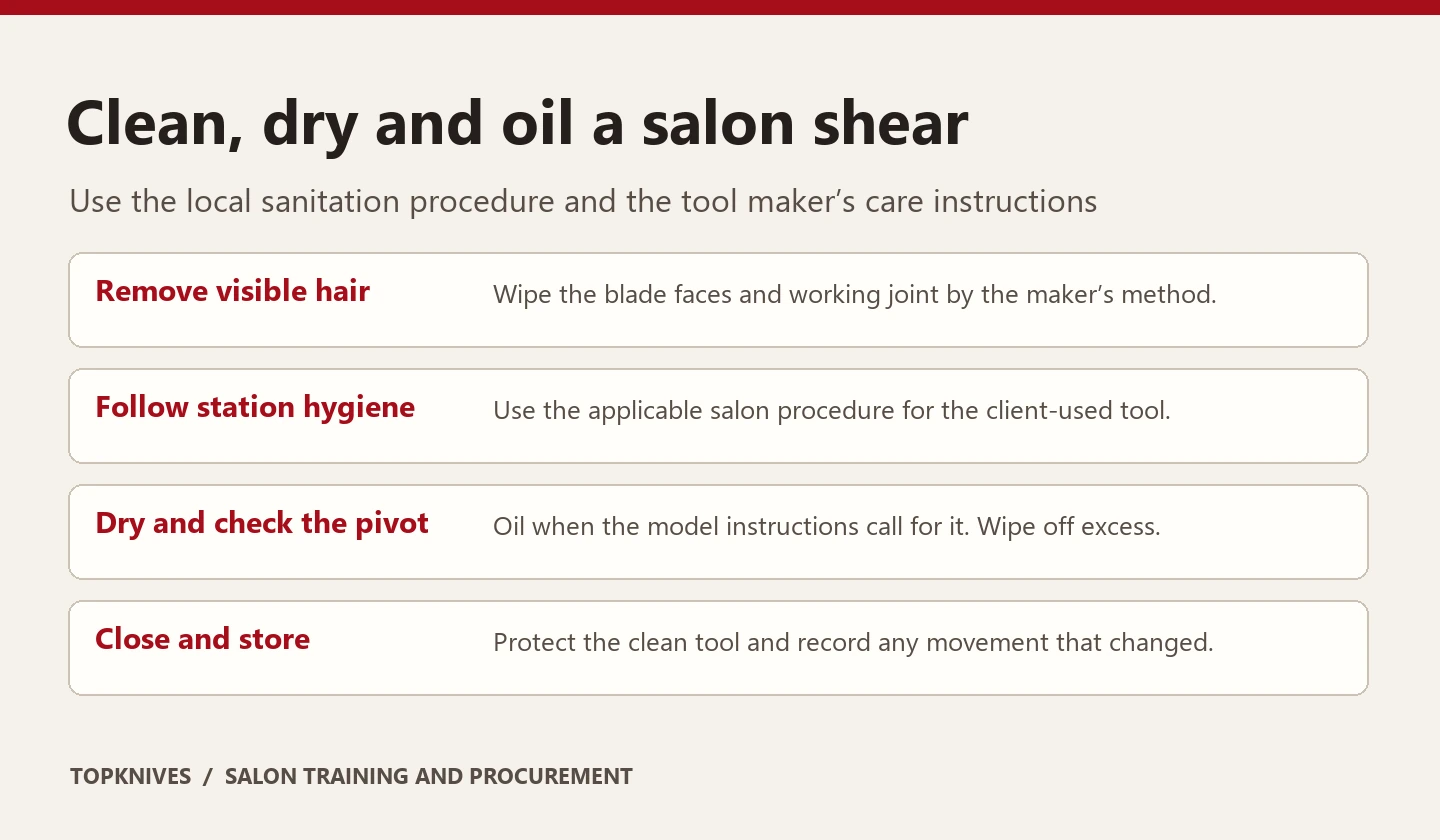
Give the salon a short cleaning and oiling routine the next shift can repeat. Clear visible residue, follow the applicable sanitation procedure, dry the pivot and use the maker’s oiling instructions for the actual pair.
Clear visible hair before you clean or store the pair
At each chair, give used shears and clean shears different places. Remove surface hair and product residue as the manufacturer directs. Look around the pivot and the area where the blades meet. JAGUAR’s guide recommends a soft dry cloth for its routine care and says to dry thoroughly after using its permitted mild cleaning method.
Disinfection is a separate station requirement. Consult the rules that apply to your establishment and the selected product’s directions. California salons, for example, can find the state’s shear requirements in Section 979 of the Board’s health and safety regulations. Put the local procedure where the team can see it and keep the model’s mechanical care notes beside it.
| Checkpoint | What the closer writes down |
|---|---|
| Visible hair or residue | Which tool and which part need attention before the local sanitation procedure. |
| Moisture near the screw | Whether the blades, joint and handles are dry using the maker’s method. |
| Pivot feels dry | The cutter’s model, the maker’s oil and any oiling schedule the manufacturer specifies. |
| Movement has changed | Record the symptom and refer it for separate evaluation if routine care did not resolve it. |
Oil only as directed for the selected model
Find the product’s guide and make sure it covers the actual pivot and surface finish. JAGUAR describes a drop of its maintenance oil at the screw when the mechanism feels dry or after prolonged use. It then calls for a few open-and-close movements to distribute the oil. Saki’s general care article illustrates a different schedule. Pick the procedure for the shear you have and record it on that station’s care card.
Wait until the tool is clean and dry before oiling. Use the oil approved for the actual model and wipe visible excess from the tool according to the maker’s directions. If the model has an unfamiliar screw or coated finish, find its product data or ask the manufacturer before changing the procedure.
Protect the clean tool and pass on one useful note
Put the closed, dry shear in its clean protective case. Keep the staff member’s name or model tag visible so a left-handed or specialist pair stays with its approved station. Order cloths, compatible oil and cases by product line if several models are in service.
Record anything that changed at closing. If the moving handle starts catching or the tool was dropped, set it aside for assessment and use the approved spare. Keep the symptom and the last routine check together. A care card should tell the next stylist which procedure was completed and whether the pair is available for service.
Sources
Confirm the oil and care instructions for your model
Send the model, pivot type and finish to the manufacturer. Ask it to identify the compatible oil and the care instructions for your region and tool. Use Saki’s form for a Saki pair and JAGUAR’s service contact for its tools.
Model references in this article
JAGUAR PRE STYLE P Slice · 81355 and 81360
Use the exact cutting shear model to identify the manual and joint system.
JAGUAR cleaning and care supplies
Manufacturer’s supply collection. Get model-specific compatibility before purchasing oil.
Plain Meaning
Knife law topics are usually location-specific. A useful answer starts with the jurisdiction, then checks blade length, mechanism, carry method, intent, and local exceptions.
A product nickname is not enough. Two knives with similar names can be treated differently if the mechanism, size, or carry situation is different.
Why It Matters
Readers often search these questions before buying, carrying, shipping, or listing products. A neutral explanation reduces misunderstanding without making legal promises.
For sellers and dealers, factual language is safer than broad claims. It keeps the article useful while leaving current legal interpretation to official or local sources.
What To Check Next
- State, city, and local code rather than only a national summary.
- Blade length, opening mechanism, lock type, and carry method.
- Whether the question is about ownership, carry, shipping, display, or use.
- Current official sources when the answer affects real-world action.