
Short answer
Compare OEM and ODM kitchenware by product changes, tooling, sample rounds, packaging minimums and design ownership.
Key Takeaways
- Separate carry-on rules, checked-bag rules, airline policy, and destination law before making a decision.
- Use current official guidance for travel questions; product descriptions alone are not enough.
- For resale, clear customer notes reduce confusion around travel, carry, and storage.
Terms Used Here
- Blade style
- The shape and edge design of the blade, which affects cutting tasks and buyer preference.
- Handle material
- The material used for grip, comfort, appearance, and durability.
- Assortment
- A grouped buying selection planned around customer needs, price points, and repeat orders.
In this article
- 01 Who owns the starting design?
- 02 Use the stock model to define where the changes stop
- 03 Compare opening orders on the same basis
- 04 Tie the approval back to the part you will receive
- 05 Sources
- 06 Request a price for the exact version you need
- 07 Models in this article
- 08 304 Stainless Steel Soup Ladle with Long Handle
- 09 Long Rounded Cake Spatulas with Pale Two-Pin Grips
The easiest way to decide between OEM and ODM is to ask who supplies the design. For a kitchenware buyer, that choice determines what to send for a quote, which sample to approve, and what needs to appear on the purchase order.

Who owns the starting design?
Janchu uses OEM for manufacturing a buyer’s design and ODM for adapting a manufacturer’s existing design. Trade usage can vary between suppliers. Describe what is already approved and what will change when you request a quote, so both parties price the same job.
| Route | Starting point | Sample to approve | Quote to request |
|---|---|---|---|
| Supplier design / ODM | Catalog model and a short list of permitted branding or pack changes. | Stock product sample, then an actual marking proof or packed retail sample as needed. | Finished-unit price, mark, pack revision, any new tool or artwork charges and reorders. |
| Buyer design / OEM | Buyer drawing, performance brief, target size and measurement tolerances. | A first product sample to the drawing, then the approved mark and production-intent pack. | Prototype, revisions and tooling separately from finished-unit tiers and repeat-order charges. |
Use the stock model to define where the changes stop
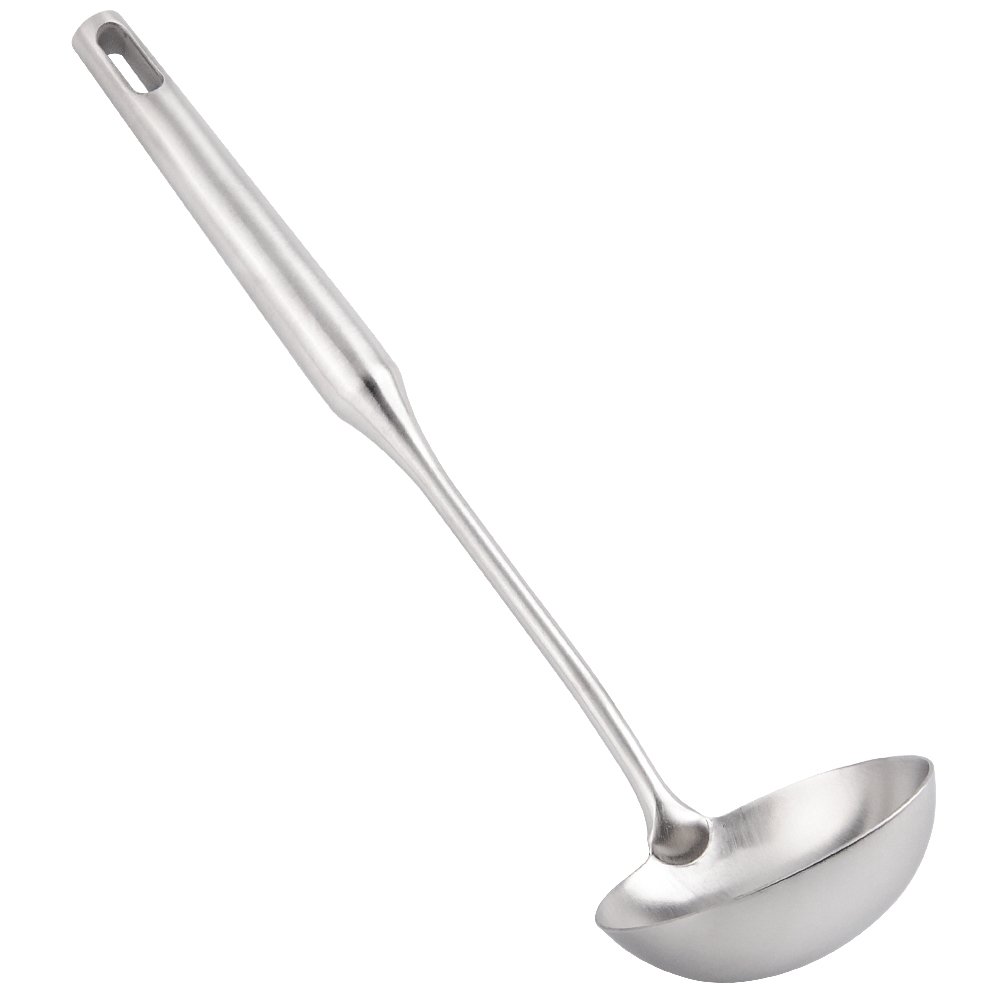
The catalog 304 stainless-steel soup ladle measures 348 mm overall, with a 90 mm bowl and 30 mm depth. If those dimensions work, price the exact model and ask what a logo and retail sleeve would add. If the buyer instead needs a different bowl depth or handle reach, mark that requirement on the drawing. Ask whether this is feasible, whether tooling is required and how many sample rounds the supplier expects.
The round-ended cake spatula offers another useful baseline. Use the item photo to identify the pale two-pin grip and rounded profile. If you only change the pack, approve the item and printed sleeve separately. If you intend to change the grip or working length, identify where that new dimension is measured before requesting a new first sample.
Compare opening orders on the same basis
Ask for an opening quantity and a repeat tier for each option. Separate tooling, print setup, samples and remakes from charges paid on every unit. Ask whether the finished utensil and each printed sleeve have different minimums, who holds surplus packs, and what happens if the artwork changes before the next run.
Make both quotes use the same currency, point of delivery and pack contents. For an existing design, ask which modifications affect lead time. For a new design, ask when production starts after the first sample approval and which charges are due before that point.
Tie the approval back to the part you will receive
Record the latest drawing, sample and packaging revisions on the order. Ask who owns and may reuse drawings or tooling, and record any exclusivity by market or channel in writing. For U.S. food-contact review, identify the materials and any finish that touches food and the intended conditions of use. Ask the reviewer for documentation covering the exact configuration.
Before releasing a lot, compare the measurement points chosen on the first sample with measurements from the delivered lot. Open packs from each revision to check the part, label and pack contents. Record who clears an exception and what will be checked again.
Sources
Request a price for the exact version you need
Send your item link or drawing, opening and repeat quantities, intended market, packaging version and delivery location. If you have a target shelf date, include it so the sample and approval milestones can be discussed.
Send a kitchenware quote requestModels in this article
304 Stainless Steel Soup Ladle with Long Handle
A listed baseline for a stock-design quote: 348 mm overall, with a 90 mm bowl diameter and 30 mm bowl depth. Include requested logo and packaging in your enquiry.
Long Rounded Cake Spatulas with Pale Two-Pin Grips
Use the pictured rounded profile and two-pin grip as the reference when discussing branding or pack changes.