
Short answer
Turn a restaurant or culinary school conversation into a one-page knife service trial with clear approval, pickup, return and billing.
Key Takeaways
- Separate carry-on rules, checked-bag rules, airline policy, and destination law before making a decision.
- Use current official guidance for travel questions; product descriptions alone are not enough.
- For resale, clear customer notes reduce confusion around travel, carry, and storage.
Terms Used Here
- Blade style
- The shape and edge design of the blade, which affects cutting tasks and buyer preference.
- Handle material
- The material used for grip, comfort, appearance, and durability.
- Assortment
- A grouped buying selection planned around customer needs, price points, and repeat orders.
In this article
A Bay Area knife-sharpening provider told r/Chefs that most of their customers cooked at home. To serve restaurants and culinary schools, they asked whom to approach, when to call, what to leave after a conversation, and how to quote. The replies described kitchens that already use a rotation service and chefs who look after their own knives. Those are good reasons to scope a small trial before proposing a regular route.
Ask who handles the house knives
Start with the restaurant’s published business contact. Ask who looks after shared prep knives and when that person can talk. The chef may choose what goes into a trial, the manager may arrange building access, and the owner or bookkeeper may approve the bill. At a culinary school, the lab coordinator can tell you which tools belong to the program and who in purchasing can approve outside work. A short scheduled conversation gives both sides time to check the current arrangement.
If the kitchen already rents its full set, ask when the agreement comes up for review and whether the site has any separate, site-owned knives. If staff maintain their own knives, offer a conversation about the shared set. Keep personal and student kits out of your proposed pickup unless the school or owner has approved those items individually. Replies in the thread show how strongly preferences can differ within the same kitchen.
Start a Kitchen Knife Sharpening Business With a Drop-Off Host
The January 2007 BladeForums startup question asked whether customers would bring items to one location and how a new operator could set prices on a tight budget. In a separate December 2011 reply, a London operator suggested arranging collection days at catering shops. For a service taking ordinary household kitchen knives, a host can help test one collection point before you pay for a premises of your own.
| When | Decision to make with the host |
|---|---|
| Before the intake date | Agree on accepted items, hours, who can quote, and a maximum booking count. Decide who tells a customer to book the next collection when the shop reaches that count. |
| At collection | Use one numbered record for the customer, shop and operator. Have the shop and operator reconcile the accepted count. Record when the order changes hands, who updates the customer, and who can approve an extra charge. |
| At return | Name the party responsible for payment, late collection and any missing item. When the published pickup window changes, have the responsible party give the customer a revised date and record the reply. |
Preserved’s Oakland shop publishes a last-Thursday drop-off rule and a next-day pickup and payment window during retail hours. Use it as one example of what a shop can explain to customers. HoweSharp lists collection and payment arrangements by location. Agree on one written set of terms for the location you are using.
After the first collection, compare accepted tickets, payments and orders still waiting for pickup. Include the host fee and staff time when deciding whether enough paid orders came back to repeat the next collection.
Give the kitchen a one-page trial it can approve
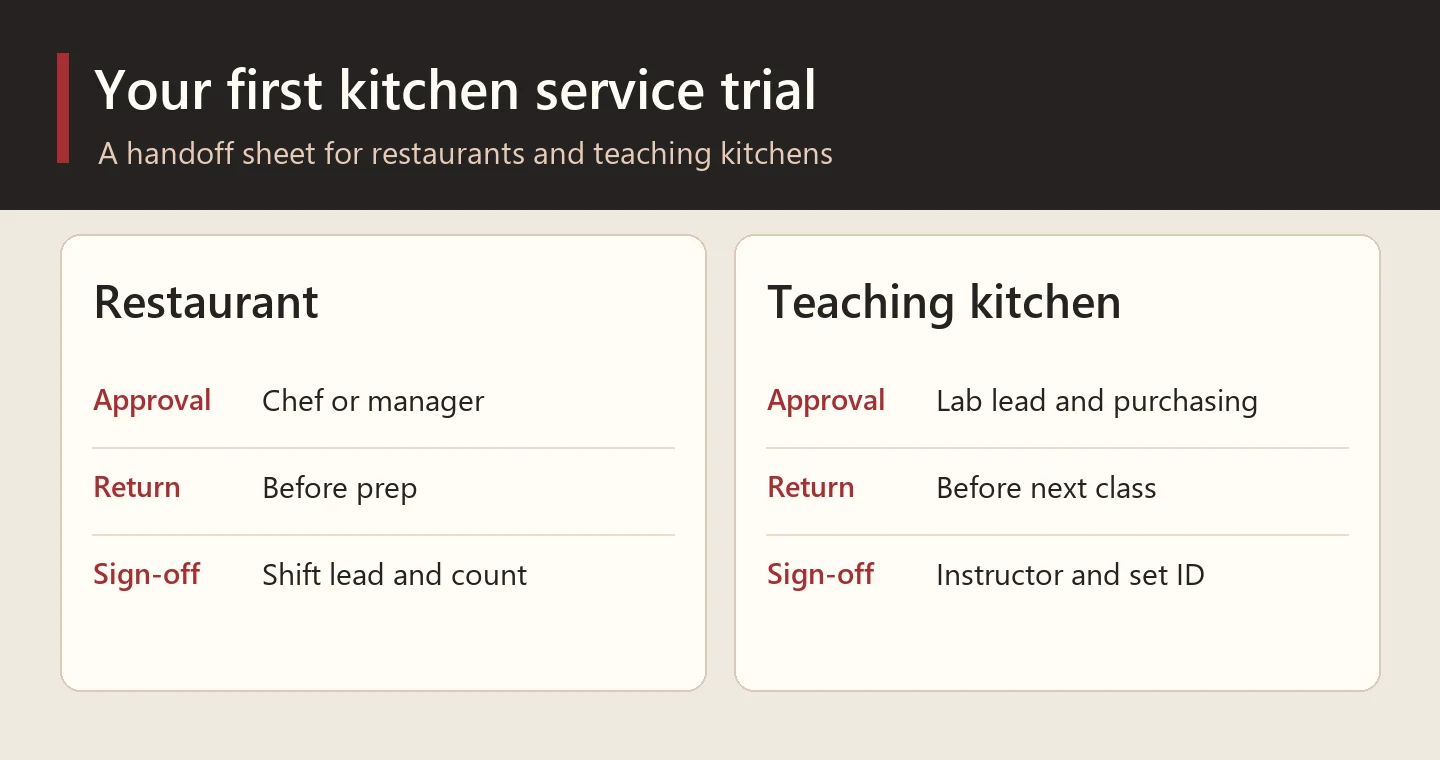
Leave one sheet the chef can forward to purchasing or the owner. Use the site’s name and the set it has agreed to trial. Keep an open question for each field the site has yet to decide.
| Put on the trial sheet | Restaurant example | Teaching kitchen example |
|---|---|---|
| Set and owner | Site-owned prep set, counted with the shift lead | School-owned lab set, counted with the instructor |
| Handoff and return | Named receiver and a return deadline before the agreed prep window | Approved service entrance and return before the next scheduled class |
| Approval and price | Named approver, one pilot charge, and any separate extra-visit fee | Buyer contact, billing reference, and any campus-approved charge |
| Closeout | Signed return count plus any exceptions | Lab sign-off by set number, with any discrepancy listed separately |
State how many agreed items the pilot covers, the total charge, and what it costs if the client requests a second visit. Ask separately what its normal service frequency would be. The thread contains informal price anecdotes. Make your own quote using the round-trip time, workload and the minimum you can reliably service. If a site asks for a different return time or adds another set, confirm the revised total before accepting the change.
Make room for campus purchasing
Ask the school how it approaches suppliers, what insurance evidence it needs for an outside worker on site, and which invoice or purchase order fields its team uses. One concrete example is San Diego Mesa College, whose culinary program runs a classroom-led restaurant. Its community college district publishes a supplier registration route via PlanetBids and a separate purchasing forms page with supplier intake, W-9 and invoice guidance. Use the prospective client’s rules, and confirm any scheduled visit after its purchasing contact gives you written authorization.
Use the return receipt to decide on a second visit
Ask the receiver to compare the return count with the pickup sheet. Document what was returned, what was set aside, and who checked it. Cozzini Bros. describes scheduled service and proof of delivery as part of its own commercial offering. A small provider can use a simple signed sheet to make the pilot easy to review. If it interfered with a prep or class window, change the schedule on the next proposal. A clean handoff and a traceable invoice give the customer evidence to decide whether to request another visit.
Read the district’s supplier registration and bid instructions