
Short answer
Once you have a base model, mark what you want to change: the branding, handle or packaging. Use the steps below to put the quote, approved samples and receiving checks on the same purchase order.
Key Takeaways
- Separate carry-on rules, checked-bag rules, airline policy, and destination law before making a decision.
- Use current official guidance for travel questions; product descriptions alone are not enough.
- For resale, clear customer notes reduce confusion around travel, carry, and storage.
Terms Used Here
- Blade style
- The shape and edge design of the blade, which affects cutting tasks and buyer preference.
- Handle material
- The material used for grip, comfort, appearance, and durability.
- Assortment
- A grouped buying selection planned around customer needs, price points, and repeat orders.
In this article
- 01 Can we use an existing model or do we need a new part?
- 02 Get two quotes for the same set
- 03 If the project pauses after the deposit, which costs have already been incurred?
- 04 What point does the freight quote cover?
- 05 Compare opening and repeat quotes for the same set
- 06 Can a common box solve short runs across languages?
- 07 Which minimum limits the order first?
- 08 Why does the unit on a listed minimum matter?
- 09 Two handle colors share a blade. What can you combine?
- 10 Can a production lot ship over or under quantity?
- 11 What measurements should come with the first production unit?
- 12 Three kinds of sample approval
- 13 Approve the product sample first
- 14 Approve marking and print
- 15 Open a production-intent pack
- 16 Which sample governs if two rounds differ?
- 17 Which wood-tone sample sets the production limits?
- 18 Which approval starts the production clock?
- 19 What to inspect, by lot, before shipment
- 20 Can you release the lot if the report omits sampled carton labels?
- 21 Can an earlier inspection report release a changed lot?
- 22 On this page
- 23 Send us the model and what you’d change
- 24 Models discussed
- 25 Three-piece wood-handle set
- 26 White-handle block set
- 27 Kitchen set with black cylindrical holder
OEM & Private Label
Once you have a base model, mark what you want to change: the branding, handle or packaging. Use the steps below to put the quote, approved samples and receiving checks on the same purchase order.

Can we use an existing model or do we need a new part?
Start with a current model number or a photo, and mark which parts stay and which must change. For a logo on an existing model, agree on its placement and the box style. If the handle shape, mounting holes or insert will change, send the mating part or a dimensioned drawing. If two quotes cover different development work, ask each supplier to name the reused parts, new tooling and fit checks included in the sample before committing to development.
Get two quotes for the same set
Ask for 200 and 300 of the same three-piece wood-handle set, with the same box revision and delivery point. In this USD example, 200 sets at $18.00, 600 boxes at $0.80, $120 in print preparation and $120 in freight total $4,320. For 300 sets at $17.20, the same boxes and print preparation plus $150 in freight total $5,910. The example uses a separate print-preparation line. Check the written packaging quote for any box-tooling charge. Remove the duplicate line if the box price already covers print preparation. With four displays in each tier, the full initial outlay comes to about $22.04 or $19.97 per sellable set across 196 or 296 sets. Record surplus boxes separately so you can match them to the original payment when you use them on a reorder.
Use the stock box for a budget quote while artwork is pending. When the box changes, ask for a revised pro forma invoice (PI) that identifies the version it replaces. Check the revised set price if the stock box was included, or check that the old box line has been removed if it was billed separately. Our published quotes are valid for 30 days. The FAQ lists a 60% deposit and balance before shipping for the $3,000–$10,000 tier. For the $4,320 example, a $2,592 deposit and an approved credit for a separately paid $60 sample leave $1,668 due. The three payments total $4,320. Put the sample order number, approved credit and payment currency on the PI. Handle sample freight as agreed, and record which payment releases which cartons if there are two pickups.
TOPKNIVES wholesale FAQ · Quote validity
If the project pauses after the deposit, which costs have already been incurred?
If the project may pause, ask us to separate payments received from work already committed. For printed boxes, record carton count and the collection date. For tooling in progress, record the completed work and the amount due. For finished goods not yet in production, ask for the last date to cancel. If the deposit exceeds costs incurred, ask how the balance will be handled and put the agreed date on the order.
What point does the freight quote cover?
Ask us to identify the packed carton spec on the freight quote, with sets per carton, carton count, dimensions and gross weight. When switching from a stock box to a gift box, have the carrier reprice the whole shipment to the same address and show the chargeable weight for air or courier. Give both suppliers the same named delivery point and Incoterms® version. For airport or port delivery, list any remaining handling, clearance and warehouse delivery charges. For DDP to your warehouse, confirm the importer, unloading arrangements and the documents you will receive after delivery.
Compare opening and repeat quotes for the same set
| Charge | Opening order | Repeat order |
|---|---|---|
| Recurring per set | Confirm inclusion of the set, marking, retail box, tray and shipping carton. | Price a repeat quantity for the same build. Recheck packing costs for a different case count. |
| Samples and setup | List samples, courier, print setup and tooling. Record agreed credits separately. | Identify recurring charges for the existing revision. Price changes separately. |
| Freight and inspection | Use one destination for freight comparisons. List the inspection booking owner and fee. | Requote against packed dimensions if quantity or pack changes. |
| Artwork and quantity changes | State the last date to change artwork and any charges after that date. | For the same revision, record allowed quantity changes and the items that need repricing. |
Can a common box solve short runs across languages?
Ask whether the markets can share a plain box and insert, then use a sleeve or leaflet for each language. List the common parts, quantities by language and minimums for each component. Have the supplier flag the one that still falls short. If you supply labels or leaflets, agree their arrival cutoff, receiving count, spare allowance and which orders can be packed if they arrive short. Use the reply to decide whether to combine the print run, change the pack or defer the smallest version.
Which minimum limits the order first?
Ask us to list finished sets, handle materials, logos and each packaging version on separate lines. For each line, show the minimum billed quantity, the quantity used on this order and the quantity you will receive now. If both blade blanks and finished branded products are quoted as pieces, identify the production stage on each line. For shared parts, specify which SKUs can pool quantities and where colors, logos or boxes must be split. You can then see which costs are due up front and which parts still need ordering to pack the first batch.
Why does the unit on a listed minimum matter?
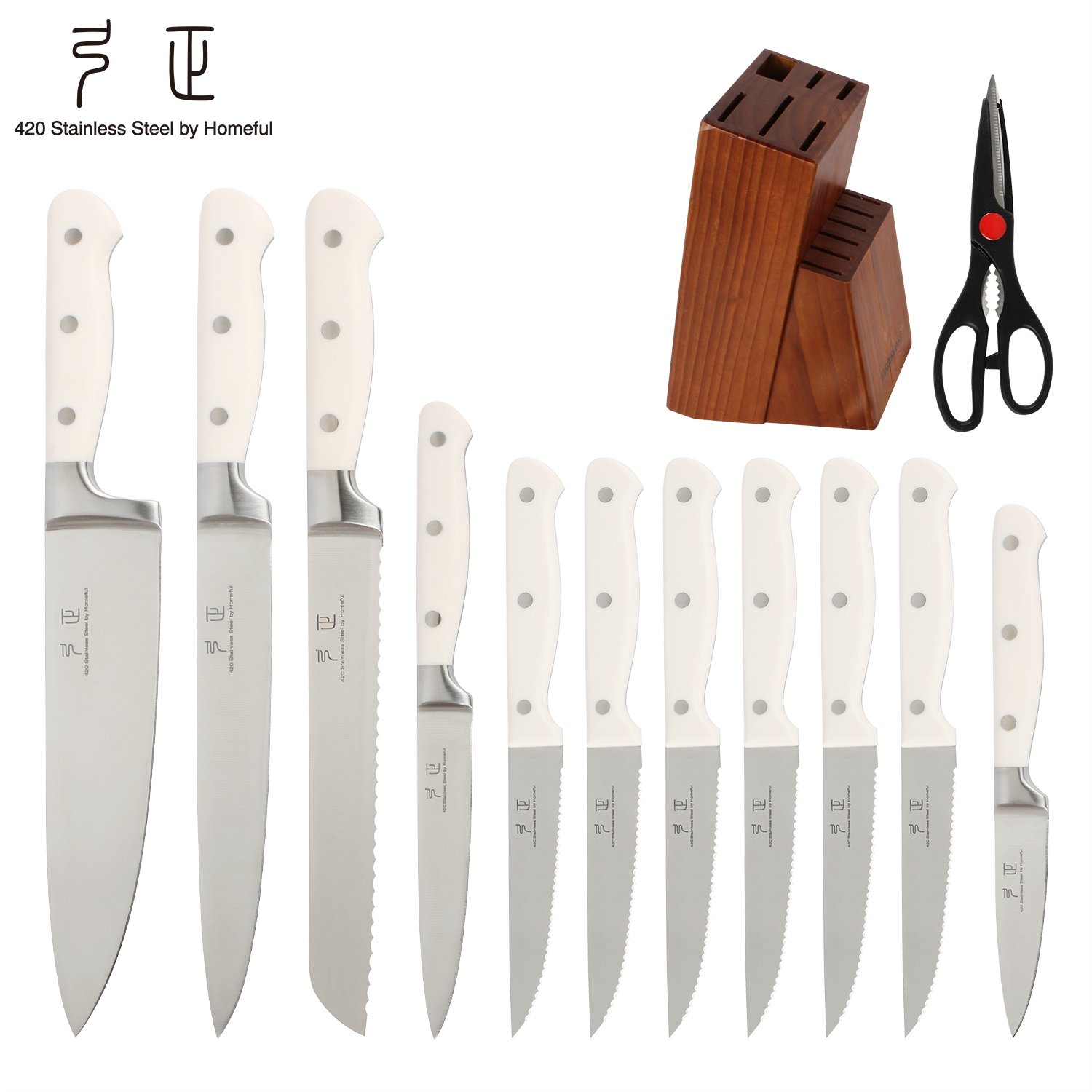
Our black cylindrical-holder set TKSC-11000025378008 lists 10 sets, and the white-handle block set TK-S-1601689655268 lists 300 pieces. Each figure belongs to its own listing. On a quote for the white-handle set, ask us to specify whether 300 counts complete sets or components. Request a trial quantity for the wood-handle trio using TK-S-1600515717121. Get separate minimums for marking, handle colors or printed packaging against the final specification.
Black cylindrical-holder set: listed minimum
White-handle block set: listed minimum
A 200-set order needs 600 knives, 200 of each type. If the first two types are complete and only 180 of the third are ready, pack at most 180 sets. Record the missing SKU and its completion date. Of 600 boxes, 180 have been used, 20 cover the incomplete sets, six are damaged and 20 are already allocated elsewhere. That leaves 374 available for reorders. Record who owns those boxes, the revision and how long they can be held.
If the design needs new tooling, ask who owns it, who approves the first sample, how maintenance is billed and whether you can retrieve the tool if you switch suppliers. Ask how tooling corrections or artwork changes would affect production. For a one-season line, work out how many sets will share the tooling cost.
ANT’s private-label guide on minimums, tooling and delivery
Two handle colors share a blade. What can you combine?
For a plan of 150 sets in each of two colors, ask whether the blades can run as one batch of 300 and whether each handle and assembly run meets its own minimum. If only the blades can be combined, price three options: launch one color, run the second color on a later order, or top it up to its own minimum. That shows which stock you would have to buy even if the shared blade order is large enough.
Can a production lot ship over or under quantity?
Agree the quantity the buyer can accept and whether the invoice uses the ordered or accepted quantity. If a gift program requires one box per recipient, specify who makes up a shortage and by when. For a store order, agree an acceptable range and send any exception to the buyer for approval.
What measurements should come with the first production unit?
After sample approval, put finished weight, length and thickness on the first-article sheet. Give blade thickness and edge angle their own measurement locations, units and tolerances. Photograph the finish, handle fit and fit in the full set. Ask for the readings, material lot and hardness report ID before signing off the run. If the steel, heat treatment or grinding setup changes, record which lot must be checked again at the same points.
Three kinds of sample approval
Approve the product sample first
Use a routine prep task to judge grip and balance, and the actual block to check fit and removal. Before signing, mark what the sample passes: handling, block fit or both. Keep the model, sample ID, approver, date and open items on the tag, and give the approved physical sample to the buyer or inspector to retain. Check first-production measurements against the specification above.
Approve marking and print
Check the size, position, orientation and legibility of the knife mark. On the box or leaflet, review language, physical colour, barcode scanning and room for batch information. Record the artwork revision, for example V2, with photos, approver and date.
Open a production-intent pack
Repack using the actual tray, edge protection, leaflet, retail label and carton. Check contents, retention and labels. Put the signed sample reference on the purchase order.
Which sample governs if two rounds differ?
If the first sample uses substitute handle stock, test its fit in the block and record “V1: block fit approved.” Review grain, weight and logo appearance on the sample made with the specified material. When V2 arrives, use one change record for the old and new sample IDs, the new check results and the operations now approved to start. If the V2 handle passes but the packed retail box is still pending, release the handle operation and keep packing on hold. Purchasing adds the approval references and open items to the PO so the first-article and first-carton checks use the right samples.
Which wood-tone sample sets the production limits?
Retain a light and a dark acceptable handle, photograph them in the same light and label both. If the supplier plans to use another wood lot, have the buyer review a sample from it before using the existing limits. Use the approved pieces for color and grain, and the signed measurement points and tolerances for fit and dimensions.
If the boxed sample is going to a store for a display trial, ask us before approval whether we can retain a matching sample for inspection. Give both physical samples their own IDs and list the buyer’s and factory’s copies on the same approval record. When a box revision is approved, retire the old box sample in that record and check that the new artwork and physical sample point to the same approval.
On the same 200-set order, send one fully packed carton through the intended route to the buyer’s receiving point. At unboxing, check which side took pressure, whether the edge guards or inserts shifted, and whether the damage is to the retail box or the shipper. If you add corner protection or change the insert, recheck the sets per carton, dimensions and freight. Keep the old quote until the new pack is approved so purchasing can see what the change costs.
Which approval starts the production clock?
Work back from the latest delivery date to sample arrival, first inspection, reinspection and pickup. Ask whether lead time starts when payment clears, the sample is approved, or the last artwork is signed. If the insert is delayed, ask us what common parts can start, the deadline to approve the packed sample and how the shipping window will change. For two order lines shipping separately, confirm the first inspection and pickup dates for each.
What to inspect, by lot, before shipment
Keep one record each for incoming material, the first article and the first packed carton. Log the material code and lot when a new handle material arrives. Use the signed specification for the first article and the approved packed sample for the first carton. If a check fails, hold the affected lot and let purchasing use the affected quantity and reinspection date to decide if it can make the planned pickup.
Give the inspector the approved sample, specification and packing list. Open the first full carton and check both the components per set and the actual sets per carton. List partially filled cartons separately. For different markets, record carton numbers, labels and scan results on separate lines. Record dimensions at the specified points and tie the readings to their carton numbers.
If both parties agree to inspect under ISO 2859-1, confirm the edition, lot size, inspection level, defect classes, AQLs, sample sizes and acceptance and rejection numbers. Have the inspector include measurements, defect photos and carton IDs. Once samples are approved, specify how missing pieces, misprinted labels and out-of-tolerance dimensions will be classified.
ISO 2859-1:2026 for lot-by-lot inspection by attributes
Can you release the lot if the report omits sampled carton labels?
If a carton-label photo is missing, ask the inspector to match it to the original sample record. Continue review if the photo traces to the report line. If it does not, recheck the affected carton, record the result, carton ID and date, and obtain the buyer’s sign-off on that report.
Can an earlier inspection report release a changed lot?
Use the change record to identify the affected cartons. From the first lot that actually uses the new material or packaging, agree fresh checks for the affected specification, performance or labeling. Record lot IDs, sampled cartons and the approved sample used. Keep the original release for units still made to the old revision. If cartons cannot be separated by version, hold them for the inspector and named approver.
The packing list for the 200-set order shows 29 full cartons at six sets each, or 174 sets. Four more await a barcode recheck in the partial carton, two complete sets still need packing, and 20 lack a component. Check that the order allows the 29 cartons to form a separate lot. If the terms make inspection approval a condition of the balance payment, purchasing matches the report to the carton IDs, finance checks the amount due and cleared against the PI, and the warehouse hands over the 174 sets against the signed release. Hold the cartons while the report or payment is outstanding. Once the partial carton passes, collect it separately if agreed or with the last 22 sets. Before combining them, reprice the second pickup from the actual carton dimensions and agree which cartons still need inspection.
Send us the model and what you’d change
Send us the product link or SKU, the pieces per set and which stock features you want to keep. Include any changes to the mark, handle or packaging, your opening quantity by version, the delivery city or warehouse and required date, and the person who will approve the sample. Please list unit prices, minimums by option, sample costs and estimated lead time separately.
Request a quote for your private-label project. Send the model, intended quantity, sample or pack specification and delivery postcode.
Models discussed

Counter storage
White-handle block set

Cylindrical holder