
Short answer
What the 2012 exit meant for cookware buyers and how to verify current supply, replacement products and warranty support.
Key Takeaways
- Start with the plain meaning of the term, then compare features and use cases.
- Knife categories often overlap, so the details matter more than the label alone.
- For buying decisions, check materials, size, mechanism, safety notes, and maintenance expectations.
Terms Used Here
- Blade style
- The shape and edge design of the blade, which affects cutting tasks and buyer preference.
- Handle material
- The material used for grip, comfort, appearance, and durability.
- Assortment
- A grouped buying selection planned around customer needs, price points, and repeat orders.
In this article
On May 14, 2012, Housewares reported that Regal Ware would leave the U.S. retail cookware market and concentrate on direct-to-consumer operations. It attributed the shift to company president Jeff Reigle, who cited weak profitability in the retail business. For a cookware buyer, the distinction still matters. A manufacturer can stop supplying a particular retail channel and continue producing kitchenware, serving other channels or making products for another brand.
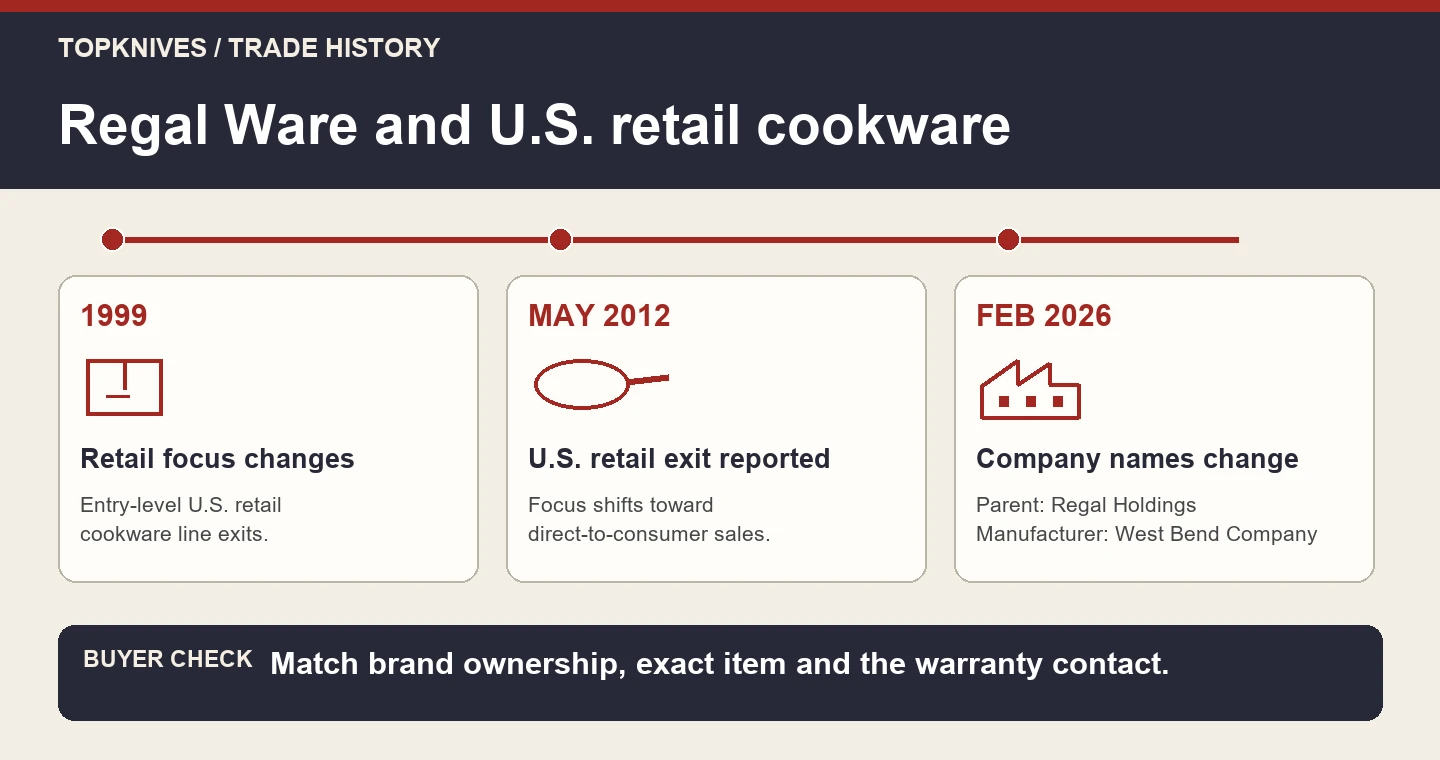
What changed in the 2012 report
The report described a retail-channel withdrawal, naming American Kitchen and Unity among the brands then associated with the manufacturer. It also noted a previous move away from entry-level retail cookware in 1999. The parent company’s history independently records that earlier change and the shift toward products sold by direct sellers. It also says Regal Ware sold Kitchen Fair in 2019 while continuing to make the cookware in West Bend. That is a useful example of why the company on the box and the company supplying the stock should be checked separately.
Treat the May 2012 report as a dated record of the position announced then. It does not establish today’s availability of a branded set, the terms of a dealer program or who handles a claim for a pan already sold. An old product listing is a useful lead only if a supplier can match it to a current item and distribution agreement.
Find the right company for the request
In a February 2, 2026 company announcement, the parent said it would operate as Regal Holdings, and its Wisconsin manufacturing company would again use the West Bend Company name. The announcement lists separate manufacturing, wholesale direct and retail groups. West Bend Company now describes contract manufacturing and private-label cookware for brands, alongside design support. These are project routes with different approval and quote requirements. The company’s warranty and parts page is the place to begin when the request is for an existing item rather than a new assortment.
Send a cookware warranty question with a photo of the item and its label, the original receipt if available, and the part or issue to be resolved. For replenishment, start with the current brand owner or its authorized distributor. For a replacement under your own brand, send the manufacturing team the product type, specifications, intended market and expected launch quantity. Keep those three conversations on separate lines.
Separate replenishment, substitution and support
| Buying question | Ask for in writing | Keep with the purchase order |
|---|---|---|
| Can we replenish an active line? | Exact maker, item number or UPC, configuration, channel eligibility, first available order date and case pack. | Dated quote and the source owner’s confirmation of availability. |
| What if the SKU was discontinued? | Last-order date, balance remaining, replacement item, and differences in diameter, coating, lid fit and pack. | A substitution decision by item and a sample check against the existing shelf. |
| Who covers units already sold? | Named warranty and parts contact, covered items, and the lot or proof-of-purchase details they need. | The exact service route for each active model and any agreed return process. |
Run one shelf comparison before committing
Consider a retailer replacing an everyday sauté pan after its distributor confirms the old SKU is unavailable. Start with the current shelf model and the channel that needs stock. Record marked diameter, pan depth, usable cooking surface, lid fit and compatibility required by the store’s listing. Ask for one approved sample and compare the carton size, barcode location, inserts and the proposed warranty route alongside the pan. If the existing lid does not match, price and approve the pan-and-lid offer as a new set.
If the retailer needs cookware under its own brand, compare the factory’s product and tooling capabilities against the existing model. Ask which design already has tooling, which changes require samples or tooling charges, and where the case will be packed and handed over. Request a written replenishment plan before printing the box. Check any country-of-origin language separately against the proposed SKU and the FTC’s U.S.-origin guidance; the location on the supplier’s letterhead alone does not establish the wording for a finished pan.