
Short answer
Plan a U.S. commercial kitchen knife order by prep station. Compare three verified models, split stock across two stores, and quote replacements.
Key Takeaways
- Start with the plain meaning of the term, then compare features and use cases.
- Knife categories often overlap, so the details matter more than the label alone.
- For buying decisions, check materials, size, mechanism, safety notes, and maintenance expectations.
Terms Used Here
- Blade style
- The shape and edge design of the blade, which affects cutting tasks and buyer preference.
- Handle material
- The material used for grip, comfort, appearance, and durability.
- Assortment
- A grouped buying selection planned around customer needs, price points, and repeat orders.
In this article
Two restaurants opening on the same menu may still need different knife orders. A store that portions its own sandwich bread needs a serrated knife at the sandwich bench. One that buys bread pre-sliced may need a single backup. Use the types in WebstaurantStore’s commercial kitchen guide to build a working list by station, then attach that list to your opening quote. You can start with one shared order and still specify what belongs at each store.
Start with what each station prepares
Put the prep list for one busy shift beside the kitchen floor plan. Record which tasks happen in-house, who works at each bench and what the opening menu buys ready to use. Three kitchen types handle the main tasks in a deli-style example:
- Chef knife for the produce bench. Make this the first line for batch vegetable prep. If another station needs its own everyday prep knife during the same service, put that unit on the second station’s line so purchasing can see why it is there. A santoku or nakiri is an option if the produce lead already prefers that style. Trial it on the same menu prep before adding a second general-purpose line.
- Paring knife for the garnish bench. Stock the jobs that recur, such as coring strawberries and trimming fruit for service. When a bar and kitchen both prep their own garnishes, mark a pickup point for each rather than leaving both crews to draw from one untracked tray.
- Serrated bread knife for slicing bread and rolls. Count the bench where bread arrives whole. If one location switches to bought-sliced bread, revisit its bread-knife count before copying the opening order across locations.
Leave specialist types on a separate menu line. A kitchen that receives meat already portioned or fish already filleted has a different starting list from one with a dedicated protein-prep station. Use the purchasing spec for those deliveries to decide whether an extra boning or fillet tool has a recurring job. Dining-room steak and table knives belong on a separate restocking list with their own pack counts.
Choose a breaking knife that fits the commercial prep station
ChefStop’s guide to choosing a professional breaking knife asks buyers to consider the station’s work, size, handle and care requirements. Add a separate line for a breaking knife when the commercial kitchen has a dedicated meat-prep station with a recurring need. Before requesting samples, measure the storage slot and record whether each store can house the complete item with its approved guard.
| Catalogue entry | Length in that entry | Dexter item number |
|---|---|---|
| S132N-8, narrow breaking knife | 8 in. | 05523 |
| S132N-10, narrow breaking knife | 10 in. | 05493 |
| S132-10PCP, cimeter steak knife | 10 in. | 05533 |
The manufacturer’s catalogue pairs the 10-inch narrow breaking item with 05493, which also appears on WebstaurantStore’s item listing. The current product family page uses the shorter family label S132N. Ask the dealer to state the item number, exact model on the carton and selling unit. A quote that lists only “10 inch” leaves two different catalogue lines possible.
Approve the sample for the assigned station only after checking the complete length, the supplier’s guard recommendation and whether the guarded item fits the storage space. If the supplier offers a replacement, request its exact item number, a photo of the carton label and the dimensions before confirming the substitution.
Ask Dexter’s sales team to identify the model and local distributor.
When the vegetable bench needs a different prep knife
The Wholesale Chef Knife restaurant guide treats a Santoku as an alternative to a chef’s knife and gives a broad Chinese knife its own vegetable-prep role. Apply that distinction to the opening list. If one cook does the same produce prep at the same bench, trial the white-handle Mercer M22707WBH Santoku in place of one existing chef-knife allocation. If two people need the different profiles at the same time, give each knife its own station and order line. Leave the paring and bread quantities tied to their own jobs.
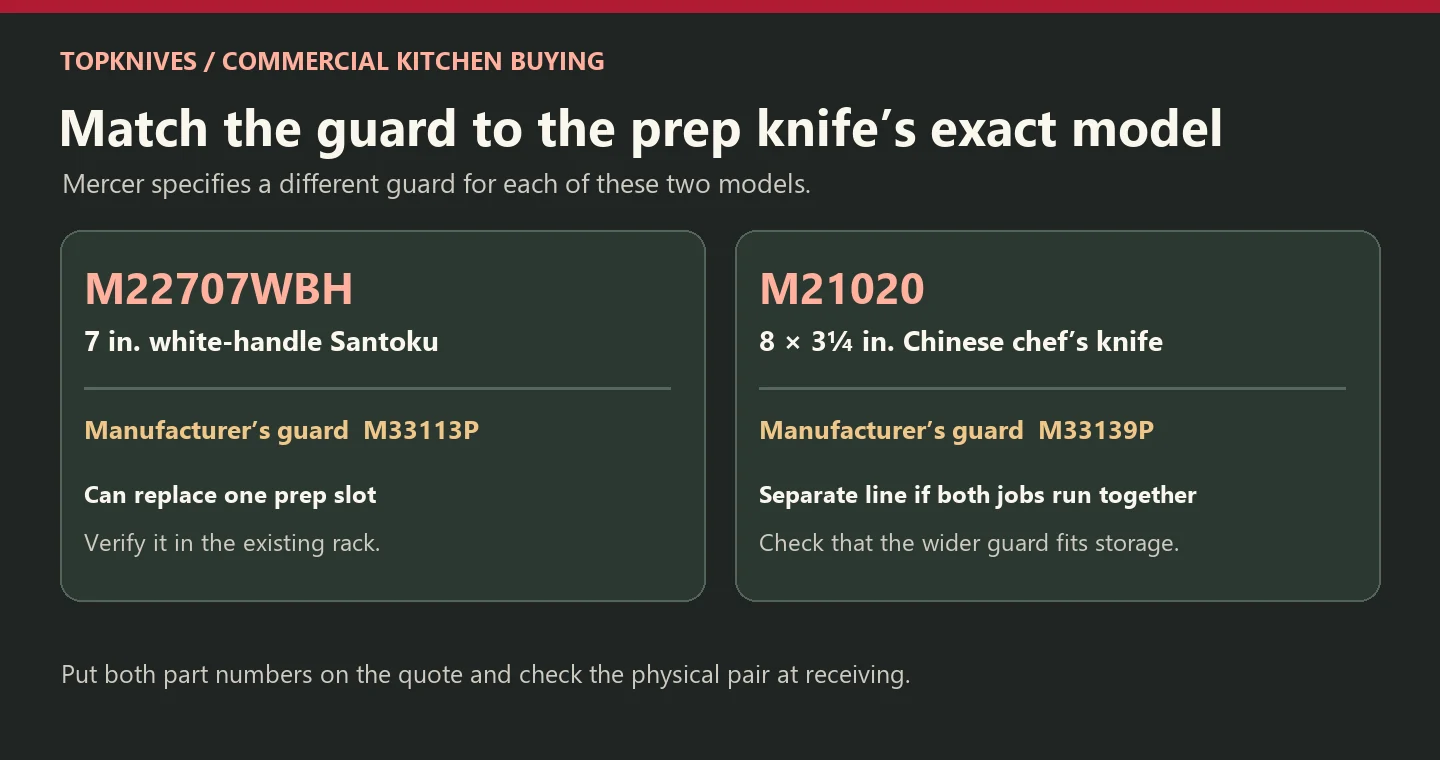
For a separate produce bench preparing a recurring vegetable batch, Mercer M21020 is a broad Chinese chef’s knife, listed at 8 in. by 3¼ in. Use it as the wide-profile option for this produce example. Mercer lists M33113P for the Santoku and M33139P for M21020. The dealer’s M21020 page also displays the standard M33113P under “Works With”. Ask the quote team to confirm the pair against Mercer’s exact-model listing. Check clear space for the wider guarded item where it will be stored.
On the change to your opening order, mark the Santoku as a replacement for an existing prep quantity or the wide knife as an additional line for the named bench. Give the dealer both item codes and the ZIP code. Check both part numbers and fit before the kit goes to its assigned station.
Ask WebstaurantStore to quote the exact prep knife and guard together
Price the same three model numbers for both stores
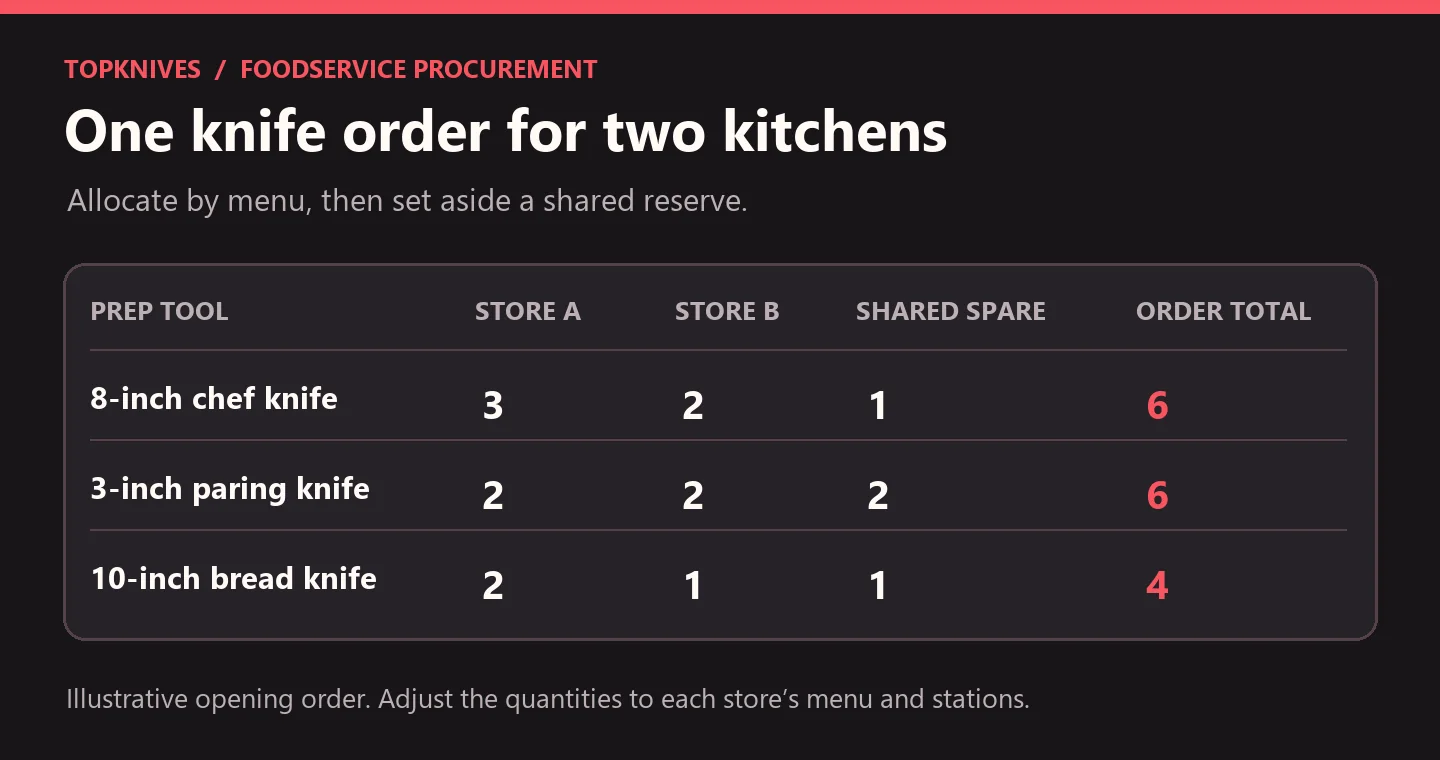
In this example, Store A orders three chef, two paring and two bread knives. Store B orders two chef, two paring and one bread knife. A shared cabinet holds one chef, two paring and one bread knife. It only makes sense to pool spares if the stores can get them during a normal shift. If they cannot, assign a reserve by delivery address before requesting a quote.
These Mercer Culinary Millennia white-handle examples were listed by WebstaurantStore on November 25, 2026, in USD per item. The color helps identify the example versions. A sample label or storage tag still needs to say which store and station owns it.
| Tool and item number | A / B / Reserve | Each / Line total |
|---|---|---|
| 8-inch chef knife 470M22608WBH · M22608WBH | 3 / 2 / 1 = 6 | $21.49 / $128.94 |
| 3-inch paring knife 470M23930WBH · M23930WBH | 2 / 2 / 2 = 6 | $6.19 / $37.14 |
| 10-inch bread knife 470M23210WBH · M23210WBH | 2 / 1 / 1 = 4 | $18.49 / $73.96 |
The example subtotal is $240.04 for 16 items before sales tax, shipping or any quoted discount. If you receive a volume price measured in cases, have the supplier show the pieces per case and how many cases or individual items it takes to reach this exact list. Ask for a separate delivered amount for one replacement bread knife to Store B. A low order-wide price can still leave a single item expensive to replace.
Write the quote so receiving can check it
In the quantity column, show the total to buy. Use a separate allocation column for each store and for the shared reserve. Keep the retailer item number and manufacturer model on the same line. Add each ZIP code, date needed, whether you want one shipment or two and whether each address must receive a complete set before opening day. Ask how backorders, partial shipments and substitutions will appear on the packing slip. If a supplier proposes another handle color or model, put it on a separate line to approve.
When cartons arrive, count by item code and station. Keep the approved model in the store’s reorder list along with the purchase order number and the location and manager responsible for the shared spares. That gives you a way to settle an opening shortage and to order one piece later without rebuilding the list.
Request an opening or multi-unit quote from WebstaurantStore