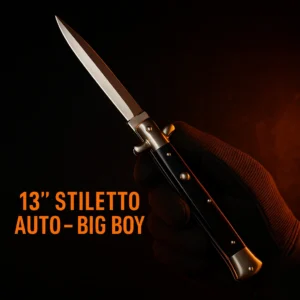


Why Do People Buy OTF Auto Knives?

Short answer
People buy OTF auto knives mainly for fast one-handed deployment, slim pocket carry, easy open-close operation, and the unique feel of the mechanism. Learn when
Key Takeaways
- Knife rules can vary by state, city, blade style, opening mechanism, carry method, and intended use.
- Do not treat a product nickname as a legal category; check the actual features and local rule.
- Retailers should keep legal or safety language factual and avoid promising that one item is allowed everywhere.
Terms Used Here
- OTF
- Out-the-front; a knife design where the blade moves forward from the front of the handle.
- Automatic knife
- A knife that opens by a spring-driven mechanism after the user activates a button, switch, or slider.
- Fixed blade
- A knife with a blade that does not fold or retract into the handle.
- EDC
- Everyday carry; gear intended for regular daily tasks.
- Sheath
- A protective cover used to store or carry a knife safely.
In this article
- 01 Top reasons people buy OTF auto knives
- 02 1. Fast one-handed deployment
- 03 2. Easy open-and-close operation
- 04 3. Slim, pocket-friendly shape
- 05 4. The mechanism itself is part of the appeal
- 06 5. They suit a specific style of everyday cutting
- 07 In plain English: how the mechanism works
- 08 When an OTF makes sense compared with other knife types
- 09 Realistic tradeoffs buyers should know
- 10 They usually cost more
- 11 They need more attention to cleanliness and maintenance
- 12 Some blade play is common
- 13 They are not ideal for every task
- 14 Common misconceptions
- 15 “People buy OTF knives only for novelty”
- 16 “They are mainly bought for self-defense”
- 17 “All OTF knives feel the same”
- 18 Quick checklist: is an OTF a good fit for you?
- 19 Short FAQ
- 20 Why do collectors buy OTF auto knives?
- 21 Why do everyday users buy OTF auto knives?
- 22 Are OTF auto knives better than side-opening automatics?
- 23 What is the biggest mistake people make when buying one?
- 24 Where can I browse OTF models?
People buy OTF auto knives mainly for fast one-handed deployment, slim pocket carry, easy open-close operation on double-action models, and the distinctive mechanical feel of the sliding mechanism.
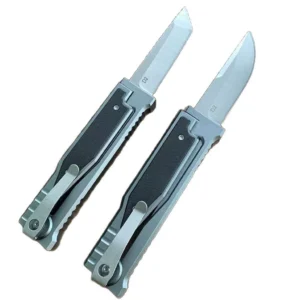
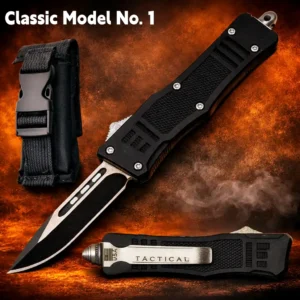
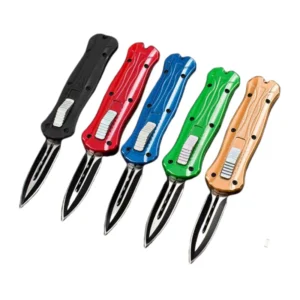
An OTF knife, or out-the-front knife, sends the blade straight out of the front of the handle instead of swinging it open from the side. Most buyers choose one for convenience and preference, not because it is the best knife style for every job. The appeal is simple: quick access, a narrow handle that carries neatly, and a design that many users find satisfying to operate. A common identification cue is the thumb slider on the face of the handle and the visible front opening where the blade travels in and out.
Top reasons people buy OTF auto knives
1. Fast one-handed deployment
This is the main reason. With an OTF, the user pushes a thumb slider and the blade fires straight out the front. There is no need to rotate the blade around a pivot, adjust grip, or use two hands. People who make lots of short, routine cuts often like that speed.
A practical example is a warehouse or shipping worker opening cartons, cutting stretch wrap, or trimming banding during the day. Another is an everyday-carry user who wants to open and close the knife with one thumb while the other hand is holding a box, cord, or tool.
2. Easy open-and-close operation
Double-action OTF knives are especially popular because the same slider both opens and retracts the blade. That means the knife can be put away just as quickly as it is deployed. For many owners, that is more convenient than a side-opening automatic that still requires a different motion to close.
This matters in repeated light utility work. If someone is cutting tape, plastic packaging, zip ties, or loose threads throughout the day, the ability to open and close the knife without changing hand position can feel more efficient.
3. Slim, pocket-friendly shape
Many OTF knives have a narrow, rectangular handle that sits flat in the pocket. Some buyers prefer that shape over wider side-opening automatics or bulky manual folders. The profile can feel cleaner, more symmetrical, and easier to clip inside work pants or jeans.
That does not mean every OTF is tiny, but the format often appeals to people who want a knife that carries neatly and does not create a large pivot bulge in the pocket.
4. The mechanism itself is part of the appeal
Some people buy OTF autos because they genuinely enjoy the mechanism. The thumb slide, the spring tension, the audible click, and the straight-line blade travel create a very different experience from a manual folder. Collectors often mention this first: the knife feels precise, mechanical, and fun to use.
That does not make the appeal frivolous. A lot of knife owners like tools that are both useful and well-executed. With OTFs, the operating feel is often a major part of why someone chooses one over another knife style.
5. They suit a specific style of everyday cutting
OTF auto knives are often chosen by people whose real use is light to medium cutting, not heavy twisting or prying. They work well for opening packages, slicing tape, cutting cord, trimming plastic, and handling quick daily tasks. Buyers who know that is their actual use pattern may prefer an OTF because it matches how they carry and use a knife.
In plain English: how the mechanism works
In plain English, an OTF auto knife uses a thumb slider to tension an internal spring system, and that spring drives the blade straight out through the front of the handle until it locks. On a double-action model, moving the same slider the other way pulls the blade back in. That is why people often describe OTFs as easy to operate with one thumb: the control is built around a simple forward-and-back motion rather than a swinging blade.
When an OTF makes sense compared with other knife types
| Knife type | Why people choose it | Best fit | Main tradeoff |
|---|---|---|---|
| OTF auto | Fast one-thumb use and slim carry | EDC, repeated light utility cuts, mechanism enthusiasts | Higher cost, more internal complexity |
| Side-opening auto | Quick automatic action with familiar folder feel | Users who want an auto but prefer pivoting blades | Wider opening arc, often bulkier carry |
| Manual folder | Simplicity, broad availability, wide price range | General everyday use and easy maintenance | Usually slower to deploy and close |
| Fixed blade | Strength and immediate readiness | Hard use, outdoor work, heavy cutting | Larger carry footprint and sheath carry |
An OTF makes the most sense when the buyer values quick one-handed operation and compact carry more than maximum strength. A side-opening automatic may suit someone who likes autos but prefers a more traditional folder feel. A manual folder is often the simpler all-around option. A fixed blade is usually the better choice for hard use.
So the short answer is not that OTFs are better than everything else. It is that they are better for a particular mix of habits: frequent short cuts, one-thumb operation, and preference for the out-the-front action.
Realistic tradeoffs buyers should know
They usually cost more
An OTF has a more complex internal mechanism than a basic manual folder. That often raises the price, especially when the action is smooth and the tolerances are good. Buyers who mainly want a simple cutting tool may decide a manual knife gives them better value.
They need more attention to cleanliness and maintenance
Because the blade travels through the front of the handle, lint, dust, and pocket debris can matter more than on a simple folder. OTF owners usually learn quickly that the knife works best when kept reasonably clean and not treated like a pry bar.
Some blade play is common
Many OTF knives have a little blade movement when open. That is normal in the category and does not automatically mean the knife is defective. The question is whether the movement feels minor and controlled or loose and poorly fitted.
They are not ideal for every task
OTFs are cutting tools. They are not the first choice for heavy batoning, twisting, digging, or rough abuse. Buyers who expect fixed-blade toughness from an OTF are often disappointed because that is not what the design is meant to do.
Common misconceptions
“People buy OTF knives only for novelty”
Not really. The mechanism is part of the attraction, but many owners use OTFs for ordinary daily cutting. The novelty may get attention first; the convenience is what keeps people carrying them.
“They are mainly bought for self-defense”
That is too narrow. Some buyers may think about emergency access, but a large share of OTF purchases are for everyday utility, collecting, and preference for the mechanism.
“All OTF knives feel the same”
They do not. Slider resistance, firing strength, lock feel, blade grind, clip design, and handle shape vary a lot. Two knives can look similar in photos and feel very different in use.
Quick checklist: is an OTF a good fit for you?
- You want one-thumb opening and closing.
- You mostly do light to medium cutting tasks.
- You prefer a slim, flat pocket profile.
- You enjoy the mechanical feel of the action.
- You understand that convenience matters more here than maximum hard-use strength.
If most of those points sound right, an OTF is probably a sensible choice. If you need the strongest possible knife for rough work, a fixed blade or sturdy manual folder may fit better.
Short FAQ
Why do collectors buy OTF auto knives?
Collectors are often drawn to the mechanism, the sound and feel of the action, and the distinctive design language. For them, the engineering is part of the value.
Why do everyday users buy OTF auto knives?
Mostly for convenience: fast deployment, easy retraction, and tidy pocket carry for routine cutting jobs.
Are OTF auto knives better than side-opening automatics?
Not universally. Many buyers prefer OTFs for straight-out deployment and one-control open-close use, while others prefer the stronger, more familiar feel of a side-opening automatic.
What is the biggest mistake people make when buying one?
Expecting every OTF to feel solid in exactly the same way. Action quality, fit, and blade movement vary widely by model and build quality.
Where can I browse OTF models?
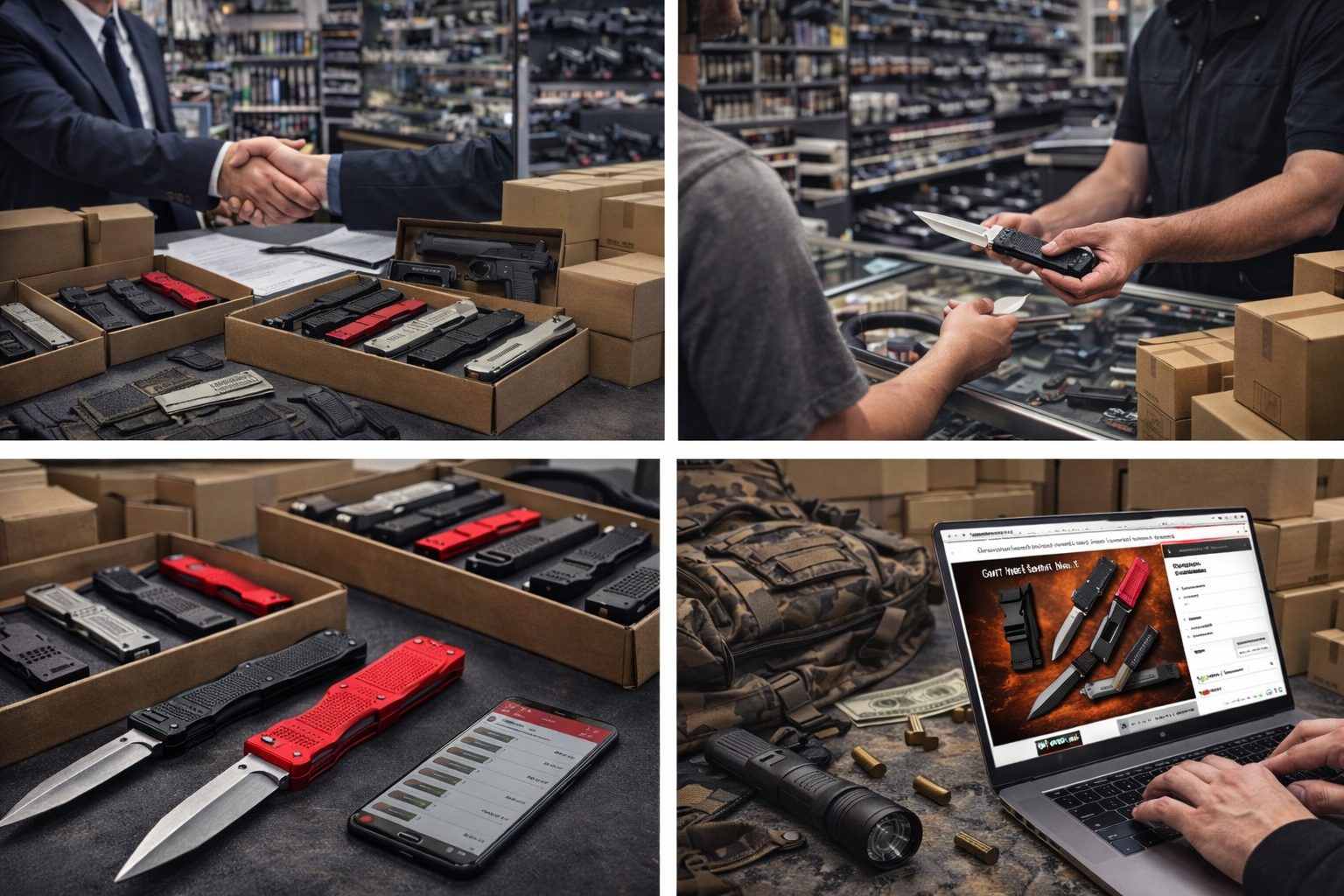
For neutral reference, you can review an OTF knife catalog to compare sizes, blade shapes, and handle styles. Business buyers looking for supply details can use the separate wholesale inquiry page.