
Short answer
Learn when an OTF knife can feel solid, how its lock compares with folding knives, what blade play is normal, and how wholesale buyers should inspect quality.
In this article
- 01 What “solid lock” means in plain English
- 02 How OTF lockup compares with folding knives
- 03 A simple pass/fail test you can do by hand
- 04 Where buyers get misled when comparing lock strength
- 05 Decision criteria for wholesale buyers and serious shoppers
- 06 Mistakes to avoid before placing a larger order
- 07 FAQ
- 08 Is blade play normal on an OTF knife?
- 09 Can a high-end OTF feel almost as solid as a folding knife?
- 10 Does less blade play always mean a better OTF?
- 11 What should a retailer tell customers?
- 12 So, can an OTF lock as solidly as a folding knife?
No—an OTF knife usually does not lock as solidly as a well-made folding knife, but a good OTF can still lock securely enough for its intended cutting tasks. The important qualifier is that “solid” and “safe” are not the same thing: a slight amount of blade movement is normal in many OTF designs, while excessive movement, failed lockup, or inconsistent deployment is not.
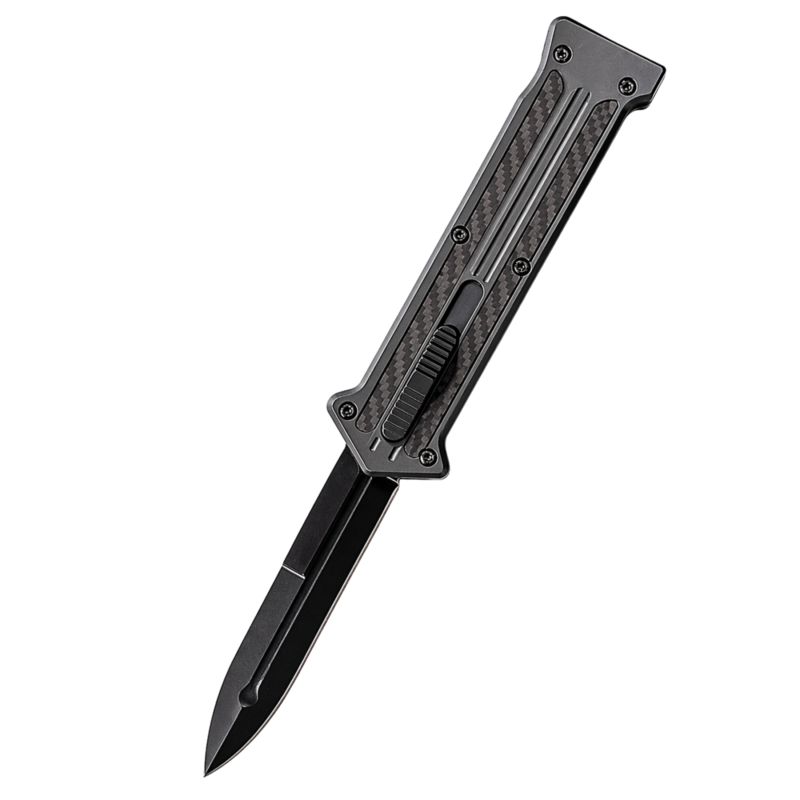
A common misconception is that any blade play means an OTF is defective. That is not true. Because an out-the-front knife uses a sliding internal carriage rather than a pivoting blade and stop pin arrangement like many folders, a small amount of front-to-back or side-to-side movement can be part of normal operation. The real question is whether the lock engages consistently, resists collapse during normal cutting, and returns the same way every cycle.
What “solid lock” means in plain English
When buyers say a knife “locks solid,” they usually mean three different things at once:
- Secure engagement: the blade stays open during normal use and does not retract unexpectedly.
- Low movement: the blade has little noticeable wiggle when lightly checked by hand.
- Consistent feel: deployment and lockup feel the same from one opening cycle to the next.
On a folding knife, especially a strong liner lock, frame lock, back lock, or crossbar-style lock, the blade often feels tighter because the blade rotates into a fixed open position and bears against defined lock surfaces. On an OTF, the blade is driven forward on a track and caught by an internal locking system. That system can be secure without feeling as rigid as a premium folder.
In short: a folding knife often wins on absolute lock rigidity; a quality OTF can still win on one-handed speed, compact carry, and acceptable lock security for utility cutting.
How OTF lockup compares with folding knives
The simplest way to compare them is this:
- Folding knife: usually better if your top priority is minimal blade play and a bank-vault feel.
- OTF knife: usually better if your top priority is fast deployment, easy operation, and compact automatic access.
Here is the practical difference buyers should expect:
- Normal for an OTF: slight blade movement when open, especially if you gently pinch the blade and test for wiggle by hand.
- Borderline: movement that is easy to feel and hear, but the knife still deploys hard, locks every time, and cuts without interruption.
- Warning sign: the blade fails to fully lock, retracts during light cutting, changes lock feel from cycle to cycle, or shows obvious looseness that worsens quickly.
For wholesale buyers comparing samples, the mistake is judging an OTF by the same standard used for a heavy-duty folding knife with almost zero blade play. That can lead to rejecting otherwise good OTF inventory. The opposite mistake is worse: accepting excessive play or weak lockup as “just how OTFs are.”
What this means in practice: if a sample OTF has slight movement but opens with authority, locks consistently, and passes repeated hand checks, it may be commercially acceptable. If it feels different every few cycles or shows partial engagement, it is not.
A simple pass/fail test you can do by hand
You do not need lab equipment to screen OTF lock quality. You do need a repeatable inspection method.
Basic hand test for open lockup:
- Deploy the blade fully and listen for a clean, decisive stop.
- With the knife pointed in a safe direction, lightly try to move the blade side to side and front to back using your fingers, not tools.
- Retract and deploy it again 10 to 20 times.
- Check whether the amount of movement stays about the same.
- Make a few light slicing cuts through cardboard or similar packaging material.
- Check again for any increase in movement or any failure to remain locked open.
Pass: the knife locks every cycle, movement remains stable, and cutting does not cause retraction.
Borderline: movement is noticeable, but it does not increase after repeated cycling and light cutting.
Fail: the blade hesitates, partially locks, retracts under light use, or develops clearly worse play after a short test.
This test is especially useful for distributors reviewing sample lots from multiple factories. It gives a visible, repeatable standard that sales teams and QC teams can both understand.
Where buyers get misled when comparing lock strength
Many lock complaints are really expectation problems. Buyers often compare unlike products: a slim double-action OTF built for quick utility carry versus a robust folding knife built around a thick pivot and strong lock face. Those products can both be good while feeling very different in hand.
Another source of confusion is the word play. A small amount of movement in an OTF does not automatically mean the lock is weak. What matters more is whether the blade remains positively engaged during realistic cutting. A knife can feel tight on day one and still be poorly made if it starts failing after a short break-in period. Conversely, a knife can have minor play from the start and still be dependable for routine use.
One real-world example: imagine a retailer evaluating private-label samples for an everyday carry line aimed at warehouse staff opening cartons, trimming wrap, and cutting banding tails. In that scenario, the better OTF sample is not necessarily the one with the least detectable wiggle. It is the one that deploys consistently across repeated cycles, keeps the same lock feel after box-cutting, and does not produce customer returns for misfires. That is a more useful buying standard than chasing the tightest sample on the table.
Decision criteria for wholesale buyers and serious shoppers
If you are sourcing OTF knives for resale, focus on the traits that affect returns, complaints, and repeat orders.
- Consistency across units: one good sample is not enough. Ask whether lockup feel is uniform across a batch.
- Cycle reliability: repeated deployment matters more than a single impressive opening.
- Open-lock stability: slight movement can be acceptable; increasing movement is not.
- Switch effort: a switch that is too stiff or too weak can both signal trouble.
- Track and internal fit: rough action, scraping, or irregular engagement often predicts complaints.
- Use-case match: OTF buyers usually want fast access and convenience, not prying or hard torque work.
For buyers comparing models in an OTF knife catalog, it helps to sort products by intended market. Entry-level users may accept a little more movement if deployment is reliable and the price point is right. Premium buyers usually expect cleaner action, better fit, and tighter tolerances, even though they still should not expect a perfect no-play feel identical to a top-tier folder.
Here is a short comparison that sharpens the decision:
- Best reason to choose an OTF: fast one-handed deployment and retraction, compact carry, automatic convenience.
- Best reason to choose a folding knife: stronger perception of rigidity and often better tolerance for heavier lateral stress.
- Poor reason to reject an OTF: slight, stable blade play that does not affect function.
- Strong reason to reject an OTF: inconsistent lockup, failed deployment, or movement that increases quickly.
What this means in practice: buy OTFs based on repeatable function and return-rate risk, not on the unrealistic assumption that every model should feel like a fixed stop-point folding knife.
Mistakes to avoid before placing a larger order
The most expensive OTF mistakes usually happen before the first shipment lands.
- Do not approve from photos alone. Lock feel, switch resistance, and deployment consistency must be checked in hand.
- Do not test only one unit. A single smooth sample can hide batch variation.
- Do not confuse hard firing with good lockup. A strong opening sound is not proof of secure engagement.
- Do not oversell “zero play.” That creates avoidable customer complaints when buyers notice normal OTF movement.
- Do not ignore use instructions. OTFs are cutting tools, not pry bars, and warranty claims often come from misuse.
If you are buying for distribution or private label, set acceptance standards in writing: deployment reliability, stable lockup after repeated cycling, no uncommanded retraction in light utility cuts, and no major variation between sample units. If you need to discuss volume requirements or inspection expectations, the wholesale inquiry form is the right place to outline those details clearly.
FAQ
Is blade play normal on an OTF knife?
Yes. Slight blade play is normal on many OTF knives. It becomes a problem when it is excessive, inconsistent, or gets worse quickly.
Can a high-end OTF feel almost as solid as a folding knife?
Yes, some premium OTFs can feel very tight and confidence-inspiring, but most still do not match the absolute rigid lock feel of a strong folding knife.
Does less blade play always mean a better OTF?
No. Reliable lock engagement and consistent deployment matter more than chasing the smallest amount of movement.
What should a retailer tell customers?
Tell them that a quality OTF may have slight normal movement, but it should deploy consistently, lock securely for intended cutting use, and not retract during routine tasks.
So, can an OTF lock as solidly as a folding knife?
Usually not in the strictest sense of rigid lock feel. But a good OTF can still lock securely enough to be a dependable, commercially viable cutting tool when chosen and inspected correctly.