
Short answer
Which OTF knife colors sell best? For wholesale buyers, black usually leads, black/silver or gray follows, OD green is next, and bright colors work best as test
Key Takeaways
- Knife rules can vary by state, city, blade style, opening mechanism, carry method, and intended use.
- Do not treat a product nickname as a legal category; check the actual features and local rule.
- Retailers should keep legal or safety language factual and avoid promising that one item is allowed everywhere.
Terms Used Here
- OTF
- Out-the-front; a knife design where the blade moves forward from the front of the handle.
- Folding knife
- A knife with a blade that pivots into the handle for storage.
- EDC
- Everyday carry; gear intended for regular daily tasks.
In this article
- 01 A decision frame: what most changes OTF color performance
- 02 Recommended starting assortment by color
- 03 What this is based on
- 04 Three anonymized examples of how color performance changes by channel
- 05 1) Tactical-leaning dealer mix
- 06 2) General online reseller with broader product photography
- 07 3) Private-label or gifting account
- 08 Why black usually wins in OTF specifically
- 09 Best quick test before a larger color order
- 10 When this changes
- 11 Tight buyer checklist
- 12 FAQ
- 13 Do bright OTF colors ever outsell black?
- 14 Is OD green better than tan for OTF knives?
- 15 Does blade style affect color demand?
For wholesale OTF knives, black usually sells best, black-and-silver or gray is the safest second color, OD green is the next most dependable, and bright colors are usually best treated as test SKUs. In this article, “sell best” means the colors most likely to produce fast sell-through, clean reorders, and broad channel appeal on first and repeat wholesale buys; the color guidance below is a practical wholesale benchmark, not a universal market share claim.
That benchmark is based on observed reorder patterns across mixed OTF accounts rather than a public industry survey. The main pattern is consistent: neutral tactical colors reorder more reliably than novelty colors, especially when the knife has a black blade, a dagger profile, or a hard-use positioning. OTFs behave differently from many folding knives because chassis wear, switch-track grime, blade-finish pairing, and the category’s tactical styling all affect what buyers consider attractive after the knife leaves the display case.
If you are choosing from current OTF knife buying options, the safest first order is usually a tight neutral core with one controlled accent color instead of a broad rainbow spread.
A decision frame: what most changes OTF color performance
Four variables change the answer faster than anything else:
- Sales channel: tactical retail, online marketplaces, gift-oriented e-commerce, and private-label programs do not reorder the same colors at the same rate.
- Blade finish: black-coated blades usually favor black, gray, green, and tan handles; satin blades can support more blue or red.
- OTF wear visibility: OTF handles show switch-path use, pocket-contact marks, and track grime differently than standard folders. Matte dark finishes hide this better.
- Buyer identity: duty, work, and EDC buyers usually prefer discreet colors; collector and gifting buyers tolerate more novelty.
That OTF-specific wear issue matters. A color that looks strong in listing photos may underperform in repeat orders if it shows grime, edge rub, or coating wear too quickly in real carry.
Recommended starting assortment by color
For a worked example, here is a simple starting assortment table for a first or reset wholesale order. These are recommended assortment ranges, not industry-wide sales percentages.
| Color | Suggested starting share | Why it earns space |
|---|---|---|
| Black | 35% to 50% | Broadest appeal, strongest tactical fit, hides wear well, works with almost any blade finish. |
| Black/silver or gray | 20% to 30% | Still neutral, slightly less severe than all-black, strong for buyers who want a tactical look without a fully dark build. |
| OD green | 10% to 20% | Reliable in tactical and outdoor channels, especially with black blades and textured handles. |
| Tan/FDE | 0% to 10% | Useful as a supporting tactical neutral, but usually less universal than black, gray, or OD green. |
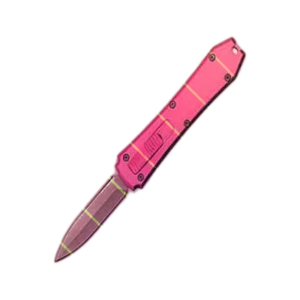
| Blue, red, orange, or other bright colors | 5% to 15% combined | Best as visual hooks, gift options, or channel tests rather than core replenishment SKUs. |
If you need one simple rule: start with black as the anchor, add one secondary neutral, add OD green if your channel leans tactical, and limit bright colors to controlled tests.
What this is based on
This article is written as house merchandising guidance, based on wholesale reorder behavior and assortment planning rather than a published consumer trend report. The ranking above reflects three recurring patterns seen in OTF programs:
- Reorder reliability: black and black/gray combinations are the colors most likely to be replenished across different account types, not just to sell once.
- Cross-model carryover: when a new OTF body style is introduced, black is usually the easiest color to move across dagger, drop-point, and utility-style variants.
- Lower color risk on first orders: buyers expanding cautiously into OTFs usually get cleaner turns with deeper quantities in fewer neutral colors than with shallow quantities across many colors.
That does not mean bright colors never work. It means they tend to be more channel-dependent and more sensitive to presentation, seasonality, and blade-finish pairing.
Three anonymized examples of how color performance changes by channel
1) Tactical-leaning dealer mix
In a tactical-heavy assortment, black was the first reorder color, gray/black was the second, and OD green stayed active while bright colors sold mainly as occasional add-ons. The key driver was not fashion alone; black blades plus dark handles matched what that customer base already expected from OTF autos.
2) General online reseller with broader product photography
In a more general e-commerce environment, black still led unit movement, but blue and red performed better than they did in tactical stores because they improved thumbnail contrast and gift appeal. Even there, bright colors were more likely to sell in bursts than to become stable replenishment leaders.
3) Private-label or gifting account
In branded or presentation-led programs, silver/gray and selected accent colors sometimes narrowed the gap with black, especially when satin blades and retail packaging softened the tactical look. In those cases, color performance was driven as much by packaging and positioning as by the knife itself.
The takeaway from all three: retail best-seller, reorder velocity, and margin contribution are not always the same thing. A bright color may generate attention or better perceived value, while black still wins on repeatability and forecasting simplicity.
Why black usually wins in OTF specifically
Black is not just a generic “safe” color. In OTFs, it benefits from several category-specific advantages:
- It matches the platform. OTF buyers often expect a tactical, mechanical, low-visibility look.
- It hides use better. Pocket carry marks, switch wear, and handling grime are less obvious on matte dark handles.
- It pairs with more blades. Black handles work with black-coated, stonewashed, and satin blades more easily than many bright finishes do.
- It reduces objections. Conservative buyers may pass on red or white, but few object to black.
Gray and black/silver follow for similar reasons. They preserve the neutral, tool-oriented look while giving the shopper some visual variation. OD green performs well because it stays inside the tactical/outdoor lane without feeling as plain as black.
Best quick test before a larger color order
- Test one model in three colors only: black, one tactical neutral, and one bright accent.
- Keep the blade finish constant: do not test color and blade finish at the same time.
- Reorder only what repeats: a one-time novelty pop is not the same as dependable replenishment.
When this changes
Color rankings can change in collector drops, seasonal gifting, or social-media-led launches where novelty and scarcity matter more than daily carry practicality. Stylized chassis designs and satin-blade builds can also support brighter anodized colors better than classic black-blade tactical OTFs. Legal and channel variation can influence demand too, since some storefronts and marketplaces skew more work-use while others skew more novelty, but that is a sales-pattern issue rather than legal advice.
Tight buyer checklist
- Define “sell best” before ordering: fastest sell-through, easiest reorder, or strongest margin.
- Start with black as the core SKU.
- Add one secondary neutral: gray or black/silver first, OD green if your channel is tactical.
- Treat bright colors as tests unless your own sales data proves otherwise.
- Match handle color to blade finish deliberately.
- Avoid too many colors in the first run.
- Track reorders separately from first-purchase novelty sales.
If you are planning a broader buy or a private-label mix, use the bulk quote request to discuss color depth by model rather than applying one color plan to every OTF in the line.
FAQ
Do bright OTF colors ever outsell black?
Yes, but usually in narrower situations such as gift programs, collector drops, or image-driven online merchandising. They are less often the most dependable reorder colors across mixed wholesale accounts.
Is OD green better than tan for OTF knives?
Usually yes for broad wholesale use. OD green tends to keep the tactical identity buyers expect from OTFs, while tan/FDE can work well but is usually a more selective add-on than a core second color.
Does blade style affect color demand?
Often. Dagger-style and more aggressive OTF profiles usually perform best in darker tactical colors, while utility-oriented single-edge models can support more visible work colors like blue or orange.
Bottom line: for most wholesale OTF programs, black is the most reliable first color, black/silver or gray is the safest second, OD green is the next best tactical option, and bright colors should earn inventory space through testing rather than assumption.