
Short answer
For wholesale OTF buyers, the easiest blade style to resell is usually the drop point. See the evidence, limits, buying criteria, cost logic, and a practical ch
Key Takeaways
- Knife rules can vary by state, city, blade style, opening mechanism, carry method, and intended use.
- Do not treat a product nickname as a legal category; check the actual features and local rule.
- Retailers should keep legal or safety language factual and avoid promising that one item is allowed everywhere.
Terms Used Here
- OTF
- Out-the-front; a knife design where the blade moves forward from the front of the handle.
- Automatic knife
- A knife that opens by a spring-driven mechanism after the user activates a button, switch, or slider.
- EDC
- Everyday carry; gear intended for regular daily tasks.
In this article
- 01 Why drop point is usually the safest resale choice
- 02 Comparison table: resale ease by OTF blade style
- 03 What wholesale buyers should actually evaluate before choosing a style
- 04 Mistakes that make an OTF blade style harder to resell
- 05 Practical starter checklist for the first OTF blade-style buy
- 06 How this was checked
- 07 Is tanto ever easier to resell than drop point?
- 08 Why not start with a dagger if OTF buyers like the classic look?
- 09 What is the safest first private-label OTF blade style?
- 10 How many blade styles should a new reseller test in one PO?
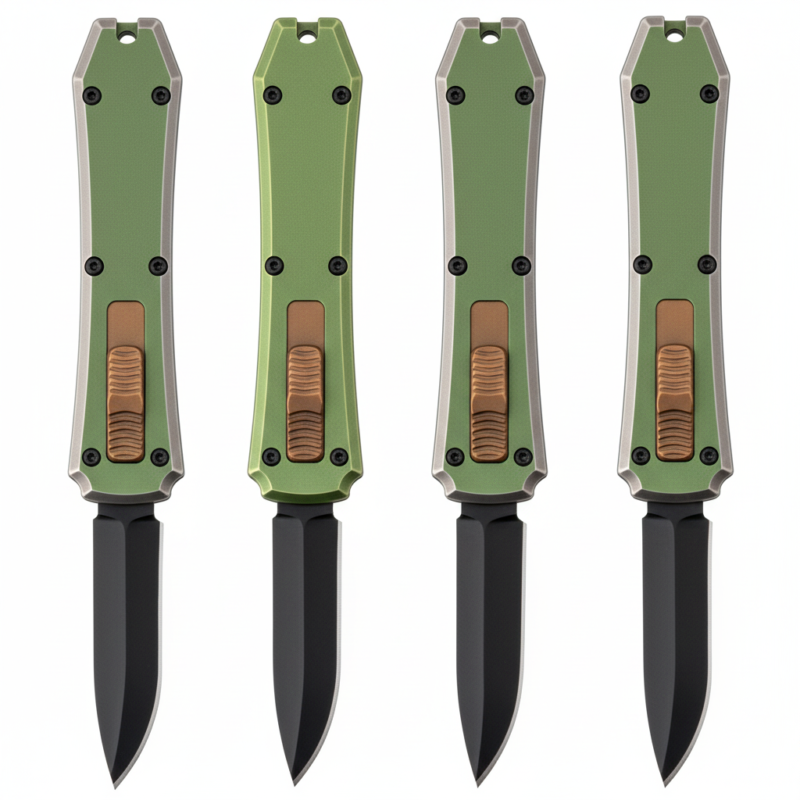
The easiest OTF blade style to resell is usually the drop point. For wholesale buyers, it tends to be the safest choice because it fits the broadest everyday-use demand, creates fewer customer objections than dagger blades, and is easier to reorder consistently across price tiers when you need repeatable sell-through rather than niche appeal.
Before comparing styles, the terms need to be exact. In OTF knives, drop point means a single-edge blade with a spine that slopes down to the tip; tanto usually means a single-edge angular tip with a reinforced point; dagger means a double-edge symmetrical blade; and clip point means a blade with a concave or straight clipped-off spine near the tip. These definitions are shown in current retailer and brand product listings and spec pages, including Blade HQ’s blade-shape guide and current OTF product filters, Knife Center’s current OTF listings, and Microtech’s current model specifications for Ultratech variants checked May 2026 (evidence type: retailer count, spec sheet, catalog) Blade HQ blade shape guide (accessed May 2026), Blade HQ OTF catalog (accessed May 2026), KnifeCenter OTF catalog (accessed May 2026), Microtech Ultratech specifications (accessed May 2026).
The evidence can prove which blade shapes appear more often in current retail assortments and which shapes align with fewer legal and practical objections. It cannot prove your exact sell-through rate in every local market, because local law, buyer age, price band, and your channel mix still matter.
Why drop point is usually the safest resale choice
For resale, the best blade style is not the most dramatic one. It is the style with the lowest friction at the point of sale. Drop point wins that test because it is easy to explain, easy to photograph, familiar to first-time OTF buyers, and generally perceived as a utility blade rather than a novelty or fighting profile.
There are three practical reasons.
- Broader buyer pool: single-edge utility profiles appeal to EDC buyers, work users, and gift buyers. Double-edge daggers narrow the audience because some buyers avoid them on legal or personal-preference grounds. Automatic knife law varies by state, and some state restrictions specifically mention daggers or double-edged knives in broader weapons statutes, so a single-edge profile often creates fewer compliance questions at retail. See AKTI’s state law resources and retailer compliance notices checked May 2026 (evidence type: law, retailer policy) American Knife & Tool Institute state knife laws (accessed May 2026), Blade HQ automatic knife legal guide (accessed May 2026).
- Lower return risk from tip misuse: compared with finer dagger or clip tips, many drop points tolerate ordinary cutting tasks better in the hands of casual users. That does not make them stronger in every grind, but in wholesale reality it means fewer complaints from buyers who expected an OTF to act like a general utility knife.
- Repeat-order stability: factories and brands commonly keep single-edge SKUs in regular production because they move across more channels, including private-label programs. That helps when you need the same profile again in a second PO instead of replacing a one-off style.
A quick check of current OTF assortments at major knife retailers shows single-edge utility profiles appearing across entry, mid, and premium price bands, while double-edge daggers remain common but more style-specific. Retailer filters and model pages checked May 2026 show multiple live OTF families with drop point or other single-edge variants from brands such as Microtech, Benchmade, Kershaw, Cobratec, and Hogue (evidence type: retailer count, spec sheet, catalog) KnifeCenter OTF catalog, Blade HQ OTF catalog, Benchmade OTF collection (all accessed May 2026).
Comparison table: resale ease by OTF blade style
For wholesale planning, resale ease means how often a style can be stocked, explained, reordered, and sold with minimal objections. The table below combines current retail assortment checks with legal and merchandising considerations checked May 2026.
- Drop point: Best all-around resale choice. Evidence: common in current OTF assortments and brand spec pages across price tiers (retailer count, spec sheet, catalog). Strength: widest utility appeal. Weakness: less visually aggressive for style-driven buyers.
- Tanto: Good second choice. Evidence: frequently present in current OTF lines from major brands and retailers (retailer count, spec sheet). Strength: strong tip story and tactical look. Weakness: more polarizing for casual buyers and slightly narrower gift appeal.
- Dagger/double edge: Easy to sell in enthusiast channels, harder in general retail. Evidence: common in premium OTF lines, but legal and buyer objections are more frequent because it is double-edge (retailer count, law, spec sheet). Strength: iconic OTF look. Weakness: narrower audience and more compliance questions.
- Clip point: Niche but workable. Evidence: appears in some current OTF assortments, though less consistently than drop point or tanto in major catalogs checked May 2026 (retailer count, catalog). Strength: familiar knife profile. Weakness: less standardized across factories, which can hurt repeat-order consistency.
If your customer base is broad retail, hardware-adjacent, online general EDC, or private-label lifestyle, start with drop point. If your customer base is tactical-focused and already understands local knife rules, tanto can perform nearly as well. Dagger belongs in a narrower, better-informed channel.
What wholesale buyers should actually evaluate before choosing a style
Blade shape alone does not decide resale speed. In OTF wholesale, the easier style to resell is the one you can reorder with stable quality and landed cost.
- MOQ: Ask whether MOQ is per handle color, per blade finish, or per total model family. A factory that quotes 300 pieces total but requires 100 per blade style can trap you in slow-moving variants. If you are testing a new account, a drop point is usually the safest style to absorb that MOQ.
- Lead time: Ask for first-order and repeat-order lead times separately. OTFs often have longer first-order setup because of spring tuning, switch fit, and packaging approvals. A style that sells well but cannot be repeated in 45 to 60 days is not truly easy to resell.
- Sample policy: Request at least one live-fire sample from production spec, not only a photo sample. On OTF knives, switch tension, lockup feel, and blade play matter more than catalog images.
- QC checkpoints: Define misfire rate tolerance, edge symmetry, finish consistency, glass-breaker fit, and deployment cycle testing. A dagger blade with poor grind symmetry gets noticed immediately; a drop point gives you a little more cosmetic forgiveness, but not much.
- Packaging: Ask whether the box, warning inserts, UPC labels, and private-label sleeves are included in MOQ pricing. For resale, clean packaging often helps single-edge utility styles more because they are bought as gifts and impulse upgrades.
- Landed cost: Compare not just unit price but freight mode, duty treatment, packaging, defect allowance, and replacement policy. A slightly higher FOB on a stable drop point can beat a cheaper dagger if the return rate is lower and reorder fill is better.
If you want to compare current wholesale-ready options, start with the wholesale OTF knife catalog. If you already know your target price band and MOQ, use the OTF bulk inquiry form to ask for repeat-order lead time, sample terms, and QC standards in one step.
Mistakes that make an OTF blade style harder to resell
- Buying for looks instead of channel fit: A dramatic double-edge satin dagger may get attention online but stall in stores where buyers want a simple work knife.
- Ignoring local compliance: Automatic knife legality is not the only issue. Double-edge shapes can trigger separate restrictions or retailer refusals. Check destination-state rules before committing style-heavy inventory.
- Testing too many finishes at once: For a first PO, blade style matters more than adding blackwash, stonewash, satin, serration, and coated variants. Too much style branching hides which blade shape actually moved.
- Skipping cycle testing: OTF customers are unforgiving about misfires. If your sample policy does not include deployment-cycle checks, resale gets harder regardless of blade style.
- Assuming catalog breadth equals demand: A retailer may list many daggers because collectors browse them, not because they outsell utility profiles. Use retailer counts only as one input, not as proof of sell-through.
Practical starter checklist for the first OTF blade-style buy
- Choose one core style: drop point for broad resale, tanto for tactical-heavy channels.
- Keep first PO to one blade finish and two handle colors if MOQ allows.
- Ask supplier for first-order lead time and repeat-order lead time separately.
- Confirm sample from production spec, not preproduction only.
- Set QC terms for misfire rate, blade centering, edge grind, and switch action.
- Calculate landed cost with packaging, freight, duty, and defect replacement.
- Check legal acceptance for your sales states, especially if considering double-edge dagger.
- Plan reorder trigger before launch: for example, reorder when 60% of sellable stock is gone, not when you are nearly out.
For most wholesale buyers, that checklist leads back to the same answer: start with drop point, validate with a controlled first order, then add tanto if your customer base wants a more tactical profile.
How this was checked
Method: on May 28, 2026, current OTF assortments, blade-shape definitions, and legal references were checked using live retailer category pages, brand specification pages, and knife-law resources. Sources used here include Blade HQ, KnifeCenter, Microtech, Benchmade, and the American Knife & Tool Institute. Evidence types are named inline for each key claim: catalog, spec sheet, retailer count, or law.
What this method can prove: it can compare current availability, definitions, and legal friction points using dated public sources. What it cannot prove: it cannot measure your exact future sell-through without your own channel data, price point, and return history.
Is tanto ever easier to resell than drop point?
Yes. If your customers are tactical-focused, buy online from enthusiast channels, and prefer reinforced tips and angular styling, tanto can match or beat drop point. It is still usually a narrower starting choice for broad retail.
Why not start with a dagger if OTF buyers like the classic look?
Because classic does not always mean easiest to move. Double-edge blades create more legal questions, more retailer restrictions, and a narrower buyer pool outside enthusiast channels.
What is the safest first private-label OTF blade style?
Usually a single-edge drop point with one plain-edge finish. It gives you the broadest audience, simpler compliance handling, and cleaner repeat-order planning.
How many blade styles should a new reseller test in one PO?
Usually one, or at most two. Testing too many styles at once makes it harder to identify what actually sold and raises your risk of being stuck with slow-moving variants.