
Short answer
A practical wholesale guide to OTF knife warranty support: what to ask suppliers about coverage, parts, QC, turnaround, packaging, repeat-order stability, and w
Key Takeaways
- Start with a mild method and increase pressure or abrasion only when the blade condition requires it.
- Edge angle, steel type, corrosion level, and handle material all affect the right care method.
- For wholesale assortments, simple care instructions help customers keep knives useful longer.
Terms Used Here
- OTF
- Out-the-front; a knife design where the blade moves forward from the front of the handle.
- Folding knife
- A knife with a blade that pivots into the handle for storage.
In this article
- 01 Use this warranty checklist before you approve an OTF supplier
- 02 Why this fails on OTFs specifically
- 03 Compare support models before you compare prices
- 04 Questions that protect margin, not just paperwork
- 05 What defect rate triggers corrective action?
- 06 How are samples related to production?
- 07 What is the sample policy for service parts?
- 08 What packaging protects warranty outcomes?
- 09 How does the supplier handle repeat-order stability?
- 10 Practical decision rules for MOQ, lead time, QC, and landed cost
- 11 FAQ for wholesale buyers
- 12 Should a wholesaler require written warranty terms for every OTF model?
- 13 Is a lifetime warranty enough?
- 14 Should distributors stock spare parts for OTF knives?
- 15 What is the biggest red flag in OTF warranty support?
- 16 When is factory return acceptable?
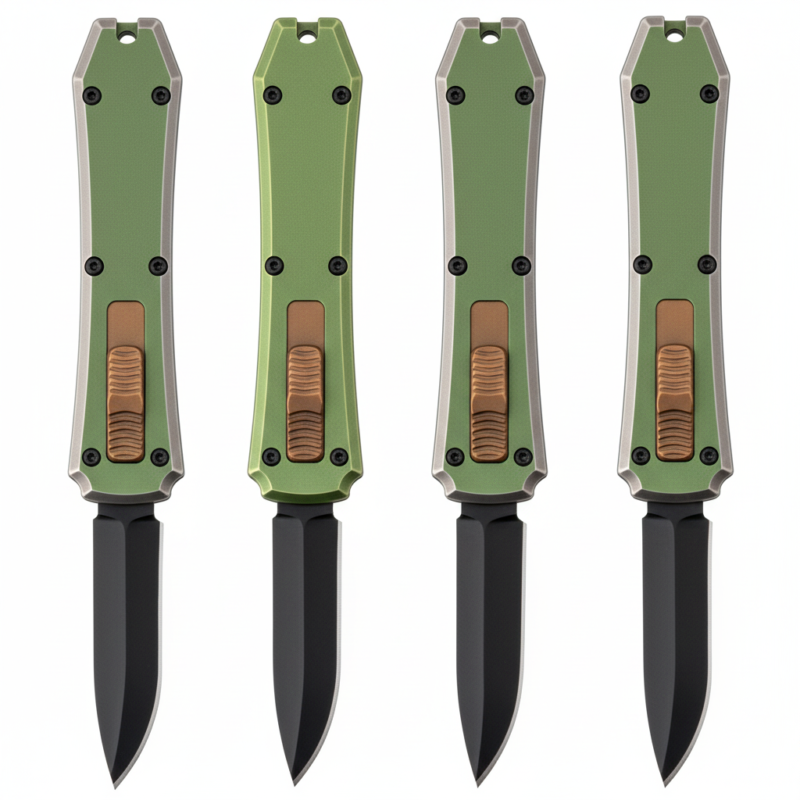
A wholesaler should ask about OTF knife warranty support before placing an order, and the right answer is not vague lifetime coverage. The supplier should be able to state, in writing, what failures are covered, who pays freight, whether parts are stocked, how RMAs are handled at bulk scale, and whether the same internal mechanism will still be available for repeat orders.
Best answer in one sentence: Buy only if the supplier can document warranty terms for spring, switch, lockup, blade play, finish defects, and dead-on-arrival units, with clear turnaround times and stable replacement parts for the exact OTF model you are sourcing.
For wholesale buyers, warranty support is a landed-cost issue, not just a customer-service issue. A low unit price can become expensive if 3% of knives come back with misfires, weak springs, or switch drag and the factory only offers credit on the next order after a long review cycle. If you are comparing options in a wholesale OTF knife catalog, treat warranty support as part of the product specification, alongside steel, handle material, MOQ, and packaging.
Use this warranty checklist before you approve an OTF supplier
Ask these questions in a fixed order. If the supplier cannot answer them clearly, you are not evaluating a real warranty program.
- What is covered?
Get a written list. For OTF knives, the useful categories are: dead on arrival, failure to deploy, failure to retract, spring breakage, switch failure, lockup failure, excessive blade play beyond agreed tolerance, loose hardware, broken glass breaker, finish defects, and packaging damage.
- What is excluded?
Ask whether misuse, dirt ingress, disassembly, sharpening damage, side-loading, or tip breakage void coverage. OTFs are sensitive to pocket lint and impact; exclusions that are too broad can wipe out most practical claims.
- What is the claim window for wholesale orders?
You need separate windows for dead-on-arrival inspection and field failures. A workable structure is 7 to 15 days after receipt for visible defects and 90 to 180 days for mechanism failures in normal use.
- Who makes the service decision?
Ask whether your account manager can approve claims, or whether every case goes back to factory engineering. Slow internal approval adds real cost.
- What is the remedy?
Replacement parts, full unit replacement, repair credit, or refund are not equivalent. For lower-cost OTFs, unit replacement is often more practical than repair. For higher-value private-label runs, spare-part kits and repair procedures may make sense.
- Who pays shipping?
Clarify inbound freight, outbound replacement freight, and whether claims are consolidated with the next shipment. This directly affects landed cost.
- Are spare parts stocked for the exact model?
Do not accept a generic yes. Ask about springs, switches, screws, clips, and internal carriers for the exact handle pattern and blade format.
- Will the same internals be used on repeat orders?
Repeat-order stability matters. A supplier may keep the same exterior but change spring gauge, switch geometry, or screw spec between runs.
Do not proceed if:
- The supplier says all OTF parts are interchangeable.
- Warranty is described only as “factory defects covered” with no examples.
- There is no separate policy for dead-on-arrival units in bulk shipments.
- Replacement parts are “available sometimes” but not stocked.
- The supplier cannot confirm whether internals will remain consistent across repeat orders.
- They require end users to ship every failed unit overseas one by one.
Why this fails on OTFs specifically
OTF warranty support is harder than standard folding-knife support because the mechanism has more moving parts, tighter tolerances, and more ways to fail without visible external damage. A liner lock with a cosmetic defect may still function; an OTF with a slightly weak spring, rough track, or switch tolerance issue may misfire repeatedly.
The common wholesale mistake is assuming a normal knife warranty process will work for OTFs. It often does not. OTF claims need model-specific diagnosis: deployment spring strength, track finish, actuator friction, lockup engagement, and hardware retention. A generic “send photos” process misses intermittent failures.
Here is one concrete failure mode: a buyer approves a sample that fires cleanly, then receives a production batch where the supplier changed the internal spring vendor. The knives look identical, packaging matches, and finish passes inspection, but cold-weather deployment becomes inconsistent. The supplier offers 2% replacement credit on the next order, while the buyer is seeing 6% retail returns. That is a warranty mismatch, not just a QC issue.
Another OTF-specific problem is that some proprietary internals are not realistically field-repairable by a distributor. If the supplier does not provide exact replacement assemblies or guided repair steps, your service team may spend more labor than the unit margin can support.
Compare support models before you compare prices
Wholesale buyers should compare warranty support the same way they compare steel or MOQ. The cheapest knife is not the lowest-cost program.
- Credit-only model: Supplier gives credit on the next order for approved defects. This can work only if defect rates are low, lead times are stable, and your cash flow can absorb returns.
- Replacement-unit model: Supplier ships replacement knives with the next bulk order or in a smaller service parcel. This is usually the cleanest option for budget and mid-range OTFs.
- Parts-and-procedure model: Supplier provides spare springs, switches, screws, clips, and service instructions. Best for experienced distributors or private-label programs with in-house service capability.
- Factory-return model: Failed units must be sent back for inspection before remedy. For most wholesale OTF programs, this is unattractive unless the knives are high value and the failure rate is very low.
Ask for concrete fit criteria when choosing among these models:
- If unit value is low and labor cost is high, prefer replacement units over repair.
- If MOQ is large and repeat orders are planned, ask for a spare-parts allowance in the first order.
- If lead time exceeds 45 days, avoid warranty programs that only resolve issues on the next shipment.
- If you sell under private label, require packaging-level traceability by batch or carton.
For buyers preparing a custom program, it is worth using a formal OTF bulk inquiry form and listing your expected claim process up front: inspection window, acceptable defect rate, remedy type, and replacement timing.
Questions that protect margin, not just paperwork
Ask these questions because they change margin and customer experience.
What defect rate triggers corrective action?
A serious supplier should define when they will investigate production, not just replace individual units. For example, if dead-on-arrival exceeds an agreed threshold, they should review spring installation, track finishing, or switch fit on that batch.
How are samples related to production?
Ask whether your approval sample came from the same assembly line, same hardware spec, and same packaging line as production. Sample-room builds can hide warranty risk.
What is the sample policy for service parts?
If you expect to handle minor repairs, request sample spare parts before the main order. Confirm that screws, clips, and springs fit the exact production version.
What packaging protects warranty outcomes?
OTFs can arrive with switch scuffs, broken clips, or cosmetic marks if tray fit is poor. Ask whether each knife has sleeve protection, foam retention, desiccant where needed, and carton drop-test standards. Some “warranty” claims are really packaging failures.
How does the supplier handle repeat-order stability?
Ask whether they lock the bill of materials after first approval. If not, a later batch may use different screws, spring temper, or coating process, making your prior service parts useless.
Brand/model variation note: Warranty expectations can differ sharply between a generic dual-action OTF and a proprietary premium-style platform. Some premium-pattern clones may look similar externally but use different carriers, springs, or switch geometry internally. Do not assume parts compatibility across lookalike models.
Practical decision rules for MOQ, lead time, QC, and landed cost
Use simple rules so warranty support becomes a buying decision, not a surprise later.
- MOQ: If MOQ is high, ask for a larger pre-shipment AQL check or a live-function test sample from production cartons. Higher volume magnifies even small mechanism defects.
- Lead time: If lead time is long, ask for advance spare units or parts. Waiting for the next production slot is not a warranty plan.
- QC: Require a function test standard for OTFs, not just visual inspection. A proper QC line should test deployment and retraction multiple times per unit or by agreed sampling level.
- Packaging: Specify retail box fit, pouch quality if included, and clip protection. Cosmetic return rates often come from packaging shortcuts.
- Landed cost: Add expected return handling, replacement freight, and service labor to unit cost. A knife that is $2 cheaper ex-factory may be more expensive after warranty friction.
If a supplier offers a strong warranty but cannot commit to stable internals, that is still a weak program. Replacing units helps short-term claims, but unstable specs create long-term support confusion for distributors and retailers.
FAQ for wholesale buyers
Should a wholesaler require written warranty terms for every OTF model?
Yes. At minimum, require written coverage, exclusions, claim windows, remedy type, and shipping responsibility for the exact model family you are buying.
Is a lifetime warranty enough?
No. “Lifetime” without defect definitions, service method, and freight terms is not enough for wholesale planning.
Should distributors stock spare parts for OTF knives?
Only if the model is stable, the supplier confirms exact part fit, and your team can perform the repair economically. Otherwise, replacement units are usually safer.
What is the biggest red flag in OTF warranty support?
A supplier who cannot explain whether repeat orders will use the same internals. Cosmetic consistency is not enough on OTFs.
When is factory return acceptable?
Only if the knife value is high, failure rates are low, and the supplier gives fast approval with clear freight rules. For most bulk OTF programs, local replacement or parts support is more practical.