
Short answer
Compare stock, private-label and custom repair kits by order minimum, sample cost, retail packaging and receiving checks.
Key Takeaways
- Start with the plain meaning of the term, then compare features and use cases.
- Knife categories often overlap, so the details matter more than the label alone.
- For buying decisions, check materials, size, mechanism, safety notes, and maintenance expectations.
Terms Used Here
- Blade style
- The shape and edge design of the blade, which affects cutting tasks and buyer preference.
- Handle material
- The material used for grip, comfort, appearance, and durability.
- Assortment
- A grouped buying selection planned around customer needs, price points, and repeat orders.
In this article
A hardware store that needs a screwdriver on the shelf next month and a distributor that wants its own 24-piece repair kit are buying two different things. Start with a finished model for regular replenishment. Ask for a separate private-label or custom quote when the pack, the parts inside it, or the way it’s sold changes. Here’s how to buy ordinary multi-bit tools for household repairs and compare those offers on the same terms.
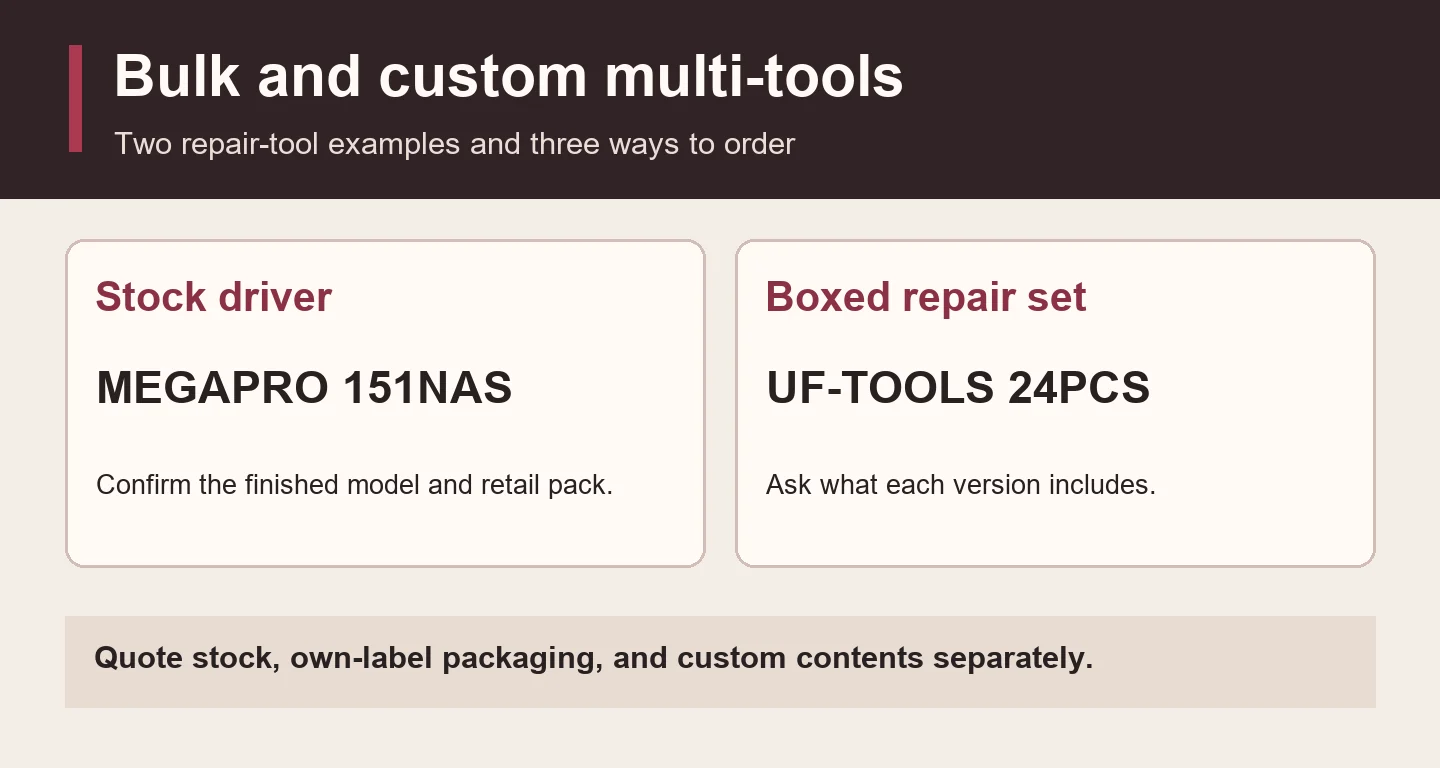
Compare a stock driver with a boxed repair set
The MEGAPRO 15-in-1 Original NAS, model 151NAS, stores seven double-ended bits in its handle. It’s a reference for a shop that wants one compact driver with the bits kept together. For your shelf tag, distinguish the number of physical bits from the number of drive tips. Ask the supplier to confirm the retail pack code and which replacement bits it can provide. That gives staff something specific to look up if a customer comes in missing a part.
The UF-TOOLS 24PCS ratchet screwdriver set uses a separate driver and 24 S2 bits, with bit types itemized on the product page. A boxed assortment gives a repair counter more variants to show in one item. Tie the product listing to a photo of the open kit and the complete bit list so customers can check what comes in the box. Ask whether a replacement bit or holder can be ordered separately, and whether a single missing item changes the return process for the whole kit.
Choose what needs to change before you ask for a price
Start with the stock SKU when the brand, package and contents already fit your shelf or website. Move to private label when you need your brand and barcode on an existing model. Ask for a custom configuration when the bit list or case has to change. MEGAPRO’s wholesale program lists separate routes for distributors, promotional imprinting and OEM. Its description for buyers also distinguishes packaging and co-branding, own-brand orders with optional color or bit selection, and development of a new tool.
| Order | When it fits | What belongs on the quote |
|---|---|---|
| Stock model | Regular shelf stock or a first range trial | Finished SKU, retail pack, units per carton, first-order minimum and refill minimum |
| Private label | The tool stays the same and the brand name, label or box changes | Print location, artwork revision, minimum per artwork or color, setup charge and sample charge |
| Custom kit | The bit assortment or case contents change for your channel | Itemized contents, case revision, minimum per configuration, costs for the change, and terms for reorders |
Get the minimum, quote and timing for the exact version
UF-TOOLS displays 100 pieces and a 15–30 day delivery window on its 24PCS product page, which also lists color, logo and packaging options. Its separate OEM program groups terms for standard designs, modified designs and new designs. When requesting a quote, ask which terms apply to the pack and color you need, whether variants can share the first-order minimum, and what triggers the dispatch clock. A supplier may start that clock on sample approval, deposit, or artwork approval. Ask them to name the trigger and put the estimated ship date on the offer.
Send the same quantities and delivery postcode for each version. Ask the supplier to itemize the packaged unit price, one-time artwork or setup fees, the sample charge and whether it’s credited, and the freight basis. Put the first order and repeat order on separate lines. If your buyer needs 300 units across two package versions, ask for a price and minimum on each version as well as on the total. A minimum applied to each print run can change which version is viable.
Approve one reference pack and use it again at receiving
Use a finished sample to check the driver model, the physical bit count and list, the case insert, the print position and barcode readability. Record the approved version and have it referenced on the order. A supplier sample in plain packaging can answer questions about what’s inside the box. Add an artwork proof or a finished retail pack before approving the packaging.
Before dispatch, request photos of the retail unit, opened kit, barcode and outer carton marks. Set the receiving check with your supplier in advance. Pull units from different cartons, scan the code, and compare pack count and kit contents with the approved record. Put any affected cartons aside and share the lot reference, mismatch count and photos with the supplier. Keep that same pack and parts record for reorders so substitutes need approval before shipment.
When you contact TOP KNIVES about a hardware order, send your target quantities, delivery postcode, finished-tool description and the label or case changes you need. Ask us to confirm which configurations are available and how the quote, samples and reorders would work. Request a wholesale quote.