
Short answer
Use Nella’s four UK centres as a case study in multi-site kitchen exchange cover, disruption reporting and branch-level invoices.
Key Takeaways
- Start with a mild method and increase pressure or abrasion only when the blade condition requires it.
- Edge angle, steel type, corrosion level, and handle material all affect the right care method.
- For wholesale assortments, simple care instructions help customers keep knives useful longer.
Terms Used Here
- Blade style
- The shape and edge design of the blade, which affects cutting tasks and buyer preference.
- Handle material
- The material used for grip, comfort, appearance, and durability.
- Assortment
- A grouped buying selection planned around customer needs, price points, and repeat orders.
In this article
In April 2026, Nella Cutlery Services used its four UK factories to explain how a caterer can get a recurring commercial kitchen knife exchange across several regions. Its account describes fixed rounds, drivers who know their kitchens and a regional supply of replacement stock. For a hotel group or contract caterer, the useful comparison is how each branch gets through a missed visit and how the account team records the result.
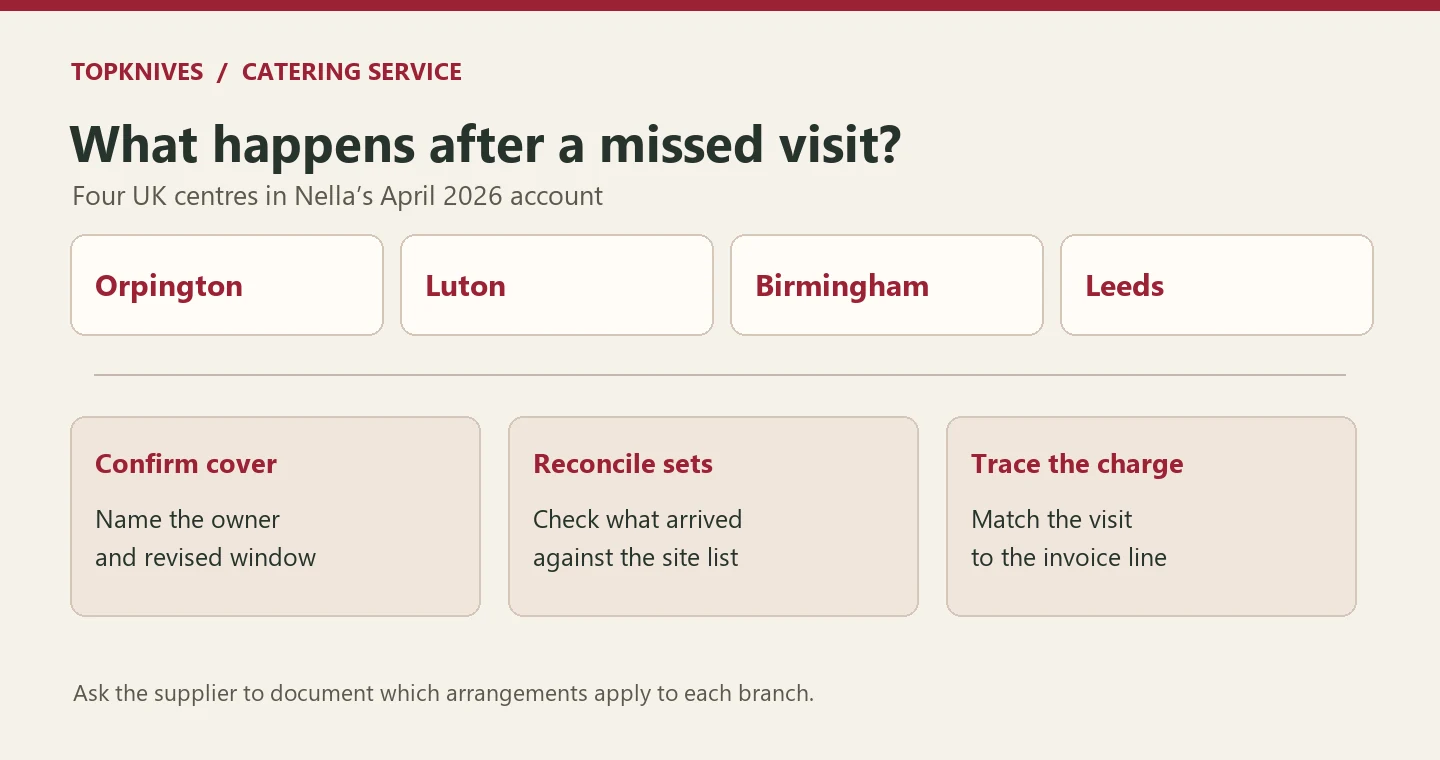
What Nella’s four UK centres show
The account identifies Orpington for London and the South East, Luton for the East of England, Birmingham for the Midlands and Leeds for Yorkshire and the North. The supplier reported around 15,000 visits a week across its network at the time. That figure describes the scale Nella reported. For a catering contract, ask which branch locations sit on distinct rounds, who owns each round and where an overlapped delivery would come from if a planned visit were interrupted.
Ask the supplier to name the first escalation contact and the person who decides how to cover an unavailable route. An alternative could be cover by a different driver, a delivery from another round, or an agreed set held locally for the affected branch. Write down which of those arrangements is included for each kitchen. If an option needs separate approval or an added fee, record the condition before treating it as part of the service.
Put a missed appointment on the agenda
Use two representative branches in the written proposal. A hotel that prepares a large breakfast service and a contract kitchen with a fixed dispatch time have different deadlines for the same replacement set. Give the supplier the last usable delivery window for each branch. Ask for a simple account of who calls when a vehicle is delayed, what happens if the receiving door is closed, and when the branch can expect a confirmed update.
| If this happens | Who should act | Proof to ask for |
|---|---|---|
| Driver cannot complete the planned round | The supplier’s route lead confirms who will cover the branch and gives a revised window. | Named coordinator, sent time and branch acknowledgement. |
| Replacement count is short | The receiving manager counts both sets and tells the account contact which station is affected. | Receipt line showing expected count, actual count and corrective action. |
| A visit is rescheduled across a billing period | Both account teams agree where the rescheduled visit and any credit appear. | Original visit reference, new delivery note and the corresponding invoice line. |
Review two ordinary cycles before rolling out
Agree the quantity and colour allocation for each kitchen with the catering or food safety lead. Let each branch record its start and finish counts, shortages, accepted substitutions, and which clean set stays available until the handover is complete. Ask for an example weekly report and a sample billing line before committing to the whole group. Management can use a consolidated invoice while retaining enough branch detail to find an extra visit, a short delivery or a disputed charge.
Check what happens to unused sets and any outstanding queries when a kitchen closes or moves. Put the location codes and designated contact beside the visit schedule, then record the approximate response window the supplier has agreed. A group should be able to open one monthly statement and connect each charged visit to the person who accepted it. Discuss that reporting and interruption plan with the supplier before extending the arrangement.
Contact Nella about multi-site exchange coverage
Sources. Nella’s April 2026 account of its four UK factories and Nella’s service area directory.
Plain Meaning
Knife care is best understood as a sequence: inspect, clean, dry, sharpen only if needed, then store safely. Skipping steps can make a simple issue harder to fix.
Rust removal, edge sharpening, handle care, and lubrication are different jobs. The right method depends on the steel, finish, edge condition, and how the knife is used.
Why It Matters
Many knife problems come from using too much force or the wrong tool. A mild method protects the blade and helps the reader understand what actually needs attention.
For product education, maintenance guidance also helps set realistic expectations around stainless steel, carbon steel, coatings, and storage habits.
What To Check Next
- Blade material and finish before using abrasives.
- Edge angle and blade shape before sharpening.
- Moisture, residue, and storage conditions after use.
- Whether the issue is cosmetic, functional, or safety-related.