

What Does OTF Mean on a Knife? A Clear Guide for Buyers and Resellers

Short answer
Learn what OTF means on a knife, how the mechanism works, and what wholesale buyers should check before ordering OTF automatic knives for resale or private labe
In this article
- 01 How an OTF knife works
- 02 What OTF means for quality, performance, and customer expectations
- 03 How OTF knives differ from other knife types
- 04 Wholesale buying criteria: what to check before placing an OTF order
- 05 OTF knife evaluation checklist
- 06 Mistakes to avoid when buying OTF knives for resale
- 07 What “OTF” should mean to a serious buyer
- 08 FAQ
- 09 What does OTF stand for on a knife?
- 10 Is an OTF knife the same as a switchblade?
- 11 Why do some OTF knives have blade play?
- 12 Are double-action OTF knives better for retail sales?
- 13 What should wholesale buyers inspect first on an OTF knife?
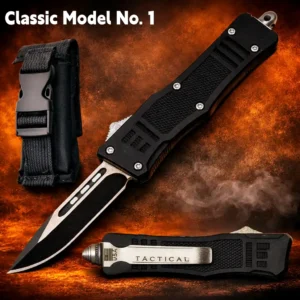
OTF on a knife means out the front. An OTF knife is an automatic knife whose blade deploys straight out of the front of the handle rather than swinging out from the side. In practical buying terms, “OTF” describes the knife’s opening mechanism, handle construction, internal drive system, and the user experience it delivers. For wholesale buyers and resellers, that difference matters because OTF knives have distinct quality points, compliance concerns, return risks, and customer expectations.
The term is simple, but the category is not. Two knives can both be labeled OTF and still differ greatly in firing force, track smoothness, lockup, switch feel, steel, body tolerances, and long-term reliability. If you buy for distribution, retail, or private label, it helps to understand exactly what OTF means beyond the acronym.
How an OTF knife works
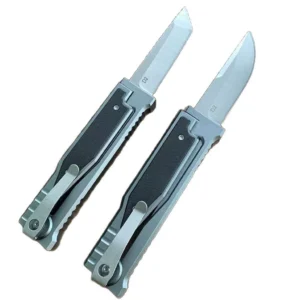
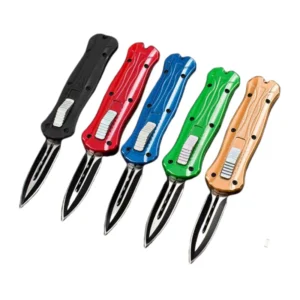
An OTF knife uses an internal spring-driven mechanism to move the blade forward through an opening at the front of the handle. Instead of rotating on a pivot like a side-opening automatic, the blade rides on internal rails or tracks. The user usually activates it with a thumb slide on the handle.
There are two main types:
- Single-action OTF: the blade fires out automatically, but must usually be manually retracted and reset.
- Double-action OTF: the same thumb slide both deploys and retracts the blade.
For most commercial buyers, double-action OTF models are the core of the market because they are faster to demonstrate, easier for customers to understand, and more convenient for everyday carry buyers.
A short, quotable way to explain it is this: An OTF knife does not swing open; it launches and retracts in a straight line through the front of the handle.
That straight-line action changes the entire product profile. The handle must house the mechanism, so internal tolerances matter more than on many manual knives. The thumb slide must have enough resistance to prevent accidental firing, but not so much that users think the knife is defective. The blade usually has a small amount of play by design, which surprises first-time buyers unless the seller explains it correctly.
What OTF means for quality, performance, and customer expectations
When a customer asks what OTF means, they are often really asking three things: how it opens, whether it is reliable, and whether it is worth the price. Wholesale buyers should answer all three.
1. OTF means a mechanism-driven product.
Customers are not only buying blade steel or handle material. They are buying firing action, lockup behavior, retraction feel, and repeatable deployment. A knife that looks good in photos but misfires in hand will create returns quickly.
2. OTF means different tolerance expectations.
Many OTF knives have some blade movement when open. That is common in the category and does not automatically mean poor quality. What matters more is whether the knife deploys consistently, locks reliably, retracts cleanly, and maintains function over repeated cycles.
3. OTF means the switch matters as much as the blade.
On a folding knife, buyers may focus on detent and pivot. On an OTF, the thumb slide is the user’s main contact point. If it is too sharp, too loose, too stiff, or inconsistent across a batch, customer satisfaction drops.
4. OTF means fit and finish must support the mechanism.
Handle screws backing out, rough internal tracks, weak springs, or poorly machined blade channels can all turn a promising sample into a warranty problem.
For buyers comparing options in the OTF automatic knife catalog, the best products are usually not the ones with the longest feature list. They are the ones with balanced mechanism tuning, consistent assembly, and predictable user operation.
How OTF knives differ from other knife types
Many wholesale mistakes happen because buyers compare OTF knives to the wrong category. OTF knives should not be judged exactly like side-opening automatics, assisted openers, or manual folders.
- Versus side-opening automatics: OTF knives deploy forward, not sideways. They usually feel more mechanical and more compact in action, but they rely heavily on internal track alignment and spring performance.
- Versus manual folders: OTF knives offer one-handed automatic deployment and retraction, but they have more mechanism complexity and therefore require closer quality control.
- Versus fixed blades: OTF knives are easier to carry discreetly, but they are not the same tool class for heavy-duty abuse.
Here is a practical comparison for buyers:
- If your customer values speed and novelty: OTF often wins.
- If your customer values maximum simplicity: a manual folder may create fewer service issues.
- If your customer values compact automatic carry: double-action OTF is a strong retail category.
- If your market is highly price-sensitive: avoid buying OTF solely on low unit cost, because mechanism complaints erase margin fast.
A useful rule is this: OTF knives sell on action first, then finish, then steel. Serious enthusiasts care about all three, but the opening and retraction experience is what defines the category.
Wholesale buying criteria: what to check before placing an OTF order
Knowing what OTF means should lead directly to better purchasing decisions. Before you commit to a production run, importer order, or private-label batch, use specific criteria.
OTF knife evaluation checklist
- Deployment consistency: Test repeated firing across multiple samples, not just one hand-picked piece.
- Retraction consistency: On double-action models, make sure retraction is smooth and not dramatically stiffer than deployment.
- Switch feel: Check for sharp edges, wobble, uneven resistance, and inconsistent texture.
- Blade channel finish: Rough internal surfaces can cause drag and premature wear.
- Lockup behavior: Expect some movement, but reject excessive looseness or unreliable engagement.
- Spring performance: Ask about cycle testing, replacement policy, and failure rates.
- Screw retention: Inspect body hardware after repeated use.
- Steel and heat treatment: Confirm actual blade material and consistency, especially on private-label orders.
- Handle material and machining: Aluminum, zinc alloy, and steel handles feel and wear differently; choose based on target price and market position.
- Safety and compliance: Verify what is legal for your sales regions before import or distribution.
- Packaging quality: Poor packaging damages premium perception and increases transit issues.
- Spare parts and after-sales support: Ask in advance how defects, spring failures, and swap-outs are handled.
One common buyer mistake is approving a sample based only on appearance and initial firing. A better approach is to test multiple samples with repeated cycles, inspect fit after use, and compare consistency from piece to piece. OTF knives are a category where batch uniformity matters as much as sample quality.
Mistakes to avoid when buying OTF knives for resale
- Do not assume zero blade play is realistic. Small movement can be normal in OTF construction.
- Do not buy the cheapest mechanism in a premium-looking shell. Cosmetic appeal will not offset return rates.
- Do not ignore switch ergonomics. Customers notice it immediately.
- Do not skip legal review. Automatic knife rules vary by market.
- Do not overpromise “heavy-duty” use. Match product claims to the actual mechanism class.
- Do not place large orders without multi-sample testing. OTF consistency is a production issue, not just a design issue.
If you are sourcing for distribution or private label and want to review options or discuss specifications, an OTF wholesale inquiry is the right starting point before committing to volume.
What “OTF” should mean to a serious buyer
For a serious buyer, OTF should mean more than “automatic knife.” It should signal a product that needs careful mechanism review, honest retail positioning, and supplier transparency. The best OTF programs are built around repeatable action, clear warranty handling, and realistic product descriptions.
In other words, OTF is not just a style label. It is a mechanical promise. When that promise is met, OTF knives are among the most engaging automatic products to sell. When it is not, they become one of the fastest ways to create customer complaints.
That is why the smartest buyers judge OTF knives by three commercial questions:
- Does it fire and retract consistently?
- Will the end customer understand its normal behavior, including acceptable blade movement?
- Can the supplier support defects, replacements, and batch consistency?
If the answer to all three is yes, then “OTF” means a viable product category with strong retail appeal. If not, the acronym is just packaging language.
FAQ
What does OTF stand for on a knife?
OTF stands for out the front. It means the blade deploys straight out of the front of the handle.
Is an OTF knife the same as a switchblade?
An OTF knife is a type of automatic knife, but not every automatic knife is an OTF. Side-opening automatics open from the side on a pivot, while OTF knives move the blade forward through the front of the handle.
Why do some OTF knives have blade play?
Some blade movement is common because of the mechanism design and the need for the blade to travel on internal tracks. Small play does not automatically mean poor quality; inconsistent lockup and unreliable firing are bigger concerns.
Are double-action OTF knives better for retail sales?
In many markets, yes. Double-action OTF knives are easier for customers to use because the same switch deploys and retracts the blade. They are often the most practical format for resale.
What should wholesale buyers inspect first on an OTF knife?
Start with deployment consistency, retraction consistency, switch feel, lockup behavior, and batch uniformity across multiple samples. Those factors usually affect returns more than cosmetic details alone.