


Why Dealers Sell OTF Knives

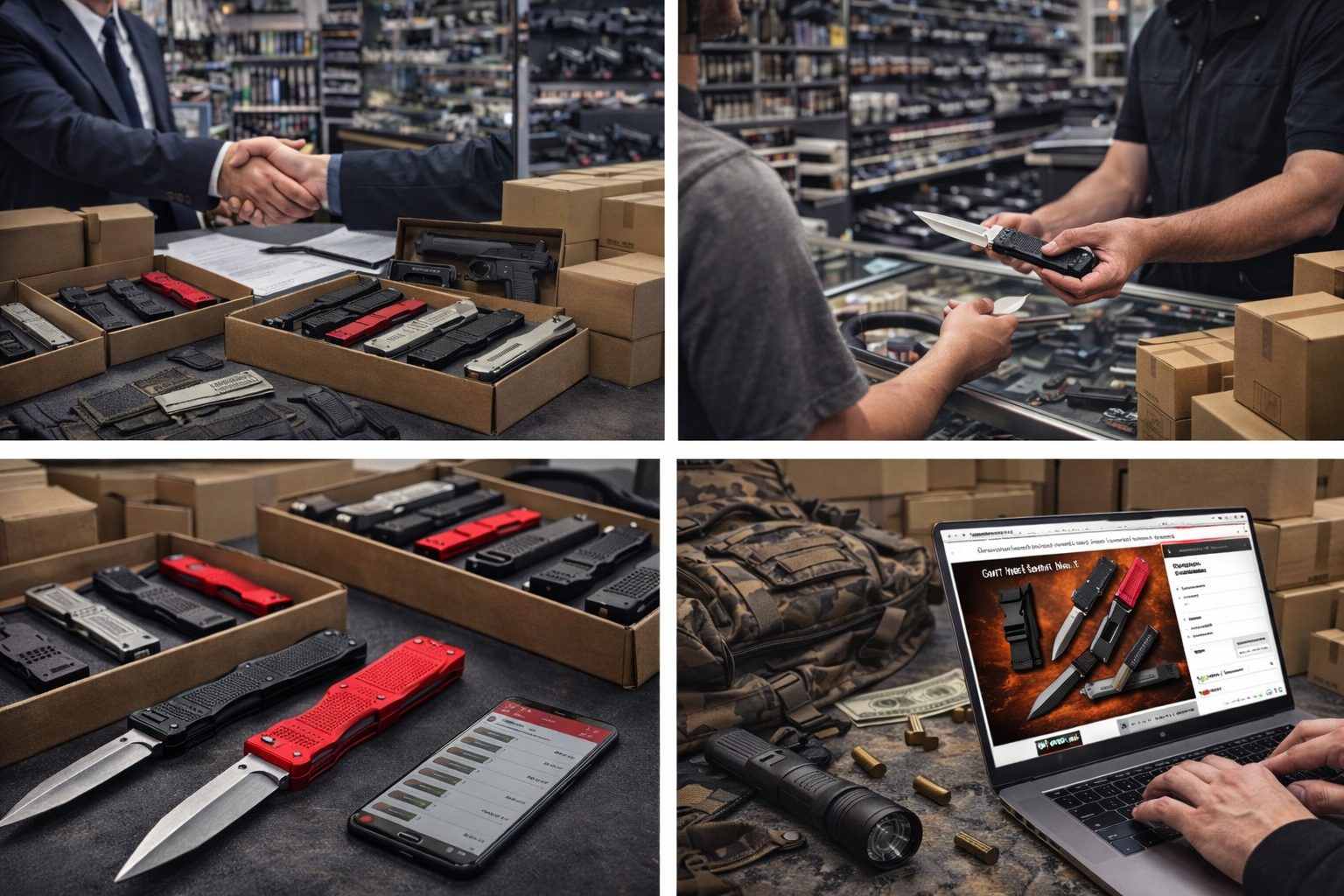
Dealers sell OTF knives because the category can fill a specific retail and wholesale role: it offers clear mechanical differentiation, consistent buyer interest in automatic opening, and a pricing structure that can support margin if QC, compliance, and repeat-order stability are controlled. Whether selling OTF knives makes sense depends on the use case, and the main deciding factors are local legal restrictions, failure-rate tolerance, and landed-cost math across MOQ, packaging, and returns.
Best when: your market allows automatic knives, your customers understand the mechanism, and your supplier can hold spring, switch, and lockup consistency across repeat orders.
Worse when: your region has unclear auto-knife rules, your business cannot absorb higher return risk than a manual folder, or your supplier treats OTF production as a one-off batch instead of a controlled program.
Why OTF knives earn shelf space for dealers
Dealers do not sell OTF knives just because they are visually distinctive. They sell them because OTF knives answer a narrow but real demand: one-handed deployment in a compact closed profile, with a mechanism that customers can immediately understand and compare. In wholesale terms, that matters because easy-to-explain differences are easier to merchandise than subtle steel or grind differences that require staff education.
For many retailers, OTF knives also create separation inside a crowded knife case. A liner lock flipper and a button lock folder can compete for the same buyer. An OTF knife usually does not. It occupies a different purchase decision: the buyer is choosing the mechanism as much as the blade.
That distinction affects dealer economics in a practical way:
- Higher perceived complexity: buyers often accept a wider price band if actuation feels consistent and the chassis looks precise.
- Accessory and packaging upside: OTF products are often sold with display boxes, nylon sheaths, branded sleeves, or private-label packaging that can raise average order value.
- Repeatability by platform: once a dealer finds a frame size and mechanism that works, new blade shapes and finishes can be added without retraining the customer base.
The category is not automatically more profitable. It becomes viable when the supplier can keep defect rates low enough that margin is not consumed by exchanges, shipping, and staff time.
What dealers are actually buying: a mechanism business, not just a knife business
The most common mistake new dealers make is treating OTF knives like standard folding knives with an automatic premium. That is inaccurate. In practice, dealers are buying a mechanism business: springs, carriers, tracks, switch geometry, internal tolerances, and assembly consistency matter as much as blade steel or handle finish.
What users commonly misjudge is that the sale is won by the opening action, but the account is kept by return rates. An OTF knife can look acceptable in photos and still fail commercially if the switch force varies from unit to unit, the blade misfires under light contamination, or the lockup becomes noticeably inconsistent after repetitive use.
That is why experienced dealers ask different questions on OTF than on ordinary folders:
- What is the misfire rate out of carton?
- How many cycles were tested before packing?
- Are springs batch-tracked?
- Is the switch force range measured or just judged by feel?
- Can screws, clips, glass breakers, and internal parts remain unchanged across repeat orders?
- Will the same finish and logo position be available six months later?
For wholesale buyers comparing options, a quick scan of a wholesale OTF knife catalog is useful only after those mechanism questions are answered. The external style matters, but OTF retail performance is usually decided by consistency rather than novelty.
Decision factors that make OTF knives work or fail at dealer level
The answer depends on the dealer’s channel. A gun-store counter, an outdoor retailer, an online reseller, and a private-label program all face different constraints. The same OTF model can work in one channel and fail in another based on these factors:
- Legal sell-through risk: automatic knife rules vary by state, city, and country. Dealers sell OTF knives where the legal framework is clear enough to avoid shipment blocks, chargebacks, or customer confusion.
- MOQ fit: a low MOQ can help test a design, but very low-volume runs often reduce packaging consistency and part standardization. For private label, a practical MOQ should match realistic sell-through within one reorder cycle.
- Lead time: if lead time is long and spring or hardware specs drift between batches, dealers cannot maintain a stable SKU. OTF buyers notice small changes in action more than small cosmetic changes.
- Sample policy: a paid pre-production sample is normal. The critical issue is whether the bulk order matches the sample in action, finish, and packaging.
- QC discipline: OTF knives need outgoing inspection that checks deployment, retraction, lockup feel, blade centering in channel, screw torque, and cosmetic finish.
- Landed cost: freight class, packaging size, warranty reserves, and replacement parts all affect true margin. Unit cost alone can be misleading.
In other words, dealers sell OTF knives when the category can be controlled operationally. They avoid it when every sale creates a service burden.
Three real selling scenarios dealers plan for
Daily carry scenario: A customer wants compact one-handed opening for ordinary daily tasks such as opening packages, cutting cord, or quick utility work. Dealers can sell OTF knives successfully here when the model has manageable switch force, pocket-friendly dimensions, and reliable deployment with normal lint exposure. If the action is too stiff or pocket clip tension is inconsistent, returns rise because the user interacts with the mechanism many times a day.
Dirty-use scenario: A ranch, shop, or field user may expose the knife to dust, grit, or metal particles. Dealers should be careful here. OTF knives can perform acceptably in light contamination, but they are more sensitive to debris in the track than many simple manual folders. Selling into this use case works only when expectations are set correctly and QC confirms the mechanism tolerates reasonable fouling without frequent misfires.
Repetitive utility cutting scenario: Warehouse staff, installers, or maintenance users may deploy and retract the knife dozens of times in one shift. This is where repeat-cycle stability matters more than first-impression snap. A dealer selling to this customer should prioritize spring consistency, switch durability, and easy warranty handling over decorative finishes or aggressive blade shapes.
These scenarios show why dealers carry different OTF lines at different price points. The mechanism may be the same category, but the user’s duty cycle changes what counts as acceptable performance.
A compact comparison: why some dealers choose OTF and others do not
| Dealer condition | OTF usually makes sense when | OTF is a weak fit when |
| Retail environment | Staff can explain legal limits and demonstrate safe operation | Staff turnover is high and product education is minimal |
| Customer base | Buyers actively ask for automatic deployment and mechanism variety | Most buyers only compare blade steel and lowest price |
| Supplier program | MOQ, packaging, and replacement parts are defined in writing | Specs change by batch or sample-to-bulk matching is inconsistent |
| Returns tolerance | Dealer has a clear test-and-exchange process | Every return creates high administrative cost |
| Private label potential | Branding, box art, and hardware finish can stay stable across reorders | Supplier cannot guarantee repeat-order consistency |
Common sourcing mistakes dealers make with OTF knives
The biggest mistakes are not dramatic. They are small purchasing shortcuts that later become expensive.
- Buying on sample feel alone: one excellent sample does not prove batch consistency. Ask for evidence of QC on production units.
- Ignoring packaging economics: oversized gift boxes can raise freight cost and damage rates. The cheapest knife can end up with the worst landed margin.
- Underestimating warranty reserve: OTF mechanisms may require a larger reserve than simple manual folders, especially on first orders.
- Skipping repeat-order verification: a dealer may approve a finish, clip, or logo placement once, then discover the second run changed hardware or tolerances.
- Using the wrong MOQ strategy: too large an MOQ locks cash into an unproven SKU; too small a MOQ can produce unstable unit economics and mixed-spec inventory.
- Failing to define inspection points: “working action” is too vague. Inspection should specify deployment, retraction, lockup feel, blade play tolerance, finish defects, and packaging completeness.
Dealer checklist before adding an OTF line
- Confirm the destination markets where automatic knives can be sold and shipped.
- Approve a sample, then require bulk-order matching on action, finish, logo, and packaging.
- Set a realistic MOQ based on one reorder cycle, not optimistic annual volume.
- Ask for lead time by component stage, not just a single delivery promise.
- Define QC checkpoints for deployment, retraction, switch force, screws, clip fit, and cosmetic inspection.
- Calculate landed cost including freight, packaging, expected returns, and spare-part support.
- Check whether the supplier can hold the same spec on the next order.
- For private label or distribution programs, document sample policy, replacement terms, and carton labeling before deposit.
If a buyer needs to formalize those points with a factory or importer, an OTF bulk inquiry form is useful as a starting structure because it forces the commercial details into writing.
FAQ
Do dealers sell OTF knives mainly for higher margins?
No. Margin is one reason, but the category only works when return rates, compliance risk, and QC are under control. A high markup on paper can disappear if the mechanism is inconsistent.
Are OTF knives harder to source than ordinary folding knives?
Usually yes, because the mechanism adds more points of failure and more variation between batches. The sourcing challenge is not only materials; it is assembly consistency.
What matters more in wholesale OTF buying: steel or mechanism?
For most dealers, the mechanism matters first. If deployment and retraction are inconsistent, blade steel will not prevent returns. Steel becomes a stronger selling point after action reliability is proven.
Can OTF knives work for private-label programs?
Yes, but only when the supplier can keep hardware, switch feel, finish, packaging, and branding stable across repeat orders. Private label fails when the second batch does not match the first.
Why do some dealers avoid OTF knives even when customers ask for them?
The usual reasons are legal uncertainty, warranty burden, or weak supplier control. Demand alone is not enough if the dealer cannot predict sell-through and after-sale cost.