
Short answer
Yes, an OTF knife can cut cardboard well if the blade geometry, lockup, and edge retention are right. Learn what works, what fails, and what buyers should inspe
In this article
- 01 What makes an OTF good or bad for cardboard?
- 02 Quick comparison: which OTF blade styles work best?
- 03 How to tell by hand if an OTF is suitable
- 04 Observable pass/fail test
- 05 Mistakes buyers often make
- 06 What this means in practice
- 07 When an OTF is a good cardboard tool, and when it is not
- 08 Buying criteria that matter to wholesalers and private-label buyers
- 09 Practical buyer checklist
- 10 FAQ
- 11 Will cardboard damage an OTF knife?
- 12 Is blade play on an OTF always a problem for cardboard?
- 13 Are serrations better for cardboard?
- 14 Should retailers market OTF knives as warehouse cutters?
Yes, you can use an OTF knife for cardboard, but only if it has the right blade shape, solid lockup, and an edge steel that does not go dull too fast. The common misconception is that any OTF is automatically a poor cardboard cutter because of the out-the-front mechanism; in reality, the mechanism matters less than blade geometry and stability under repeated slicing.
Cardboard is harder on edges than many people expect. It contains glue, recycled fibers, dust, and sometimes embedded grit. That means an OTF that feels sharp on paper may still perform poorly after a few boxes if the edge is too thick, the grind is too wedge-like, or the blade develops noticeable play. For daily breakdown work, the question is not just “will it cut?” but “will it keep cutting cleanly without becoming annoying or unsafe?”
What makes an OTF good or bad for cardboard?
For cardboard, the best OTF knives are slicers first and novelty second. A practical cardboard-cutting OTF usually has a plain edge, a narrow blade profile, and a grind that enters material easily instead of forcing it apart.
In plain English:
- Blade geometry means the shape and thickness behind the edge. Thinner usually cuts cardboard better.
- Lockup means how firmly the blade stays extended during use. Some movement is normal on many OTFs; too much movement is a warning sign.
- Edge retention means how long the blade stays useful before it feels draggy or starts tearing fibers.
- Deployment reliability matters because cardboard dust can get into the mechanism over time.
What is normal, borderline, and a warning sign?
- Normal: light blade play that does not affect straight cuts, a little extra drag after several boxes, and occasional cleaning if used in dusty packing areas.
- Borderline: noticeable side-to-side wiggle you can feel while slicing corrugate, or an edge that loses clean cutting ability after a short session.
- Warning sign: the blade retracts or feels unstable under modest forward pressure, deployment starts failing after light dust exposure, or the edge chips on ordinary shipping boxes.
If you are browsing an OTF knife catalog, cardboard suitability is usually strongest in models with practical drop-point or spear-point profiles and plain edges, not fantasy shapes or heavily serrated blades meant to look aggressive.
Quick comparison: which OTF blade styles work best?
- Plain edge drop point: Usually the safest all-around choice for box breakdown, tape cuts, and controlled slicing.
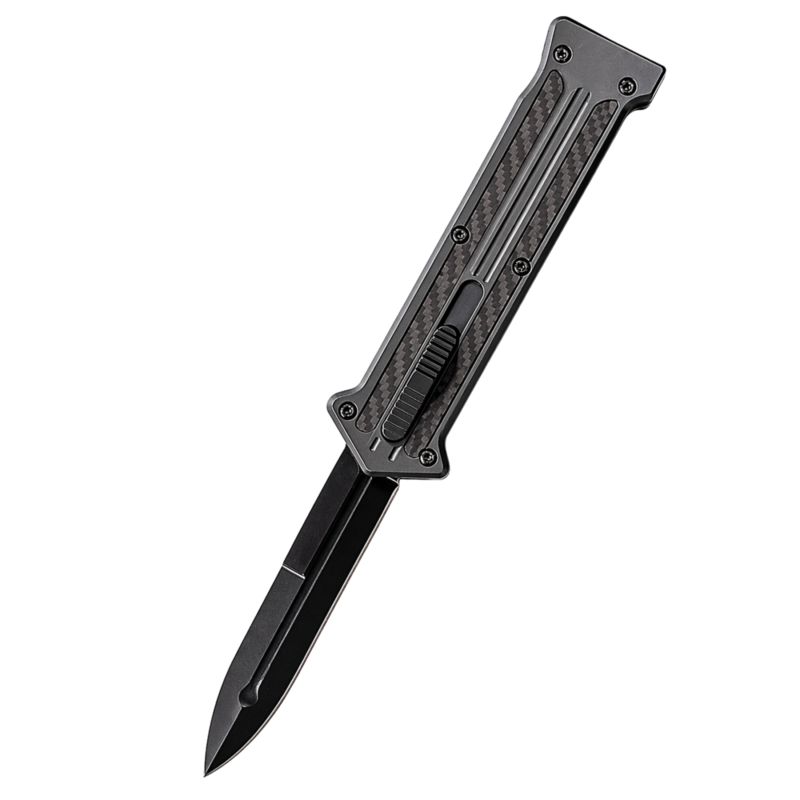
- Plain edge spear point: Good if the grind is thin enough; often popular in OTFs and effective for general warehouse tasks.
- Tanto: Can work, but many tantos feel less smooth in long slicing cuts through corrugate unless the primary edge is ground thin.
- Double-edge dagger style: Often less practical for cardboard because edge geometry and legal handling concerns may not suit utility work.
- Partially serrated blades: Better for dirty rope and strap than for clean, repeatable cardboard slicing.
Short answer: if the job is mostly cardboard, choose a plain edge with a utility-oriented profile over a tactical-looking shape.
How to tell by hand if an OTF is suitable
You do not need a lab test to screen an OTF for cardboard use. A simple pass/fail inspection can reveal a lot before you buy or stock it.
Observable pass/fail test
- Extend the blade fully and hold the handle firmly.
- Place the edge lightly against a piece of folded cardboard.
- Apply modest forward slicing pressure, not stabbing pressure.
- Pay attention to three things: edge entry, blade chatter, and cut finish.
- Pass: the edge bites quickly, the blade tracks without rattling, and the cardboard separates with a mostly clean line.
- Borderline: the edge starts the cut but drags hard, leaves fuzzy tears, or the blade feels slightly unsettled.
- Fail: you feel obvious wobble, the edge skates before biting, or the cut tears badly unless you force it.
This test matters because cardboard exposes weak geometry fast. A knife that only cuts well when pushed hard is usually not the right OTF for repeated warehouse or retail use.
Mistakes buyers often make
- Choosing blade style by appearance instead of cutting behavior.
- Assuming harder steel always means better cardboard performance. Hardness helps only if the edge geometry is useful and the heat treatment is sound.
- Ignoring handle traction. Slippery aluminum plus dusty hands can turn a routine box breakdown into clumsy work.
- Testing with one tape slice and calling it good. Cardboard performance shows up after repeated corrugate cuts, not one clean package opening.
What this means in practice
Imagine a small retail shipper processing 40 to 60 outbound orders a day. Staff are cutting down incoming master cartons, trimming filler, and opening tape repeatedly. In that environment, an OTF can work well if it deploys consistently, slices rather than wedges, and can be cleaned without drama. A flashy blade that looks impressive in a display case may frustrate users by dragging through corrugate and collecting dust in the mechanism.
For that kind of use, the better OTF is usually the one employees forget about because it just works: plain edge, comfortable handle, reliable action, and a blade shape that does not fight the material.
When an OTF is a good cardboard tool, and when it is not
An OTF is a good cardboard tool when the user values one-handed deployment, compact carry, and fast access for light to moderate box work. It is especially appealing in retail, receiving, and everyday carry settings where the knife is used often but not abused like a pry bar.
An OTF is not the best choice when the job is nonstop carton breakdown all day, every day, or when the environment is extremely dusty and maintenance is unlikely. In those cases, some users may prefer a manual utility knife or a simpler folder because blade replacement or deep cleaning may be easier.
That does not mean OTFs are unsuitable. It means expectations should match the use case. For occasional to moderate cardboard cutting, a quality OTF can be efficient and satisfying. For high-volume warehouse abuse, the standard is higher: stable lockup, easy maintenance, and proven edge life matter more than novelty or speed.
Buying criteria that matter to wholesalers and private-label buyers
Once the basic question is answered, the wholesale reality is straightforward: returns and complaints usually come from poor consistency, not from the OTF format itself. If your customers will use these knives on cardboard, inspect samples with utility work in mind.
Practical buyer checklist
- Check deployment consistency: cycle each sample multiple times. Misfires are a warning sign, especially before dust exposure.
- Check lockup feel: a little play can be normal, but excessive movement under light cutting pressure is not.
- Check edge behavior on corrugate: test more than tape. Cardboard reveals weak sharpening quickly.
- Check handle grip: smooth scales may look premium but can feel insecure in packing-room conditions.
- Check cleaning access: if cardboard lint builds up, can the knife be reasonably maintained?
- Check grind consistency across units: one good sample is not enough for distribution.
- Check tip usability: the tip should start cuts cleanly without feeling fragile.
For resellers and private-label programs, it is also smart to separate “display appeal” from “work appeal.” A model that sells well in photos is not always the one that earns repeat orders from customers who actually break down boxes. If you are sourcing in volume, use the wholesale inquiry form only after you know which samples pass a basic cardboard test and which ones are better suited to collector-oriented demand.
A quotable rule for this category is simple: Cardboard does not care how fast the blade deploys; it cares how thinly and steadily the edge moves through the cut.
FAQ
Will cardboard damage an OTF knife?
Normal cardboard use should not damage a quality OTF, but it will dull the edge faster than many users expect and can introduce dust into the mechanism. Regular cleaning and realistic use are important.
Is blade play on an OTF always a problem for cardboard?
No. Slight play can be normal on many OTF knives. It becomes a problem when you can feel instability during slicing or when cut control drops noticeably.
Are serrations better for cardboard?
Usually no for general box breakdown. Serrations can grab and tear rather than give a smooth, controlled slice. A plain edge is usually better for clean corrugate cuts.
Should retailers market OTF knives as warehouse cutters?
Only if the tested model truly supports that claim. It is safer and more accurate to position most OTFs as capable utility knives for light to moderate cardboard work unless you have verified stronger performance in repeated-use conditions.