

Can I Use an OTF Knife for Rope Cutting?

Short answer
Yes—an OTF knife can cut rope well for occasional utility use, especially with the right edge. Learn which blade setups work best on nylon, wet braided, and dir
Key Takeaways
- Knife rules can vary by state, city, blade style, opening mechanism, carry method, and intended use.
- Do not treat a product nickname as a legal category; check the actual features and local rule.
- Retailers should keep legal or safety language factual and avoid promising that one item is allowed everywhere.
Terms Used Here
- OTF
- Out-the-front; a knife design where the blade moves forward from the front of the handle.
- Fixed blade
- A knife with a blade that does not fold or retract into the handle.
In this article
- 01 Quick answer
- 02 What decides rope-cutting performance
- 03 Rope type vs. blade setup
- 04 Which OTF blade styles make the most sense
- 05 Single-edge plain edge
- 06 Single-edge partial serrations
- 07 Double-edge dagger
- 08 Thick tanto-style edge
- 09 Normal, borderline, and warning signs
- 10 A simple hand test you can do
- 11 What this means in practice
- 12 Real example: pallet freight vs. weathered field rope
- 13 Buyer note: when businesses should choose an OTF, and when they should not
- 14 Common selection mistakes
- 15 Choosing a dagger blade because it looks more aggressive
- 16 Assuming serrations are always superior
- 17 Ignoring handle traction
- 18 Judging only by deployment
- 19 FAQ
- 20 Is a serrated OTF better than a plain-edge OTF for rope?
- 21 Does slight blade play mean an OTF is bad for rope?
- 22 Can a double-edge OTF still cut rope?
- 23 What is the best one-line buying rule?
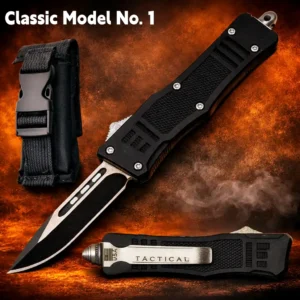
Yes—an OTF knife can cut rope effectively, especially for occasional utility cuts, but the result depends far more on edge geometry, sharpness, and blade stability than on the OTF mechanism itself.
Short version: an OTF is a practical rope cutter for light to moderate tasks and one-handed access, but it is usually not the best choice for repetitive, abrasive, or dirty rope work.
A common misconception is that fast deployment means better cutting. It does not. An OTF may be faster to access, but rope cutting is still a slicing job. The knife has to bite cleanly, track predictably, and keep enough edge to finish the task without excessive sawing.
Quick answer
Good fit: cutting nylon cord, utility rope, packaging ties, and similar materials where convenience and one-handed opening matter.
Poor fit: repeated cutting of thick dock line, dirty ranch rope, gritty construction rope, or any rope-heavy job where edge wear and long-term control matter more than deployment speed.
Best overall setup: a single-edge OTF, ideally with a plain edge for clean utility work or partial serrations for slick and fibrous rope.
Bottom line: best for occasional utility cuts, not best for repetitive abrasive rope work.
What decides rope-cutting performance
Rope exposes weaknesses quickly. A knife can feel impressive in hand and still perform poorly if the edge is too thick, too dull, or too unstable under pressure.
Four factors matter most:
- Edge sharpness: A sharp edge starts cutting early instead of skating across synthetic fibers.
- Blade geometry: Thin, slicey edges usually outperform thick, wedge-like grinds on rope.
- Edge style: Plain edges cut cleanly and are easier to maintain; partial serrations usually grab slick or fibrous rope faster.
- Open-blade stability: Some blade play is normal on OTF knives, but the blade should still feel predictable in a controlled draw cut.
This is why two OTF knives can behave very differently on the same rope. The mechanism alone does not tell you much about cutting ability.
Rope type vs. blade setup
| Rope or material | Best OTF setup | Works poorly | What to expect |
| Clean nylon cord or tie-down line | Single-edge plain edge | Thick double-edge dagger | Plain edge gives a clean start and easy control if sharp |
| Wet braided rope or slick synthetic line | Single-edge partial serrations | Dull plain edge | Serrations usually bite faster when the surface is slippery |
| Dirty, sandy, or abrasive jobsite rope | Single-edge partial serrations, preferably with easy field maintenance | Fine polished plain edge used all day | Anything sharp will cut at first, but abrasive rope dulls edges quickly and exposes weak geometry |
If your rope use changes from clean indoor utility work to outdoor abrasive work, the same OTF may move from “very workable” to merely “acceptable.” That is the tradeoff many buyers miss.
Which OTF blade styles make the most sense
Single-edge plain edge
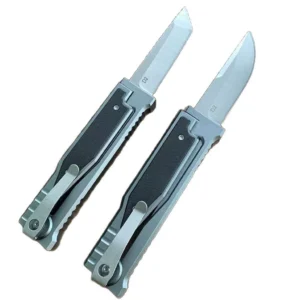
This is usually the best all-around choice for clean cord, packaging, nylon rope, and general utility. It is easier to guide against a surface, easier to sharpen, and less awkward than a double-edge blade in work settings.
Single-edge partial serrations
This is often the strongest rope-focused setup within the OTF category. Partial serrations help on wet, fibrous, or slick rope, while the plain section still handles cleaner utility cuts. For mixed field use, this is often the most practical compromise.
Double-edge dagger
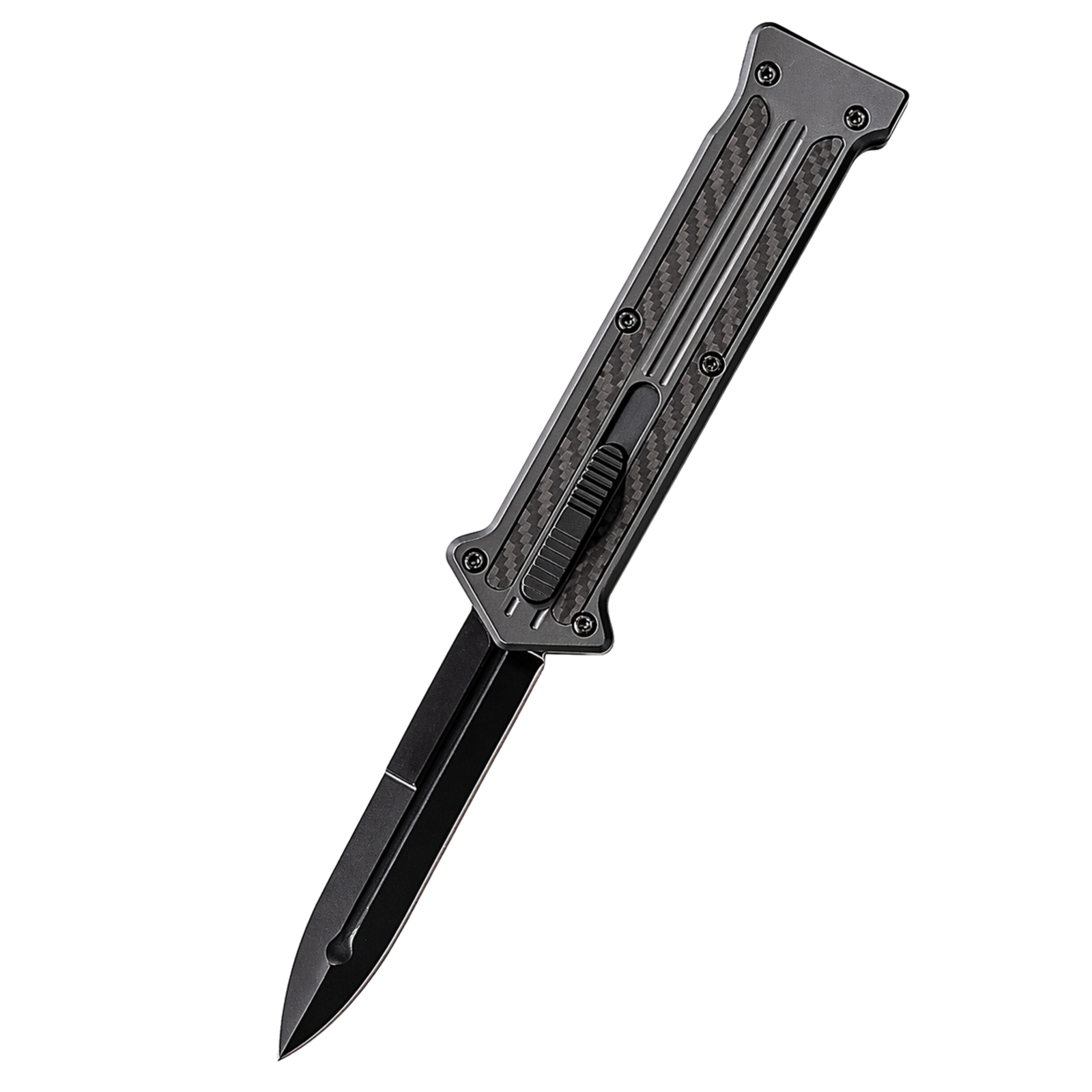
It can cut rope, but it is usually not the best rope-first design. You get less practical edge orientation, less forgiving control near surfaces, and fewer advantages for routine utility work.
Thick tanto-style edge
Some tantos work fine, but thick edge geometry can wedge instead of slice. If the primary task is rope, cutting efficiency matters more than an aggressive tip profile.
Normal, borderline, and warning signs
OTF buyers often overfocus on whether there is any blade movement at all. That is the wrong question. The right question is whether movement changes the cut.
- Normal: slight blade play when open, but the edge still bites early and tracks straight through rope.
- Borderline: noticeable wiggle plus occasional slipping before the edge starts cutting, especially on synthetic rope.
- Warning sign: the blade chatters, shifts enough to alter your cut line, feels unstable under moderate pressure, or does not stay confidently extended.
A practical threshold: if you instinctively reduce pressure because the knife feels unsettled, that is already a performance problem for rope work.
A simple hand test you can do
You do not need lab equipment to judge whether an OTF is suitable for rope. A controlled pass/fail test reveals a lot.
- Extend the blade fully and confirm lockup feels consistent.
- Use a normal utility grip, not a defensive grip.
- Put a piece of common rope or cord under light tension.
- Make one steady draw cut with moderate pressure.
Pass: the edge bites within the first part of the pull, the blade tracks without noticeable chatter, and the knife stays composed in hand.
Borderline: the blade eventually cuts, but only after sliding, sawing, or needing extra force.
Fail: the edge skates repeatedly, the blade chatters side to side, or the handle and blade feel unstable enough that you back off pressure.
Rope is useful for this test because it quickly exposes thick geometry, weak sharpening, and poor real-world control.
What this means in practice
If you carry an OTF for everyday utility, it can be a very workable tool for occasional rope and cord cutting. If rope cutting is a core job function rather than an occasional task, choose the knife like a cutting tool first and a deployment mechanism second.
Real example: pallet freight vs. weathered field rope
Consider two users. One cuts nylon tie-down cord around palletized freight a few times per shift and values one-handed access while the other hand manages wrap or packaging. For that user, a single-edge plain-edge OTF can make good sense.
Now consider a field crew repeatedly cutting weathered rope outdoors where dust, grit, and moisture are present. The same OTF may still work, but edge retention drops faster, control matters more, and maintenance intervals get shorter. In that setting, a fixed blade often becomes the more efficient tool even if the OTF remains convenient.
Buyer note: when businesses should choose an OTF, and when they should not
For wholesale or fleet purchasing, the question is not only “Can it cut rope?” but also “What is the maintenance burden across many users?”
Choose a single-edge OTF with partial serrations when:
- Users need one-handed deployment in utility tasks
- Rope cutting is intermittent, not constant
- The environment includes wet or slick synthetic line
- You want one platform to handle cord, packaging, and occasional rope
Choose a fixed blade instead when:
- Teams cut abrasive rope repeatedly every day
- Sharpening frequency and edge life are major cost factors
- The work involves thicker, dirtier, or more fibrous material
- Maximum cutting efficiency matters more than compact carry
In other words, an OTF can be a strong utility option for mixed-use crews, but a fixed blade is usually the better procurement choice for rope-dominant field work.
For buyers comparing practical edge formats rather than just handle styles, the OTF knife catalog is most useful when filtering for single-edge profiles and partial-serrated working blades instead of dagger-style designs. If you are sourcing for a team or retail program, the wholesale inquiry form is the direct way to discuss use-case fit and order requirements.
Common selection mistakes
Choosing a dagger blade because it looks more aggressive
For rope, visual appeal is secondary. A practical working edge usually beats a symmetrical double-edge profile.
Assuming serrations are always superior
Partial serrations often help, especially on wet or fibrous rope, but they are not magic. Poor serrations can tear unevenly and are harder to maintain than a plain edge.
Ignoring handle traction
Rope cutting often happens with gloves, wet hands, or awkward body position. If the handle is slick, the blade quality alone will not save the user experience.
Judging only by deployment
A fast, satisfying opening action says little about slicing efficiency. Rope performance shows up in the cut, not in the launch.
FAQ
Is a serrated OTF better than a plain-edge OTF for rope?
Often yes for wet, slick, or fibrous rope. Plain edges are usually better for clean utility cuts and easier sharpening. Partial serrations are often the most practical mixed-use option.
Does slight blade play mean an OTF is bad for rope?
No. Slight play is common. It becomes a real issue only when it causes slipping, chatter, or reduced confidence during a controlled cut.
Can a double-edge OTF still cut rope?
Yes, but it is usually less practical than a single-edge design for routine rope and utility work.
What is the best one-line buying rule?
If rope cutting is occasional, a single-edge OTF works well; if rope cutting is repetitive and abrasive, buy a fixed blade.