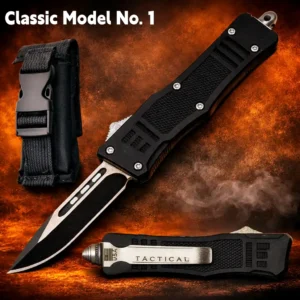


What Replacement Blades Fit an OTF Utility Knife?


Short answer
OTF utility knives do not use one universal blade standard. Most fit either standard trapezoid utility blades on standard-compatible models or proprietary OEM b
Key Takeaways
- Start with a mild method and increase pressure or abrasion only when the blade condition requires it.
- Edge angle, steel type, corrosion level, and handle material all affect the right care method.
- For wholesale assortments, simple care instructions help customers keep knives useful longer.
Terms Used Here
- OTF
- Out-the-front; a knife design where the blade moves forward from the front of the handle.
- Automatic knife
- A knife that opens by a spring-driven mechanism after the user activates a button, switch, or slider.
In this article
- 01 Standard-compatible vs proprietary OTF utility knives
- 02 1. Standard-compatible OTF utility knives
- 03 2. Proprietary-carriage OTF utility knives
- 04 Blade families that may or may not fit
- 05 How to tell what your OTF utility knife uses
- 06 What manufacturer wording should you look for?
- 07 When standard trapezoid blades are the right replacement
- 08 When hook blades fit, and when they do not
- 09 Failure points and disqualifiers
- 10 Common mistakes to avoid
- 11 Quick fit checklist before you order
- 12 FAQ
- 13 Do all OTF utility knives take standard trapezoid blades?
- 14 Can I use any standard utility blade in a standard-compatible OTF knife?
- 15 Can I switch from a straight blade to a hook blade?
- 16 What if the product page does not say what blades it uses?
- 17 What is the fastest sign that a replacement blade does not fit?
It depends: an OTF utility knife usually fits either standard trapezoid utility blades or proprietary OEM replacement blades, depending on how that specific knife was designed. Hook blades fit only on models that already use the same standard slot pattern and have enough front-end clearance for the hook to extend and retract cleanly.
Quick decision box
- Buy standard trapezoid blades if the product page, manual, or package says “accepts standard utility blades” or “uses standard trapezoid blades.”
- Buy hook blades only if the maker also says hook blades are supported, or the knife clearly uses the same slot pattern and has enough nose clearance.
- Buy OEM blades only if the maker says “replacement blade for model X only” or the knife uses a proprietary carriage.
Best when: the knife is clearly marketed as standard-blade compatible and the original blade is a normal contractor-style trapezoid utility blade.
Not best when: the knife shipped with a short custom blade, an unusual notch pattern, or a model-specific replacement part number.
The evidence basis is straightforward: the safest answer comes from the maker’s wording, the original blade’s slot and notch layout, blade thickness, and the amount of clearance at the front of the knife. If you are comparing options in an OTF knife collection, blade compatibility is one of the first details worth checking because OTF utility knives do not all share one universal blade standard.
Standard-compatible vs proprietary OTF utility knives
The simplest way to answer this question is to sort OTF utility knives into two groups:
1. Standard-compatible OTF utility knives
These are built around the common contractor-style trapezoid utility blade. On these models, the maker will usually say something explicit such as:
- “Accepts standard utility blades”
- “Uses standard trapezoid blades”
- “Fits standard replacement utility blades”
If you see wording like that, standard trapezoid blades are the correct first replacement to buy.
2. Proprietary-carriage OTF utility knives
These use a blade carrier or retention system that is specific to that model. The maker may sell replacement packs with wording like:
- “Replacement blade for model X only”
- “Use OEM replacement blades only”
- “Designed for this knife only”
In that case, the correct answer is simple: use the OEM blade. Even if a standard blade looks close, it may not seat fully, lock correctly, or expose the right amount of edge.
Blade families that may or may not fit
| Blade family | Will it fit? | What confirms fit | What usually disqualifies it |
|---|---|---|---|
| Standard trapezoid utility blade | Yes, on standard-compatible OTF utility knives | Maker states standard compatibility; original blade matches common trapezoid format | Wrong slot pattern, wrong notch layout, wrong thickness, proprietary carrier |
| Hook utility blade | Sometimes | Same mounting pattern as the straight blade and enough nose clearance | Hook catches the front opening during extension or retraction |
| Proprietary OEM blade | Yes, when specified for that model | Exact model number match from the maker | Using a look-alike blade with different retention geometry |
| Snap-off segmented blade | No | Only fits knives designed for segmented blades | Different blade family and retention system |
| Single-edge razor blade | Usually no | Only fits flat-razor utility knives built for that format | Wrong shape and unstable seating in trapezoid-style carriers |
| No. 11 hobby or craft blade | No | Would require a hobby knife collet or clamp | Different tang and no safe retention in an OTF utility carrier |
How to tell what your OTF utility knife uses
If the listing or manual is unclear, inspect the original blade and carrier before ordering replacements. These are the fit signals that matter most:
- Blade family. Is the installed blade a standard trapezoid utility blade, a hook blade, a flat razor, or a short custom blade?
- Center slot and notch layout. This is often the deciding factor. The carrier tabs or studs must match the blade’s cutouts exactly.
- Blade length and shoulder position. Two trapezoid blades can look similar but still place the edge too far forward or too far back.
- Blade thickness. A blade that is slightly thicker can add drag in the track or prevent full seating.
- Nose clearance. This matters most with hook blades, where the blade shape may hit the front opening during travel.
A useful rule: if the replacement matches only the outline of the cutting edge but not the slot and notch geometry of the original, treat it as incompatible.
What manufacturer wording should you look for?
Buyers often get the clearest answer from exact wording on the package, product page, or instruction sheet. Here is how to read it:
- Good sign for standard blades: “accepts standard utility blades”
- Good sign for standard blades: “uses standard trapezoid blades”
- Possible hook compatibility: “compatible with standard and hook utility blades”
- OEM-only signal: “replacement blade for model X only”
- OEM-only signal: “use factory replacement blades”
- Too vague to trust by itself: “fits utility blades”
That last phrase is not specific enough. In OTF utility knives, “utility blades” can mean standard trapezoid blades, flat razor blades, or a proprietary utility-style blade sold only for one model.
When standard trapezoid blades are the right replacement
Standard trapezoid blades are the right choice when three things line up:
- The maker explicitly says the knife accepts standard utility blades
- The original blade is a common contractor-style trapezoid blade
- The carrier clearly captures the standard center slot and shoulders
This is the most convenient setup because replacements are easy to source and easy to verify against the original blade. It is also the least risky option for routine work such as cardboard breakdown, shrink-wrap cuts, and general warehouse use.
When hook blades fit, and when they do not
Hook blades are not automatically compatible just because a straight trapezoid blade fits. They must share the same mounting geometry and clear the front of the knife during travel.
That second point is where problems happen. An OTF utility knife may hold a hook blade on the carrier but still fail during use because the hook contacts the nose on extension or drags on retraction. That is why the safest basis for buying hook blades is direct maker approval.
Practical scenario: a user on a roofing or warehouse team wants to switch to hook blades for cutting wrap or membrane while wearing gloves. On the bench, the blade seems to install correctly. In real use, dust and debris build up in the track, the hook starts rubbing the nose, and the knife no longer retracts smoothly. That is not a true fit, even if the blade can be mounted.
Failure points and disqualifiers
Some replacement blades are close enough to install but still wrong for dependable use. Watch for these disqualifiers:
- Blade does not seat flat: the slot or notches do not fully engage the carrier
- Weak lock-up: the blade feels loose or rocks under light pressure
- Wrong edge exposure: too much or too little blade extends because the shoulders sit in the wrong position
- Track drag: the blade is too thick or has rough shoulders that slow extension and retraction
- Hook interference: the hook strikes the front opening during travel
Any one of those is enough reason to stop using that blade in the knife.
Common mistakes to avoid
- Assuming all OTF utility knives use the same blade. They do not.
- Buying by edge shape alone. The retention slot and notch pattern matter more than the cutting outline.
- Assuming hook blades fit wherever straight blades fit. Hook clearance must be checked separately.
- Forcing a blade into the carrier. A forced fit is usually an unsafe fit.
- Trusting vague wording. “Fits utility blades” is not enough; look for “standard trapezoid” or a model-specific replacement statement.
Quick fit checklist before you order
- Read the exact maker wording.
- Match the original blade family.
- Compare slot and notch geometry.
- Check blade thickness.
- Verify nose clearance, especially for hook blades.
If you cannot confirm those points, the safest replacement is the OEM blade for that exact model.
FAQ
Do all OTF utility knives take standard trapezoid blades?
No. Some do, but others use proprietary OEM blades on model-specific carriers.
Can I use any standard utility blade in a standard-compatible OTF knife?
Not always. Even within the standard trapezoid family, slot layout, shoulder position, and thickness still need to match the carrier well enough for secure seating and smooth travel.
Can I switch from a straight blade to a hook blade?
Only if the hook blade uses the same mounting pattern and the knife has enough front clearance. The safest confirmation is explicit maker wording.
What if the product page does not say what blades it uses?
Inspect the original blade and carrier, then compare the slot pattern, notches, thickness, and overall blade family. If that still leaves doubt, buy the OEM replacement blade.
What is the fastest sign that a replacement blade does not fit?
If it will not seat flat, locks weakly, changes edge exposure, or drags during extension or retraction, it is not the correct blade for that OTF utility knife.