

Are OTF Knives Good for Emergency Use?

Short answer
Yes, OTF knives can be useful for some emergency cutting tasks, especially quick one-handed cuts in tight spaces, but they are not the best tool for every rescu
In this article
- 01 Best emergency tasks for an OTF
- 02 When a rescue hook is safer
- 03 Quick decision table
- 04 What makes an OTF more suitable for emergency carry
- 05 How to tell if an OTF is a good emergency-use buy
- 06 A likely misconception
- 07 Common failure points to watch
- 08 Should you carry an OTF for emergencies?
- 09 Short note for retailers and wholesalers
- 10 FAQ
- 11 Are double-edge OTF knives good for emergency kits?
- 12 Can an OTF knife cut a seatbelt?
- 13 Are OTF knives reliable enough for emergency carry?
- 14 What is the best blade style for emergency use?
- 15 So, are OTF knives good for emergency use?
Yes—OTF knives can be good for emergency use, but only for certain kinds of emergencies. They are often most useful as compact, one-handed cutting tools for controlled tasks such as cutting a belt, clothing, cord, or plastic in a tight space; they are not the best choice for prying, dirty rescue work, or close-to-skin cutting where a rescue hook is safer.
The main takeaway is simple: if your idea of emergency use means fast access and short, precise cuts, an OTF can be a practical option. If you mean full rescue work, vehicle extrication, medical-adjacent cutting, or heavy abuse, a dedicated cutter or fixed blade is often the better tool.
OTF means “out the front,” with the blade sliding straight out of the handle instead of opening from the side. That straight-line deployment can be convenient when one hand is busy, space is limited, or you want to keep the handle aligned with the cut. In plain English: an OTF can be a very handy emergency cutter, but it should not be mistaken for a complete rescue tool.
Best emergency tasks for an OTF
An OTF tends to make the most sense when the job is quick cutting rather than forceful tool work. Depending on the model, edge shape, and maintenance, it can be useful for:
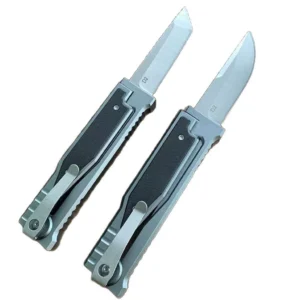
- Seatbelt or webbing cuts: A slim single-edge blade can be easier to position in a narrow gap than some broader folders, though this depends on blade shape and user skill.
- Cutting clothing or light gear: Helpful when you need a short, controlled cut and do not want to change grip to open a manual knife.
- Cord, rope, zip ties, and plastic: Good for urgent utility cuts where speed matters but the task is still basically slicing, not chopping or twisting.
- Vehicle or work-kit carry: Easy to stage in a pocket, door pouch, or pouch organizer where consistent access matters.
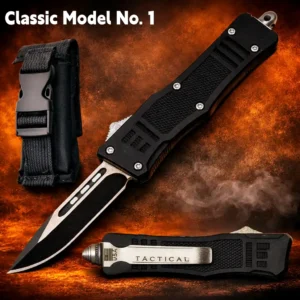
A concrete example: a user carrying a Benchmade Infidel-style OTF or similar single-edge private-label model in a front pocket may be able to draw it, push the thumb slider forward, and make a short pull cut across jammed webbing without opening the knife sideways into nearby trim or clothing. That does not prove every OTF is ideal for seatbelt cutting, but it shows where the format can be helpful: compact access, one hand, straight-line presentation, and a short controlled cut.
When a rescue hook is safer
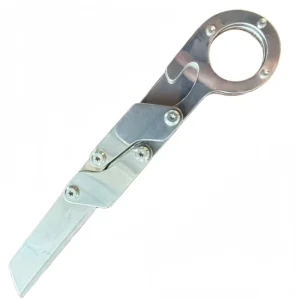
Real rescue work often favors dedicated cutters or fixed blades, especially when reliability and user safety matter more than compact carry. If the blade may pass close to skin, a rescue hook or blunt-tip safety cutter is usually the safer option.
An OTF is usually not the first-choice tool for:
- Cutting material directly off a person: A pointed blade adds puncture risk.
- Heavy-duty rescue tasks: Twisting, prying, or forcing a blade through dirty material is better suited to a fixed blade or purpose-built rescue tool.
- Muddy, sandy, or lint-heavy environments: OTF mechanisms can be more sensitive to debris than simpler knives.
- Glove-heavy use: Some thumb sliders are hard to operate with thick gloves, especially on low-cost models.
- Vehicle escape kits: If your main concern is breaking glass and cutting restraints, a dedicated vehicle rescue tool may be more complete.
If your emergency plan centers on family vehicle safety, roadside preparedness, or workplace first response, a rescue hook is often the smarter primary tool and an OTF is better treated as a secondary cutter.
Quick decision table
| Good for | Not ideal for | Better alternative |
|---|---|---|
| One-handed emergency cutting in tight spaces | Prying, twisting, or hard leverage | Fixed blade |
| Cutting cord, plastic, light webbing, clothing | Close-to-body cutting near skin | Rescue hook or safety cutter |
| Compact pocket or kit carry | Dirty, muddy, sandy environments | Simple manual folder or fixed blade |
| Users who want straight-line deployment | Full vehicle rescue or extrication tasks | Dedicated rescue tool |
| Controlled utility cuts under stress | Users wearing thick gloves on a regular basis | Larger manual folder or fixed blade with easier grip |
What makes an OTF more suitable for emergency carry
Not all OTF knives are equally useful in emergencies. The best emergency-oriented models usually look less dramatic and more practical.
- Single-edge blade: Usually easier to control and safer around clothing and skin than a double-edge dagger.
- Useful blade shape: Drop point or spear point profiles are often more practical than aggressive novelty grinds.
- Plain edge or light serration: Plain edges are easier to maintain; partial serrations can help with fibrous materials like webbing.
- Secure handle texture: Jimping, grooves, or textured aluminum can improve grip under stress.
- Deliberate slider tension: The switch should not feel dangerously loose, but it also should not require excessive thumb force.
- Consistent action: Deployment and retraction should feel crisp and repeatable, not mushy or hesitant.
One useful buying signal is the action itself. A healthy OTF usually has a clean, consistent snap in both directions. If the blade occasionally fails to lock out, retracts weakly, or the slider feels gritty after only a few cycles, that is a warning sign.
How to tell if an OTF is a good emergency-use buy
If you are deciding whether to carry one, this short checklist is more useful than looking only at blade steel or appearance:
- Choose a single-edge model first. It is usually the safer and more versatile emergency option.
- Deploy and retract it at least 20 times. Look for the same feel every time, without weak lockup or hesitation.
- Check blade movement. Some play can be normal in OTFs, but excessive wobble is a bad sign.
- Test the slider with your normal grip. If you struggle with it barehanded, gloves will likely make it worse.
- Inspect the handle texture and clip. Emergency carry only works if you can find and draw the knife consistently.
- Think about maintenance honestly. If you never clean pocket lint or debris out of your gear, a simpler knife may serve you better.
A likely misconception
Misconception: If a knife deploys fast, it must be a great emergency knife.
What actually matters: speed helps, but safe cutting geometry, grip security, and dependable function matter more. A fast-deploying OTF with a slippery handle or a dagger blade is not automatically better than a plain rescue cutter. In many emergencies, predictability beats speed.
Common failure points to watch
The most common concern with an OTF in emergency use is not usually sharpness. It is mechanism confidence.
Watch for these issues:
- Failure to fully deploy: Often linked to weak springs, poor tolerances, or debris in the track.
- Gritty slider feel: Can indicate contamination, rough machining, or poor lubrication.
- Overly slick handles: Fine for display, less ideal for wet or rushed handling.
- Double-edge blades sold as “rescue” knives: Often more about style than practical emergency use.
If your use case involves real-world stress, a plain, serviceable OTF with a practical blade is usually a better choice than a flashy one with a dramatic profile.
Should you carry an OTF for emergencies?
For many people, the honest answer is yes, as a secondary or limited-purpose emergency cutter. It can be a smart carry choice if you want one-handed access, compact size, and the ability to make quick controlled cuts. It is a weaker choice if you expect dirt, impact, prying, close-to-skin cutting, or all-around rescue duty.
If you are comparing options, browsing an OTF knife collection makes the most sense when you focus on single-edge utility models rather than purely tactical-looking designs.
Short note for retailers and wholesalers
For B2B sellers, the consumer question still applies: customers asking about “emergency use” usually mean vehicle carry, everyday preparedness, or quick utility cutting—not professional rescue. The safer merchandising approach is to position OTFs as compact emergency-capable cutters, not universal rescue tools.
The strongest emergency-oriented SKUs are usually single-edge models with secure traction, practical clips, and consistent action. If you sell to preparedness, workwear, or vehicle-kit buyers, product descriptions should clearly state that an OTF can be useful for controlled cutting but may not replace a dedicated rescue cutter.
FAQ
Are double-edge OTF knives good for emergency kits?
Usually not as a first choice. Single-edge blades are generally easier to control and safer around clothing and skin.
Can an OTF knife cut a seatbelt?
It can, depending on the blade shape, sharpness, and how much room you have to work. A rescue hook is often safer and more purpose-built for that task.
Are OTF knives reliable enough for emergency carry?
They can be, but reliability depends heavily on build quality, maintenance, and how much debris the mechanism collects over time.
What is the best blade style for emergency use?
A single-edge drop point or spear point is usually the most practical place to start.
So, are OTF knives good for emergency use?
Yes—within limits. They can be very useful for fast, controlled emergency cutting, but dedicated rescue cutters and fixed blades are often better for higher-risk or heavier-duty situations.