
Short answer
Most OTF knives are not truly waterproof. Learn how water affects the blade channel, spring area, button, and hardware, plus what buyers should inspect before o
Key Takeaways
- Knife rules can vary by state, city, blade style, opening mechanism, carry method, and intended use.
- Do not treat a product nickname as a legal category; check the actual features and local rule.
- Retailers should keep legal or safety language factual and avoid promising that one item is allowed everywhere.
Terms Used Here
- OTF
- Out-the-front; a knife design where the blade moves forward from the front of the handle.
- Folding knife
- A knife with a blade that pivots into the handle for storage.
- Fixed blade
- A knife with a blade that does not fold or retract into the handle.
In this article
- 01 Why OTF knives are vulnerable to water
- 02 Are any OTF knives waterproof?
- 03 What users notice first after water exposure
- 04 How wholesale buyers should evaluate water resistance
- 05 What not to do after an OTF gets wet
- 06 Buying guidance: when water resistance is good enough
- 07 FAQ
- 08 Can an OTF knife be used in the rain?
- 09 Will stainless steel make an OTF waterproof?
- 10 What part usually fails first after water exposure?
- 11 Is saltwater worse than fresh water for OTF knives?
- 12 Should a seller describe an OTF knife as waterproof?
No, most OTF knives are not truly waterproof. Many OTF knives can tolerate rain, splashes, or short-term exposure to water, but their out-the-front mechanism has a blade channel, spring area, button, and hardware that can trap moisture and lead to rust, sluggish action, or misfires.
That short answer matters because OTF knives are different from fixed blades and simple folding knives. An OTF depends on a moving internal drive system. Water does not just touch the blade; it can enter the handle through the button track, blade opening, and screw points, then stay inside where buyers cannot see it during a quick inspection. For wholesale buyers, that means “water resistant enough for normal carry” and “waterproof” are not the same claim.
Why OTF knives are vulnerable to water
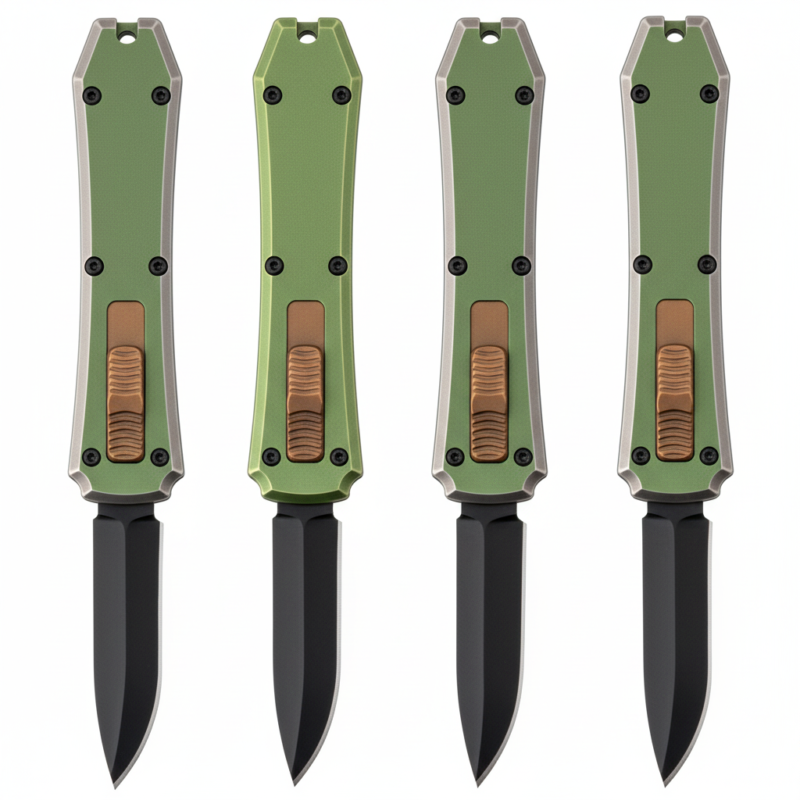
An OTF knife has more internal exposure points than many other knife types. The blade must travel through the front opening, and the thumb button must slide through a side cutout. Those openings are necessary for deployment, but they also give water, pocket lint, salt, and fine grit a path into the mechanism.
The exact parts most affected are:
- Blade channel: Moisture can sit inside the track where the blade rides. If debris mixes with water here, the blade may drag or fail to lock cleanly.
- Spring area: Springs and internal carriers can corrode if the steel grade or coating is not matched to wet use. Corrosion here affects deployment force.
- Button: Water and residue around the button track can make the control feel gritty, sticky, or slow to reset.
- Hardware: Body screws, clip screws, and internal fasteners are common early rust points, especially if they are standard carbon steel rather than stainless hardware.
This is why an OTF can look fine on the outside while developing internal problems. A satin blade in a dry environment may be fine for months, while the same knife near saltwater can show screw rust and rough action quickly.
Are any OTF knives waterproof?
Some OTF knives are better described as water resistant, not waterproof. A maker can improve wet performance with stainless blade steel, corrosion-resistant internal parts, coated hardware, tighter tolerances, and drain-friendly handle construction. But unless the knife is specifically engineered and tested for submersion with sealed internals, “waterproof” is usually too strong a word.
For buying decisions, separate products into three practical tiers:
- Basic splash resistance: Fine for pocket carry in rain or occasional wet handling, but not for repeated soaking.
- Improved wet-environment tolerance: Better steel, better finish, and cleaner internal fit. Suitable for humid climates, marine-adjacent retail, and users who will wipe and maintain the knife.
- Purpose-built water exposure models: Less common in OTF. These need specific material and construction claims, not just marketing language.
If you are reviewing an OTF knife catalog, look for concrete details rather than broad words like “rugged” or “tactical.” Steel, finish, hardware material, and maintenance access matter more than vague durability claims.
What users notice first after water exposure
The first signs are usually mechanical, not dramatic. Users often notice one visible or tactile symptom before they ever see heavy rust.
- Slower deployment: The blade fires, but with less snap than before.
- Button drag: The button feels heavier, scratchy, or does not return smoothly.
- Blade hesitation: The blade stops short, then needs a reset.
- Rust at hardware: Orange or dark spotting appears first on screws, clip hardware, or at the blade base.
- Residue at the opening: A wet knife that dried dirty may show gray paste or grit near the front opening.
Two warning signs deserve special attention in returns screening: repeat misfires and button stickiness after drying. Those often point to moisture plus debris inside the blade channel or spring area, not just surface staining.
How wholesale buyers should evaluate water resistance
For distributors, resellers, and private-label buyers, the question is not only “Can this knife get wet?” It is “What failure rate should we expect in our market, and how clearly can we set customer expectations?” A coastal shop, fishing retailer, or humid-climate distributor should evaluate an OTF differently than a general gift retailer in a dry region.
Use this compact checklist when comparing OTF models for wet-environment risk:
- Blade steel: Is it a stainless steel with a known corrosion-resistant profile, or a steel that needs more careful drying?
- Blade finish: Stonewashed, coated, or satin? Finishes can affect how quickly staining shows and how easy the blade is to wipe clean.
- Hardware material: Are screws and clips stainless or coated, or are they likely early rust points?
- Handle construction: Does the design appear to trap water, or is there a practical path for moisture to escape during cleaning?
- Button fit and feel: Is the slider already stiff out of the box? A marginal button can get worse after contamination.
- Serviceability: Can the knife be cleaned and maintained realistically by the end user or service team?
- Environment match: Will this SKU be sold into marine, high-humidity, workwear, or casual indoor carry channels?
That list is more useful than a simple “waterproof or not” label. In wholesale reality, return rates often come from mismatch: a standard OTF gets sold into a wet-use market without clear care instructions or realistic claims.
What not to do after an OTF gets wet
Maintenance advice matters because many OTF problems start with the wrong cleanup method. Water exposure itself is one issue; bad follow-up is another.
Do not do these things:
- Do not leave the knife closed and wet overnight. Moisture can sit in the blade channel and spring area longer than users expect.
- Do not flood the inside with heavy oil or grease. Thick lubricants attract lint and grit, which can make the button and blade track worse.
- Do not assume a stainless blade means the whole knife is safe. Hardware and internal parts may corrode before the blade does.
- Do not use saltwater and then only wipe the exterior. Salt residue inside the handle is a common hidden problem.
- Do not force repeated firing if the action feels rough. That can spread grit through the track and increase wear on the mechanism.
Better practice is simple: dry the exterior, remove visible moisture, cycle only if the action feels normal, and clean the mechanism according to the maker’s instructions. For wholesale accounts, it is smart to include short care guidance with wet-climate shipments or private-label packaging. If you are sourcing at volume and need to align claims, warranty language, or market fit, a direct wholesale inquiry is the right place to clarify those details before ordering.
Buying guidance: when water resistance is good enough
Not every buyer needs a near-marine-ready OTF. For many retail channels, a knife that handles rain, sweat, and brief splash exposure is enough, as long as the product description does not overpromise. Water resistance is usually good enough when the knife is intended for ordinary pocket carry, dry storage, and users who understand basic wipe-down maintenance.
Buy more cautiously when any of these apply:
- Sales channel includes boating, dock work, fishing, or coastal tourism.
- End users are likely to carry the knife in wet workwear or high-humidity conditions.
- The model uses hardware that has shown early cosmetic rust in sample review.
- The action is already sensitive to fine debris or slight button drag.
A quote-worthy way to frame it is this: an OTF can survive water better than it can ignore water. Exposure is often manageable; trapped moisture inside a moving mechanism is the real issue.
FAQ
Can an OTF knife be used in the rain?
Yes. Most OTF knives can handle rain or brief splashes, but they should be dried afterward because water can enter the blade channel and button track.
Will stainless steel make an OTF waterproof?
No. Stainless blade steel helps with corrosion resistance, but it does not protect the spring area, button, or hardware by itself.
What part usually fails first after water exposure?
Users often notice the button getting gritty or the blade deploying more slowly before they see major rust. Screws and clip hardware are also common early rust points.
Is saltwater worse than fresh water for OTF knives?
Yes. Saltwater is much more aggressive because residue can stay inside the handle and accelerate corrosion on internal parts and hardware.
Should a seller describe an OTF knife as waterproof?
Usually no, unless the model has a specific tested design that supports that claim. For most OTF knives, “water resistant” or “can handle brief exposure if cleaned and dried” is the more accurate description.