

How to Tell if an OTF Knife Is Well Made

Short answer
You can tell an OTF knife is well made by checking five things: reliable firing, controlled blade play, smooth switch action, even grind and tip symmetry, and c
Key Takeaways
- Start with a mild method and increase pressure or abrasion only when the blade condition requires it.
- Edge angle, steel type, corrosion level, and handle material all affect the right care method.
- For wholesale assortments, simple care instructions help customers keep knives useful longer.
Terms Used Here
- OTF
- Out-the-front; a knife design where the blade moves forward from the front of the handle.
- Automatic knife
- A knife that opens by a spring-driven mechanism after the user activates a button, switch, or slider.
In this article
- 01 The 5 signs of a well-made OTF knife
- 02 Quick in-hand checklist
- 03 What good and bad quality actually feel like
- 04 What is normal on an OTF, and what is not
- 05 How to inspect each quality signal more specifically
- 06 1. Reliable firing
- 07 2. Controlled blade play
- 08 3. Smooth switch action
- 09 4. Grind and tip symmetry
- 10 5. Clean internal fit
- 11 Mistakes people make when judging OTF quality
- 12 For buyers ordering in volume
- 13 FAQ
- 14 How much blade play is acceptable on an OTF knife?
- 15 Is a stiff slider a sign of a better OTF?
- 16 What is the best single test for OTF quality?
- 17 Can a nice-looking OTF still be poorly made?
You can tell an OTF knife is well made by checking five things: reliable firing, controlled blade play, smooth switch action, even grind and tip symmetry, and clean internal fit. A good default is to handle the knife in person and cycle it at least 20 times, then judge what changes and what stays consistent.
The details that can change your decision are the knife’s size, blade shape, price level, and whether you are inspecting one knife for personal use or several from the same run. This article solves a simple user problem: an OTF can look excellent in photos but still feel rough, unreliable, or poorly aligned once it is in your hand.
The 5 signs of a well-made OTF knife
- Reliable firing and retraction
Each cycle should feel similar. The blade should open and close with a clear, positive snap, not one strong cycle followed by one weak cycle. - Controlled blade play
Some movement is normal on OTF knives. What matters is whether the play feels limited and repeatable, not loose, noisy, or different every time. - Smooth switch action
The slider should feel firm and deliberate, with resistance that stays even through the stroke. It should not feel sandy, scratchy, or catch halfway. - Even grind and straight tip
Look at the bevels, edge line, and tip symmetry. A well-made OTF usually shows clean grinding and a point that lines up with the blade centerline. - Clean internal fit
The blade should travel without scraping the frame. Rub marks, metallic scraping sounds, or visible side contact are warning signs.
Quick in-hand checklist
If you are holding an OTF knife at a counter, show, or private sale, this is the fastest useful inspection:
- Fire and retract it 20 times. Listen and feel for consistency. A quality knife should not become weaker, rougher, or less secure after repeated cycles.
- Pay attention to the slider. Firm resistance is normal. Grit, sudden sticking, or a rough patch in mid-stroke is not.
- Check lockup every few cycles. Open the blade, lightly test for movement, close it, and repeat. The lockup should feel basically the same each time.
- Look for blade rub. Inspect the blade flats and the opening area for fresh wear lines or uneven marks that suggest the blade is contacting the inside of the handle.
- Inspect the grind and tip. Hold the knife straight and compare both bevels. On dagger or tanto styles especially, uneven symmetry is easy to spot.
- Test reset after an interrupted cycle. If the blade is intentionally interrupted and comes off track, a good OTF should reset cleanly with normal operation, not jam or demand excessive force.
What good and bad quality actually feel like
| What you check | Normal or good | Red flag |
|---|---|---|
| Firing | Same snap and travel almost every cycle | Random weak launches, hesitation, or partial lockup |
| Switch feel | Firm, even resistance | Gritty drag, scraping, or a catch halfway through |
| Blade play | Small, repeatable movement | Rattle, wobble, or lockup that changes cycle to cycle |
| Blade travel | No visible rubbing, no scraping sound | Wear marks, side contact, or metallic scraping |
| Grind and tip | Even bevels, straight point, centered look | Crooked tip, uneven bevels, drifting centerline |
Those differences matter because OTF knives depend on internal tracks, spring force, and lock geometry more than a manual folder does. Small errors in fit or finish show up quickly as misfires, rough action, or changing lockup.
What is normal on an OTF, and what is not
A common misconception is that any blade play means the knife is cheaply made. That is not true. On an OTF, some blade movement is normal because the blade rides on rails and locks through an internal mechanism rather than a simple pivot stop.
What is usually normal:
- A little front-to-back or side-to-side movement when the blade is open
- A firmer slider than you would expect on a manual knife
- A strong mechanical sound when the blade fires or retracts
- Minor cosmetic variation in finishes such as stonewash or coating
What should make you cautious:
- Random misfires during ordinary thumb pressure
- Lockup that feels tighter one cycle and looser the next
- Scraping sounds or visible blade rub
- A tip that looks off-center or crooked when viewed head-on
- Body screws, clip hardware, or rear hardware that feel loose
In short, an OTF does not have to feel motionless to be well made. It does have to feel controlled.
How to inspect each quality signal more specifically
1. Reliable firing
A good OTF should fire with enough energy to lock open and retract with the same confidence. If one cycle feels crisp and the next feels lazy, that often points to friction inside the track, uneven spring behavior, or poor tuning. The knife should not sound dramatically different from cycle to cycle either. A healthy action sounds consistent, not random.
2. Controlled blade play
Open the blade and gently move it side to side and front to back. You are not looking for zero movement. You are looking for movement that feels limited and predictable. If the blade chatters, rattles, or feels much looser after a few cycles, quality is questionable.
3. Smooth switch action
The slider on a double-action OTF usually needs deliberate thumb pressure because you are loading and releasing the mechanism. That resistance should feel smooth. If it feels like sand in the track, scrapes sharply near the end, or pinches your thumb because the edges are too harsh, the knife may work on paper but still be poorly finished in real use.
4. Grind and tip symmetry
Look straight down the blade. On single-edge models, check whether the bevel is even from heel to tip. On dagger and tanto blades, symmetry matters even more because uneven grinding is easy to see. A crooked point or visibly uneven bevels often means the knife was rushed through finishing.
5. Clean internal fit
Inspect the blade after cycling. If you see fresh shiny streaks where the finish is being rubbed away, the blade may be contacting the inside of the chassis. You may also hear a metallic scrape instead of a clean mechanical snap. That is not normal wear on a new or lightly handled knife.
Mistakes people make when judging OTF quality
- Assuming harder firing means better quality. A knife that slams open violently is not automatically better built. Excess force can hide friction at first and create wear later.
- Rejecting any blade play at all. Some play is part of the design. Judge whether it is controlled, not whether it exists.
- Focusing on finish before function. Attractive handles, coatings, and hardware can distract from a rough mechanism.
- Testing only one clean deployment. Many weak OTFs pass a single quick test. Repetition reveals more than first impressions.
- Ignoring reset behavior. One of the most useful OTF-specific tests is whether the knife resets easily after an interrupted cycle.
For buyers ordering in volume
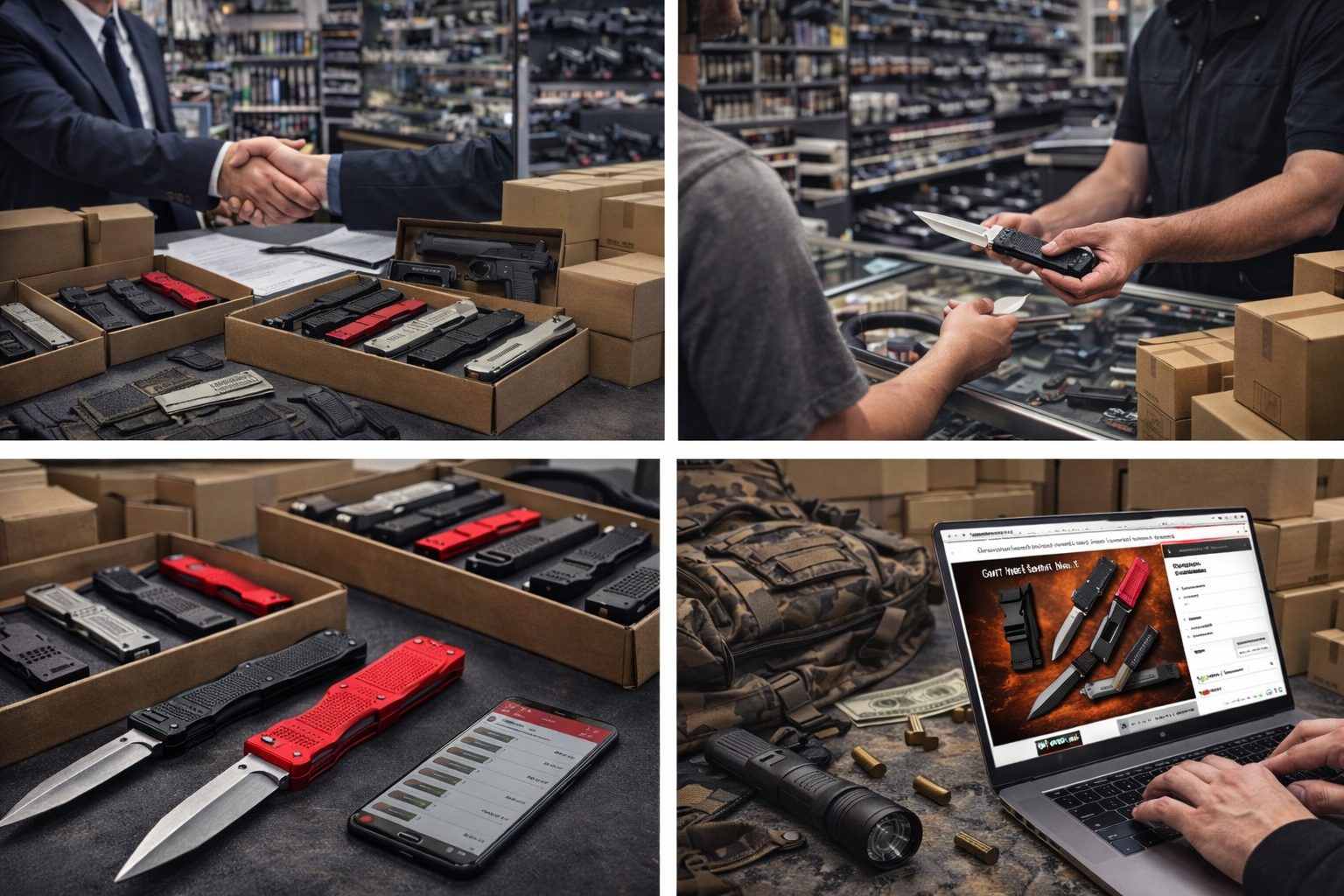
If you are evaluating OTF knives for resale, the same five checks still matter, but consistency across samples matters just as much as the quality of one knife. Test several pieces from the same run, cycle each one repeatedly, and compare lockup, slider feel, grind symmetry, and internal wear patterns side by side. One excellent sample does not prove a whole batch is excellent.
If you need to compare current models by size, shape, or mechanism style, you can review the OTF knife catalog. If you are screening multiple samples for a stocking or private-label program, the wholesale inquiry form is the right place to ask about sample availability and QC expectations.
FAQ
How much blade play is acceptable on an OTF knife?
A small amount is common and does not automatically mean poor quality. It becomes a problem when the movement is excessive, noisy, or inconsistent from one cycle to the next.
Is a stiff slider a sign of a better OTF?
Not by itself. A good slider feels firm and intentional, but not gritty, painful, or uneven through the stroke.
What is the best single test for OTF quality?
Cycle the knife at least 20 times and pay attention to whether the action, lockup, and switch feel stay consistent. Consistency is the clearest visible sign of quality on an OTF.
Can a nice-looking OTF still be poorly made?
Yes. Cosmetic machining and coatings can look impressive while the internal action is rough, misaligned, or unreliable. On an OTF, mechanism quality matters more than surface appearance.