

Is 8Cr13MoV Good for OTF Knives?


Short answer
Yes—8Cr13MoV is a solid choice for budget OTF knives used for pocket carry and light utility. Its main limits are faster dulling in heavy cardboard work and wea
Key Takeaways
- Knife rules can vary by state, city, blade style, opening mechanism, carry method, and intended use.
- Do not treat a product nickname as a legal category; check the actual features and local rule.
- Retailers should keep legal or safety language factual and avoid promising that one item is allowed everywhere.
Terms Used Here
- OTF
- Out-the-front; a knife design where the blade moves forward from the front of the handle.
- Automatic knife
- A knife that opens by a spring-driven mechanism after the user activates a button, switch, or slider.
- HRC
- Rockwell hardness scale; a common way to describe blade hardness.
- EDC
- Everyday carry; gear intended for regular daily tasks.
In this article
- 01 Short answer
- 02 Why 8Cr13MoV works in OTF knives
- 03 1) It is easy to maintain
- 04 2) It handles normal carry moisture reasonably well
- 05 3) It matches common OTF tasks
- 06 4) It helps keep the total knife cost reasonable
- 07 What to realistically expect from 8Cr13MoV in an OTF
- 08 When to choose D2 or 154CM instead
- 09 Choose D2 if edge life matters most
- 10 Choose 154CM if you want a more complete upgrade
- 11 Why the answer changes for budget vs premium OTFs
- 12 FAQ
- 13 Is 8Cr13MoV good for everyday OTF carry?
- 14 Does 8Cr13MoV rust easily in an OTF knife?
- 15 Is 8Cr13MoV better than D2 for OTF knives?
- 16 Is 8Cr13MoV too cheap for an OTF?
- 17 What is the biggest downside of 8Cr13MoV in an OTF?
- 18 Should I avoid an OTF just because it uses 8Cr13MoV?
- 19 Bottom line
Yes—8Cr13MoV is good for OTF knives when the knife is a budget or mid-value model meant for pocket carry, repetitive deployment, moisture exposure from daily carry, and light utility cuts. The main exception is heavy cardboard work or premium-priced OTFs, where edge retention and buyer expectations usually favor D2 or 154CM.
Quick verdict
- Best for: budget EDC OTFs used for tape, packages, plastic, and occasional cord.
- Acceptable for: light utility in normal pocket-carry conditions, including sweat and humidity.
- Weak for: repeated cardboard breakdown, long abrasive cutting sessions, or OTFs priced like premium models.
The reason is simple: in an OTF, blade steel is only part of the value. You are also paying for the firing mechanism, button, lockup, internal track, and handle construction. For that kind of knife, 8Cr13MoV can be a sensible steel if the goal is reliable everyday use rather than maximum edge life.
Short answer
8Cr13MoV is a practical stainless steel for OTF knives because it balances corrosion resistance, sharpening ease, and low cost well enough for how many people actually use an OTF: short cuts, frequent carry, and occasional touch-ups.
Where it falls behind is edge retention. If your OTF will spend a lot of time breaking down boxes, cutting abrasive packaging, or doing shift-long utility work, 8Cr13MoV will often need sharpening sooner than D2 and usually sooner than 154CM. That does not make it bad. It means it fits a certain job description better than others.
A useful way to think about it: 8Cr13MoV is often a good OTF steel at the right price, but rarely an impressive one at a premium price.
Why 8Cr13MoV works in OTF knives
OTF knives have different tradeoffs than a basic manual folder. Buyers care about deployment consistency, acceptable blade play, button feel, and how the mechanism holds up in pocket lint and daily carry. In that setting, 8Cr13MoV makes sense for several OTF-specific reasons.
1) It is easy to maintain
Many production examples of 8Cr13MoV are heat treated in the high-50s HRC range, often around 57–59 HRC, though this varies by maker. In practical terms, that usually means the steel is easy to touch up with simple stones or sharpeners. For a user carrying an OTF as a convenience tool, quick resharpening is a real advantage.
2) It handles normal carry moisture reasonably well
For pocket carry, sweat, humidity, and occasional rain matter. 8Cr13MoV is a stainless steel, so it is generally less fussy than D2 in those conditions. It is not a saltwater specialist, but for ordinary daily carry it is usually fine with basic cleaning and light oil.
3) It matches common OTF tasks
Most OTF owners are not doing all-day cutting. They are opening packages, slicing tape, trimming loose threads, cutting plastic wrap, opening mail, or making a few quick cuts during the day. That usage pattern fits 8Cr13MoV well. It does not need extreme wear resistance to perform those jobs capably.
4) It helps keep the total knife cost reasonable
With OTFs, some of the budget has to go into the mechanism. That is why a well-made OTF with 8Cr13MoV can be a better buy than a poorly executed OTF with a more impressive steel on paper. Mechanism quality and blade grind can matter as much as steel in an OTF, especially in entry-level models.
If you want to compare how steels are positioned across different price tiers and designs, see the OTF knife collection.
What to realistically expect from 8Cr13MoV in an OTF
The exact result depends on the maker, heat treat, edge geometry, and blade thickness. That caveat matters. A thin, well-ground 8Cr13MoV blade can cut better in daily use than a thick, poorly ground blade made from a higher-tier steel.
Still, most buyers can expect this general pattern:
- Corrosion resistance: good enough for normal pocket carry and light moisture exposure.
- Sharpening: easier than D2 and generally beginner-friendly.
- Edge retention: fair for light utility, weaker in cardboard-heavy use.
- Price fit: strongest in budget and lower midrange OTFs.
That means 8Cr13MoV is usually a good match for:
- opening delivered boxes at home
- cutting tape and shrink wrap
- light cord or zip-tie work
- general pocket carry where the knife sees many short cuts rather than one long work session
It is usually a weaker match for:
- warehouse or shipping work
- frequent cardboard breakdown
- buyers who want long intervals between sharpenings
- high-priced OTFs where the steel should feel like part of the upgrade
When to choose D2 or 154CM instead
If your use goes beyond light utility, upgrading steel makes sense quickly.
| Steel | Best at | Main tradeoff | Best OTF use case |
|---|---|---|---|
| 8Cr13MoV | Easy upkeep, stainless behavior, low cost | Shorter edge life in abrasive cutting | Budget EDC OTFs and light utility |
| D2 | Longer wear in cardboard and rough utility work | Less stainless, more care needed | Users who cut lots of boxes or abrasive material |
| 154CM | More balanced upgrade in edge retention and corrosion resistance | Higher cost | Midrange to premium OTFs where steel should match price |
Choose D2 if edge life matters most
D2 often outlasts 8Cr13MoV in cardboard and other abrasive materials. If your OTF is a work tool first and a carry piece second, D2 is usually the better call. The tradeoff is corrosion resistance: D2 is not as stainless, so it typically needs more attention in humid or sweaty carry conditions.
Choose 154CM if you want a more complete upgrade
154CM is often the more balanced step up for OTFs because it improves edge retention while still offering solid corrosion resistance. It also fits the expectations of a higher-priced knife better. If an OTF is marketed as premium, 154CM usually makes more sense than 8Cr13MoV.
These are broad production-knife tendencies, not guarantees. Heat treat and grind still matter. A well-executed 8Cr13MoV blade can outperform a poorly done D2 blade in actual cutting feel, even if D2 has the higher ceiling.
Why the answer changes for budget vs premium OTFs
This is where many buyers get tripped up. The same steel can be a smart choice in one OTF and a weak choice in another because the product promise is different.
In a budget OTF, 8Cr13MoV is often reasonable because the knife must also pay for a working automatic mechanism. At that price level, buyers usually care most about reliable action, decent sharpness, acceptable corrosion resistance, and easy maintenance.
In a premium OTF, expectations rise. Buyers want the mechanism, handle materials, finish, and blade steel to all feel upgraded. In that context, 8Cr13MoV may still function perfectly well, but it often looks like the weak point on the spec sheet and in long-term use.
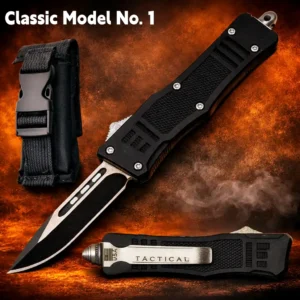
One buying mistake to avoid: do not assume a tactical-looking OTF with 8Cr13MoV is a heavy-duty work knife just because the handle styling is aggressive. For repeated abrasive cutting, the steel usually becomes the limiting factor before the look of the knife does.
FAQ
Is 8Cr13MoV good for everyday OTF carry?
Yes. It is a solid choice for everyday carry if your tasks are mostly tape, packaging, plastic, light cord, and other short utility cuts.
Does 8Cr13MoV rust easily in an OTF knife?
Usually no in normal carry. It has enough stainless behavior for sweat, humidity, and occasional rain, though basic cleaning still helps.
Is 8Cr13MoV better than D2 for OTF knives?
It is better if you want easier sharpening and less concern about staining. D2 is often better if your priority is longer edge retention, especially in cardboard.
Is 8Cr13MoV too cheap for an OTF?
Not for a budget or value-focused OTF. It feels out of place mainly when the knife is priced and marketed like a premium model.
What is the biggest downside of 8Cr13MoV in an OTF?
The biggest downside is faster dulling in abrasive work. If you break down boxes often, you will likely notice the edge fading sooner than with D2 or 154CM.
Should I avoid an OTF just because it uses 8Cr13MoV?
No. If the knife is priced fairly, has a good mechanism, and matches light-duty use, 8Cr13MoV is a sensible steel. For many buyers, an OTF with reliable action and a well-ground 8Cr13MoV blade is more useful than a poorly built knife with a fancier steel.
Bottom line
8Cr13MoV is good for OTF knives when the goal is affordable everyday carry, light utility, easy sharpening, and decent stainless performance. It is not the best choice for repeated cardboard breakdown or for premium-priced OTFs where buyers reasonably expect better edge retention.
If your OTF will mostly ride in the pocket, see short cutting sessions, and need simple upkeep, 8Cr13MoV is a practical choice. If your knife is a work tool for abrasive materials or you want a more premium steel-to-price match, step up to D2 or 154CM.