

Is S35VN Good for OTF Knives?


Short answer
S35VN is generally a very good steel for OTF knives: stainless, wear-resistant, and tough enough for typical slicing tasks. Learn when it makes sense, when to s
Key Takeaways
- Knife rules can vary by state, city, blade style, opening mechanism, carry method, and intended use.
- Do not treat a product nickname as a legal category; check the actual features and local rule.
- Retailers should keep legal or safety language factual and avoid promising that one item is allowed everywhere.
Terms Used Here
- OTF
- Out-the-front; a knife design where the blade moves forward from the front of the handle.
- Automatic knife
- A knife that opens by a spring-driven mechanism after the user activates a button, switch, or slider.
- Fixed blade
- A knife with a blade that does not fold or retract into the handle.
- HRC
- Rockwell hardness scale; a common way to describe blade hardness.
In this article
- 01 Why OTF knives need balanced steel, not maximum steel
- 02 How good is S35VN in actual OTF use?
- 03 S35VN vs other realistic OTF steels
- 04 S35VN vs D2
- 05 S35VN vs 154CM
- 06 S35VN vs MagnaCut
- 07 S35VN vs M390
- 08 When to choose S35VN for an OTF
- 09 When to skip S35VN
- 10 One OTF-specific mistake to avoid
- 11 Wholesale and sourcing guidance
- 12 Bottom line
- 13 FAQ
- 14 Is S35VN too hard to sharpen on an OTF?
- 15 Is S35VN better than D2 for humid carry?
- 16 Does S35VN matter more than mechanism quality on an OTF?
- 17 Is MagnaCut better than S35VN for OTF knives?
For most OTF knives, S35VN is a solid choice. It gives a useful mix of corrosion resistance, edge retention, and adequate toughness for the way OTFs are usually carried and used. The main exception is value-focused knives or light-use owners who will not cut enough to justify the extra cost.
The strongest reason to choose S35VN is that it is a balanced stainless steel for real pocket carry. The strongest reason to skip it is simple: on a budget OTF or a knife that mostly opens tape once in a while, cheaper steels often deliver better value.
Why OTF knives need balanced steel, not maximum steel
OTF knives put different demands on a blade than a hard-use fixed blade. Most OTFs have relatively slim blades, fine tips, and grinds meant for slicing, package opening, cord, plastic, and everyday utility. They also spend a lot of time in pockets, where sweat, lint, and humidity matter.
That is why a balanced stainless steel often makes more sense than chasing the highest possible wear resistance or hardness. In practical terms, an OTF buyer usually benefits more from four things:
- Good rust resistance for pocket carry, sweat, and inconsistent maintenance
- Enough edge life to reduce frequent touch-ups during normal cutting
- Adequate toughness for thin blade geometry and everyday slips or twists
- Reasonable sharpening difficulty so the knife is still maintainable
S35VN fits that profile well. It is a powder-metallurgy stainless steel designed as an evolution of S30V, with niobium added to improve toughness and make the carbide structure a bit friendlier in use and sharpening. That does not mean every S35VN blade performs the same. Heat treat, edge geometry, and factory consistency still matter a lot.
As practical guidance rather than lab data, many users find S35VN works best on OTFs that are actually carried and used, not just collected. It is especially sensible when the knife will see cardboard, tape, plastic strapping, food prep in a pinch, or humid pocket carry.
How good is S35VN in actual OTF use?
In real use, S35VN is usually good enough to feel like an upgrade without becoming annoying to maintain. A well-done S35VN OTF should hold a working edge longer than 154CM and usually longer than D2 in mixed daily carry, while resisting rust much better than D2.
Typical hardness for S35VN knives is often around 58-61 HRC, with many makers aiming near 59-60 HRC for a balanced result. That range matters. Too soft, and edge retention feels underwhelming for the price. Too hard, and a thin OTF blade can become less forgiving at the edge. In other words, the steel name alone is not the whole story.
Sharpening is also part of the answer. S35VN is not a beginner steel in the way 154CM can be, but it is also not the most stubborn premium stainless. Most users with decent stones or diamond sharpeners can maintain it without drama. Relative to common OTF steels, a simple rule is:
- Easier to sharpen than: M390
- Harder to sharpen than: 154CM
- Often worth the effort if you carry daily: yes
A short example: if someone carries an OTF five days a week for warehouse supervision, uses it for stretch wrap, tape, cardboard, and occasional cord, and keeps it in a sweaty pocket during summer, S35VN is a sensible match. It gives better stain resistance than D2, longer edge life than many mid-tier steels, and does not push maintenance difficulty as high as some ultra-wear-resistant options.
S35VN vs other realistic OTF steels
| Steel | Rust resistance | Edge life | Sharpening | Price/value | Best fit |
|---|---|---|---|---|---|
| S35VN | Very good | Very good | Moderate | Good in mid-to-premium OTFs | Daily carry, humid pockets, buyers wanting a balanced upgrade |
| D2 | Fair to poor compared with stainless options | Good | Moderate | Strong budget value | Lower-cost OTFs if rust risk is low and maintenance is consistent |
| 154CM | Good | Moderate | Easier | Very good value | Users who want stainless performance with simpler sharpening |
| MagnaCut | Excellent | Very good | Moderate | Higher cost | Users prioritizing corrosion resistance and top-tier modern steel |
| M390 | Excellent | Excellent | Harder | Usually expensive | Spec-driven buyers who want maximum wear resistance |
S35VN vs D2
If the OTF will live in a pocket, glove box, or humid climate, S35VN is the safer choice. D2 can cut well for the money, but it is not truly stainless and is more likely to spot, stain, or rust if neglected. Choose D2 when price matters most. Choose S35VN when rust risk and daily carry matter more.
S35VN vs 154CM
This is one of the closest real-world decisions. 154CM is easier to sharpen, usually cheaper, and often makes more sense on practical mid-priced OTFs. S35VN usually wins on edge life and feels like a more substantial upgrade for frequent users. If someone only cuts lightly, 154CM may be the smarter buy. If they carry every day and want fewer touch-ups, S35VN is often worth it.
S35VN vs MagnaCut
MagnaCut is the stronger choice if corrosion resistance is the top priority and the budget supports it. For salt air, heavy sweat, or buyers who want one of the best current stainless options, MagnaCut has a real advantage. S35VN still makes sense when you want a proven premium steel without jumping to a higher cost tier.
S35VN vs M390
M390 usually offers longer wear resistance, but that does not automatically make it better for an OTF. On thin, utility-oriented OTF blades, the practical gain may be smaller than expected, while sharpening effort and price go up. If the user actually values long edge life above all else, M390 can be worth it. If they want a more balanced daily-use steel, S35VN is often the easier recommendation.
When to choose S35VN for an OTF
- You carry the knife regularly, not occasionally
- You want better rust resistance than D2
- You cut enough cardboard, tape, and packaging to notice edge retention
- You want a premium steel but do not want the sharpening burden or cost jump of some higher-wear options
- You live in a humid area or sweat on your gear
When to skip S35VN
- The knife is mainly a novelty, backup, or occasional desk tool
- Your budget is tight and the rest of the knife quality matters more
- You prefer very easy sharpening over longer edge life
- You are choosing between a well-built 154CM OTF and a poorly executed S35VN OTF
One OTF-specific mistake to avoid
Do not overpay for blade steel while ignoring the mechanism. On an OTF, misfires, weak spring tuning, inconsistent lockup, and poor internal finishing will affect user satisfaction more quickly than the difference between S35VN and a decent mid-tier steel.
A practical buying rule: if you have to choose between better steel and better platform quality, choose the better platform first. A reliable OTF in 154CM is usually a better tool than an unreliable OTF in S35VN.
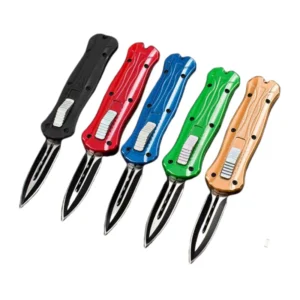
If you are comparing models in an OTF knife collection, check deployment consistency, blade play, edge geometry, and fit before treating the steel stamp as the deciding factor.
Wholesale and sourcing guidance
For wholesale buyers, keep the steel decision separate from the sales story. S35VN belongs on an OTF when the target retail tier supports it and the maker can document consistent heat treat and build quality. If returns are mostly caused by mechanism issues, changing to S35VN will not solve the real problem.
Useful sourcing questions include:
- What hardness range is the maker targeting for S35VN?
- How thin is the blade behind the edge?
- Is the mechanism consistent across samples?
- Does the target customer actually use the knife enough to value the upgrade?
If your catalog also includes self-defense products, avoid letting steel branding overshadow deployment reliability and legal-market fit. For OTFs, steel can improve the user experience, but it cannot rescue a weak design.
Bottom line
S35VN is generally a good steel for OTF knives because it matches how most of them are really used: daily carry, slicing, package opening, and exposure to pocket moisture. It is stainless enough to be low-drama, wear-resistant enough to feel premium, and tough enough for slim blades when heat treated well.
It is not the automatic best choice for every buyer. If the knife is budget-driven, lightly used, or chosen by someone who values easy sharpening most, 154CM or even D2 may be more practical. But for a mid-to-premium OTF that is meant to be carried and used, S35VN is one of the safer all-around picks.
FAQ
Is S35VN too hard to sharpen on an OTF?
No. It takes more effort than 154CM, but it is still manageable with good sharpening tools, especially diamond abrasives.
Is S35VN better than D2 for humid carry?
Usually yes. The biggest advantage is better corrosion resistance in sweat, humidity, and inconsistent maintenance.
Does S35VN matter more than mechanism quality on an OTF?
No. Mechanism reliability, lockup consistency, and overall build quality matter more. Steel is important, but it comes after platform quality.
Is MagnaCut better than S35VN for OTF knives?
For maximum corrosion resistance, yes. For overall value and proven premium performance, S35VN still remains a very practical choice.