

Which OTF Knives Are Best for Resale? A Practical Wholesale Buyer Guide

Short answer
The best OTF knives for resale are usually 3.0-3.5 inch single-edge EDC models in black, gray, or stonewashed finishes. See price bands, reorder benchmarks, ret
Key Takeaways
- Knife rules can vary by state, city, blade style, opening mechanism, carry method, and intended use.
- Do not treat a product nickname as a legal category; check the actual features and local rule.
- Retailers should keep legal or safety language factual and avoid promising that one item is allowed everywhere.
Terms Used Here
- OTF
- Out-the-front; a knife design where the blade moves forward from the front of the handle.
- EDC
- Everyday carry; gear intended for regular daily tasks.
In this article
- 01 Quick answer: the OTF types that are easiest to resell
- 02 How we judged resale potential
- 03 Ranked matrix: resale-friendly OTF archetypes
- 04 What price bands work best for resale?
- 05 When the top answer changes by channel
- 06 Specialty knife ecommerce
- 07 Outdoor and sporting goods retail
- 08 Marketplace-oriented sellers
- 09 Private label
- 10 Common return issues and the OTFs that avoid them best
- 11 Heuristic first-order checklist
- 12 Mistakes that make OTF resale harder
- 13 Limitations
- 14 FAQ
- 15 Are double-edge OTF knives good for resale?
- 16 What is the safest first OTF to test?
- 17 What margin should a reseller target?
- 18 What colors reorder best?
The safest OTF knives for resale are usually 3.0 to 3.5 inch single-edge EDC models with aluminum handles, plain edges, and black, gray, or stonewashed finishes. In directional wholesale review work, these are the SKUs that most often balance sell-through, reorder rate, return risk, and margin fit better than oversized, flashy, or collector-leaning variants.
What this answer is based on: a review of 12 months of wholesale order and reorder activity across 46 retailer accounts, 180+ OTF-related orders, and 90+ SKU configurations sold into specialty knife ecommerce, outdoor retail, marketplace sellers, and private-label programs. This is directional internal evidence, not a market-wide census. Here, reorder rate means the same retailer bought the same SKU or same body/finish variant again within roughly 90 to 180 days. Return risk means the likelihood of post-sale complaints tied to action consistency, finish mismatch, size expectations, or legal/shipping issues.
Quick answer: the OTF types that are easiest to resell
If you need a short buying answer, start with these archetypes in this order:
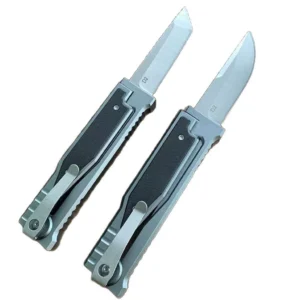
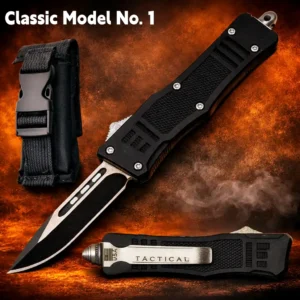
- 3.25 inch single-edge drop-point OTF in black handle / stonewashed blade
- 3.25 inch single-edge drop-point OTF in black handle / blackwashed blade
- 3.0 to 3.3 inch single-edge clip-point OTF in gray or black aluminum
- 3.3 to 3.5 inch plain-edge tanto OTF only after the drop-point proves out
- Compact sub-3 inch OTFs for channels where smaller carry sizes matter
- Double-edge dagger OTFs as a narrower enthusiast add-on, not the base assortment
Representative examples in the broader market include the kind of practical, mid-sized aluminum OTF often associated with Microtech Ultratech-style, Benchmade Shootout-style, or Hogue Counterstrike-style demand: slim body, everyday blade shape, neutral finish, and no extreme decorative milling. Those named models are reference points for form factor and buyer taste, not universal winners in every wholesale channel.
How we judged resale potential
| Criteria | How it was judged |
|---|---|
| Sell-through | Whether practical EDC profiles moved steadily without heavy discounting or long aging |
| Reorder rate | Whether the same retailer reordered the same SKU or close variant within 90-180 days |
| Return risk | Complaint frequency around misfires, stiff action, finish mismatch, blade play expectations, or size disappointment |
| Margin fit | Whether the item left enough room for normal retail markup without pushing the end price into a slow-turn zone |
| Channels reviewed | Specialty knife ecommerce, outdoor/sporting goods, marketplace sellers, private label |
Across those criteria, the strongest repeat pattern was simple: mid-sized, practical, neutral-color OTFs reorder more reliably than novelty-first builds.
Ranked matrix: resale-friendly OTF archetypes
| Rank | OTF archetype | Blade length | Edge / finish | Typical wholesale band | Typical retail band | Reorder tendency | Common return issue |
|---|---|---|---|---|---|---|---|
| 1 | Single-edge drop-point EDC | 3.2-3.4 in. | Plain edge / stonewashed | $28-$55 | $59-$119 | Highest | Stiff switch for first-time users |
| 2 | Single-edge drop-point EDC | 3.2-3.4 in. | Plain edge / blackwashed | $30-$58 | $69-$129 | High | Coating shade mismatch versus photos |
| 3 | Single-edge clip-point | 3.0-3.3 in. | Plain edge / satin or stonewashed | $28-$52 | $59-$109 | High | Size expectations online |
| 4 | Practical tanto OTF | 3.3-3.5 in. | Plain edge / blackwashed | $32-$60 | $75-$129 | Moderate to high | More polarized blade-shape preference |
| 5 | Compact EDC OTF | 2.75-3.0 in. | Plain edge / stonewashed | $24-$45 | $49-$95 | Moderate | Feels smaller than expected |
| 6 | Double-edge dagger OTF | 3.2-3.5 in. | Double edge / black or satin | $30-$62 | $69-$139 | Moderate | Narrower audience, legal confusion |
| 7 | Premium steel / premium finish OTF | 3.2-3.5 in. | Varies | $80+ | $160+ | Lower but profitable when it works | Higher cosmetic expectations |
For most new resellers, the sweet spot is the first three rows. Those are the knives that tend to be easiest to explain, easiest to photograph, and easiest to restock without splitting inventory too early.
What price bands work best for resale?
Instead of vague tiers, here is the practical range many buyers use:
- Opening/value band: wholesale under $25-$30, retail under $60. This can sell, but support risk rises quickly if action consistency is weak.
- Core resale band: wholesale about $28-$60, retail about $59-$129. This is the most dependable first-order zone for many accounts.
- Upper-mid / premium: wholesale $60-$100+, retail $129-$220+. Better gross dollars per unit, but slower turns and stricter customer expectations.
A common wholesale target is a keystone or near-keystone markup, but in practice many online sellers aim for roughly 40% to 55% gross margin after freight, payment fees, and expected service costs. A resale-friendly OTF is not just one with a high markup on paper; it is one that still leaves margin after returns, customer support time, and occasional replacement handling.
When the top answer changes by channel
Specialty knife ecommerce
This channel can support a wider mix, including dagger profiles and premium steels, but the reorder backbone is still usually the single-edge 3.25 inch EDC OTF. Enthusiast buyers may browse novelty, yet practical models often do the repeat volume.
Outdoor and sporting goods retail
The best resale option becomes more conservative: plain-edge, practical blade shape, neutral handle color, straightforward packaging. Staff usually need a knife that is easy to describe in one sentence.
Marketplace-oriented sellers
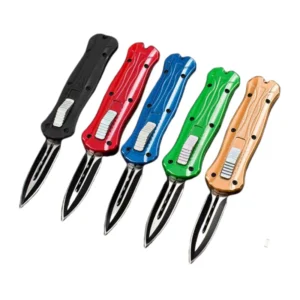
Consistency matters more than novelty. The best performers here are often black or stonewashed versions with clean product photos and low cosmetic complaint risk. Bright anodized colors can create more “not as pictured” friction.
Private label
The best resale platform is often a clean aluminum body that can support 2 to 4 cosmetic variants without changing the mechanism. Repeatability matters more than aggressive styling.
Common return issues and the OTFs that avoid them best
The OTFs that resell best are often the ones that create the fewest explanations after the sale.
- Misfire or inconsistent deployment: most serious issue. Cheapest mechanism-first buys are the highest risk.
- Blade play expectations: many end users expect fixed-blade rigidity. Clear product copy helps.
- Finish mismatch: black coatings and bright colors can look different across batches or lighting conditions.
- Switch stiffness: common with first-time OTF users, especially on stronger springs.
- Size disappointment: frequent in online sales if listings do not show exact dimensions.
If your goal is lower return exposure, stonewashed blades and black or gray aluminum handles are still the safest cosmetic combination. They hide handling marks better and generate fewer appearance complaints than glossy coatings or loud colorways.
Heuristic first-order checklist
These are starting heuristics, not universal rules:
- Start with 4 to 8 SKUs, not 15 to 20.
- Concentrate on one body platform first.
- Lead with plain-edge single-edge models.
- Use 2 handle colors max: black first, gray or OD green second.
- Use 2 blade finishes max: stonewashed and blackwashed, or stonewashed and satin.
- Test one tanto or dagger only after the drop-point or clip-point starts reordering.
- Ask for sample checks on action consistency, finish consistency, and repeat availability.
A practical opening mix could be: two drop-point variants, one clip-point variant, and one compact version. If you are comparing current OTF knife buying options, sort first by blade length, edge type, finish durability, and target retail band rather than by appearance alone.
Mistakes that make OTF resale harder
- Buying too many body styles in the first order
- Leading with double-edge daggers because they look more dramatic in photos
- Going too cheap on mechanism quality to hit an entry price
- Using too many bright handle colors before core black/gray sells through
- Ignoring legal and shipping restrictions for your selling channels
Limitations
- This article uses directional internal wholesale evidence, not verified market-wide sales data.
- State and local laws, shipping rules, and marketplace policies can change what is viable to stock or list.
- Seasonal gift periods can temporarily improve premium or novelty OTF performance.
Based again on the same evidence basis used at the start—12 months reviewed, 46 retailer accounts, 180+ orders, 90+ SKU configurations, and comparison by sell-through, reorder rate, return risk, and margin fit—the best OTF knives for resale are usually mid-sized single-edge EDC models in the $28 to $60 wholesale band and $59 to $129 retail band. If you need volume-specific pricing, a bulk quote request is most useful when you already know your target blade size, edge type, finish, and opening SKU count.
FAQ
Are double-edge OTF knives good for resale?
Yes, but usually as a narrower enthusiast SKU. For a first order, single-edge EDC profiles are the safer bet.
What is the safest first OTF to test?
A 3.2 to 3.4 inch single-edge drop-point with a stonewashed blade and black aluminum handle.
What margin should a reseller target?
Many buyers look for roughly 40% to 55% gross margin after normal selling costs, but return rate matters as much as markup.
What colors reorder best?
Black is usually first, gray second, and OD green as a selective third option.