

Which OTF Knives Are Best for Online Resellers?

Short answer
A practical wholesale guide to the best OTF knives for online resellers, with clear size and price definitions, MOQ guidance, margin targets, packaging standard
Key Takeaways
- Knife rules can vary by state, city, blade style, opening mechanism, carry method, and intended use.
- Do not treat a product nickname as a legal category; check the actual features and local rule.
- Retailers should keep legal or safety language factual and avoid promising that one item is allowed everywhere.
Terms Used Here
- OTF
- Out-the-front; a knife design where the blade moves forward from the front of the handle.
- Automatic knife
- A knife that opens by a spring-driven mechanism after the user activates a button, switch, or slider.
In this article
- 01 Quick answer table for reseller types
- 02 What “mid-size” and “mid-range” mean in practice
- 03 How we judged this
- 04 Why this OTF type works best online
- 05 Commercial benchmarks resellers can actually use
- 06 Best SKU archetypes for online resale
- 07 1. Entry marketplace SKU
- 08 2. Core independent-store SKU
- 09 3. Giftable step-up SKU
- 10 4. Private-label starter SKU
- 11 5. Poor-fit archetype to avoid first
- 12 Channel-specific buying advice
- 13 Marketplace sellers
- 14 Independent online stores
- 15 Private-label and brand-building stores
- 16 Tradeoffs resellers should understand
- 17 Common buying mistakes
- 18 FAQ
- 19 What is the safest first OTF assortment for a new online reseller?
- 20 Should I start with budget or premium OTF knives?
- 21 What should I confirm before placing a wholesale OTF order?
- 22 How many OTF SKUs should a new seller launch with?
The best OTF knives for online resellers are usually mid-size double-action models in the mid-range price band, with common blade shapes, neutral finishes, and retail-ready packaging. In editorial judgment, that combination gives the broadest buyer appeal, the clearest listings, and the lowest return risk for most online sellers.
This recommendation is based on observable retail factors such as price band, size, finish visibility, and likely buyer intent.
Quick answer table for reseller types
| Reseller model | Best OTF type | Target price band | Preferred blade shape | Finish | Packaging | Typical MOQ | Main risk |
|---|---|---|---|---|---|---|---|
| Marketplace seller | Mid-size double-action | $25-$45 wholesale / $59-$99 retail | Spear point or drop point | Black, stonewash, satin | Clean box, foam or tray insert, barcode-ready label area | 12-48 units per SKU | Fee pressure and return sensitivity |
| Independent online store | Mid-size to slightly premium double-action | $35-$60 wholesale / $79-$129 retail | Drop point, spear point, restrained tanto | Stonewash, two-tone, matte black | Giftable box with consistent branding and spec card | 12-36 units per SKU | Slow-moving niche variants |
| Private-label starter | Stable body platform with simple finish options | $30-$55 wholesale / brand-dependent retail | Spear point or drop point | Black handle, satin or stonewashed blade | Plain or custom box with insert and logo space | 50-200 units total, often split by finish | Batch inconsistency and packaging mismatch |
What “mid-size” and “mid-range” mean in practice
For OTF resale, mid-size usually means an overall length around 7.5 to 8.5 inches open, with a blade around 2.75 to 3.5 inches and a handle that is substantial without looking oversized in photos. That size works because buyers can picture it as everyday carry, a gift item, or a general-use automatic.
Mid-range usually means a wholesale cost around $25 to $60 per unit, supporting a realistic online retail price around $59 to $129 depending on finish, packaging, and channel. In editorial judgment, this is the safest lane because it leaves room for platform fees, promotions, customer service time, and the occasional replacement without forcing you into ultra-budget quality compromises or slow premium turnover.
How we judged this
- Listing clarity: easy to explain in title, bullets, and images.
- Margin after selling costs: enough room for fees, discounts, and support.
- Reorder stability: likely to be available again without major cosmetic changes.
- Return resistance: fewer issues tied to finish mismatch, damaged boxes, or confusing design choices.
- Broad buyer appeal: practical size, familiar blade shape, and easy-to-understand action.
Why this OTF type works best online
Online resale rewards products that are easy to understand at a glance. A buyer scrolling on mobile usually responds better to an OTF that looks practical and familiar than to one that looks oversized, highly aggressive, or hard to categorize. Mid-size double-action OTFs are easier to merchandise because the use case is obvious, the action is simple to describe, and the photos tend to look consistent across batches.
In editorial judgment, the strongest resale pattern is:
- Double-action deployment: one control for out and back is easier to explain and creates fewer pre-sale questions.
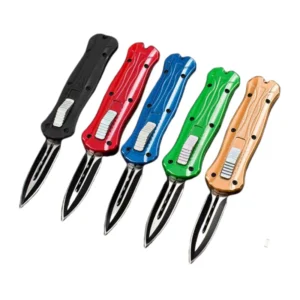
- Neutral finishes: black, stonewashed, and satin hide minor batch variation better than bright or patterned coatings.
- Common blade shapes: spear point and drop point appeal to more buyers than novelty or highly stylized shapes.
- Retail-ready packaging: box arrives intact, knife is secured inside, and presentation is good enough to ship directly to the customer.
Retail-ready packaging should mean a structured box, inner tray or foam support, a protective sleeve or bag if used by the supplier, and labeling that does not require you to rebox every order. For online sellers, packaging is not cosmetic only. Crushed corners, loose knives inside the box, and missing inserts are common triggers for avoidable returns even when the knife itself is acceptable.
Commercial benchmarks resellers can actually use
- Target gross margin: many online resellers need at least 45% to 60% gross margin before ads and overhead to stay comfortable after fees and customer service.
- Sample order size: 2 to 5 units per candidate SKU is usually enough to inspect action consistency, finish, packaging, and photo readiness.
- Starter MOQ: 12 to 24 units per SKU is manageable for testing; higher MOQs make more sense only after a SKU proves repeat demand.
- Reorder trigger: many sellers reorder when they have 30 to 45 days of stock left, especially if lead time is variable.
- Acceptable defect tolerance: in editorial judgment, new sellers should be cautious of any SKU line that regularly creates more than 2% to 3% immediate replacement or defect handling.
A simple filter helps: if a knife only looks profitable before returns, damaged packaging, and selling fees, it is not a strong online reseller SKU.
Best SKU archetypes for online resale
1. Entry marketplace SKU
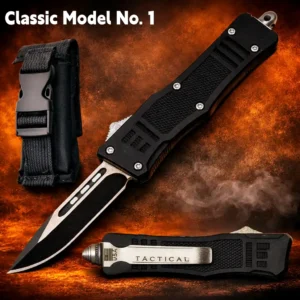
A representative example is a 3-inch spear point, black or stonewashed double-action OTF in the $25-$35 wholesale range and $59-$79 retail lane. This works because the value proposition is simple, the finish photographs cleanly, and the retail price leaves some room for marketplace fees. Keep packaging plain but tidy. The main risk is racing too low on price and losing margin to returns or promotions.
2. Core independent-store SKU
A representative example is a 3.25-inch drop point or spear point double-action OTF with a cleaner handle profile, better box presentation, and a $35-$50 wholesale cost supporting $79-$109 retail. This is often the best all-around online store choice because it feels giftable without entering slow premium territory.
3. Giftable step-up SKU
A representative example is a mid-size OTF with stonewashed blade, matte black handle, and slightly upgraded hardware or finish detail in the $45-$60 wholesale range. This works for independent stores that want an upsell item near holidays or gifting periods. It should still use a familiar blade shape; the upgrade should be finish and presentation, not a radical design change.
4. Private-label starter SKU
A representative example is a stable mid-size chassis offered in one handle color and one or two blade finishes, with predictable screw hardware and enough flat area for logo placement. This is a good private-label starting point because it reduces complexity. Before scaling, confirm MOQ, packaging format, logo application, and how closely later batches will match the approved sample through the OTF bulk inquiry form.
5. Poor-fit archetype to avoid first
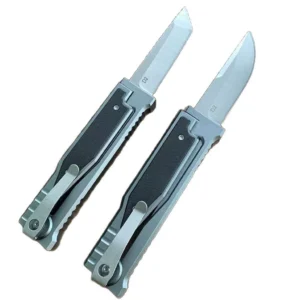
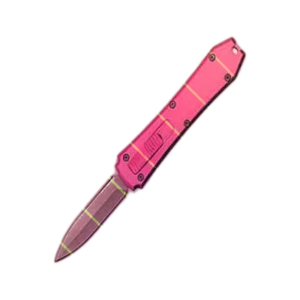
A poor first-reseller choice is a large, dagger-heavy, brightly coated or novelty-finish OTF with inconsistent packaging. It may attract clicks, but it narrows the buyer pool, creates more listing questions, and often leads to color or finish mismatch complaints. In editorial judgment, this type belongs later in an assortment, not in a first wholesale buy.
Channel-specific buying advice
Marketplace sellers
Choose simple, comparable products. Buyers on marketplaces often decide quickly, so dimensions, blade shape, and finish should be obvious from the first image. Prioritize lower-return packaging and avoid overstocking too many colors. One black and one stonewashed variant usually teaches you more than six slow-moving handle colors.
Independent online stores
You have more room to sell presentation and story, so a slightly better finish and better box can justify a healthier retail price. A small three-SKU ladder often works well: an entry OTF, a core bestseller, and a step-up giftable option. Avoid overstocking niche blade shapes until standard SKUs show repeat reorder behavior.
Private-label and brand-building stores
Start narrow. One handle color, one blade shape, and one box format are easier to control than a broad launch. The real risk here is not just unit cost; it is batch drift. If the clip shape, coating tone, screws, or insert card changes, your listings and brand presentation become harder to maintain. Review options from the wholesale OTF knife catalog with repeatability in mind, not just appearance.
Tradeoffs resellers should understand
The safest OTF reseller SKUs are not always the most exciting. Plain black or stonewashed mid-size models can look less dramatic than oversized tactical or brightly coated versions, but they usually create steadier sell-through and fewer support issues. In editorial judgment, a balanced assortment beats a flashy assortment because online resale depends on repeatability, clean listings, and packaging consistency as much as on visual impact.
Common buying mistakes
- Buying too many variants at launch: inventory gets fragmented and no single SKU has enough depth.
- Ignoring packaging condition: dented or loose packaging causes avoidable returns.
- Choosing by catalog photo only: slider feel, edge finish, and box quality need sample review.
- Overvaluing the cheapest unit cost: low cost does not help if defect handling erases margin.
- Skipping reorder planning: a winner is only useful if you can buy it again without major changes.
FAQ
What is the safest first OTF assortment for a new online reseller?
In editorial judgment, start with two to three mid-size double-action SKUs in black, satin, or stonewashed finishes, using spear point or drop point blades and MOQ levels you can reorder quickly.
Should I start with budget or premium OTF knives?
Most resellers should start in the middle. Ultra-budget SKUs can create more QC and packaging issues, while premium SKUs tie up cash and usually move slower.
What should I confirm before placing a wholesale OTF order?
Ask about MOQ, sample availability, packaging details, lead time, replacement handling, and whether future batches will match your approved sample closely enough to keep the same listing live.
How many OTF SKUs should a new seller launch with?
Usually two to four. That is enough to compare buyer response without spreading inventory too thin.