

Which OTF Knife Style Is Safest for a First Wholesale Order? A Practical Buying Guide

Short answer
A procurement-focused guide to the safest OTF knife style for a first wholesale order, with concrete selection criteria, tradeoffs, reseller fit, QC checks, and
Key Takeaways
- Knife rules can vary by state, city, blade style, opening mechanism, carry method, and intended use.
- Do not treat a product nickname as a legal category; check the actual features and local rule.
- Retailers should keep legal or safety language factual and avoid promising that one item is allowed everywhere.
Terms Used Here
- OTF
- Out-the-front; a knife design where the blade moves forward from the front of the handle.
In this article
- 01 Three selection criteria that matter most on a first order
- 02 1. Return-driver control
- 03 2. Reorder stability
- 04 3. Shelf appeal without niche risk
- 05 The safest starting configuration
- 06 Best for each buyer type
- 07 Best for marketplace sellers
- 08 Best for independent stores
- 09 Best for distributors
- 10 Best for gift or promotional channels
- 11 Tradeoffs: when not to choose the safest option
- 12 Mistakes first-time wholesale buyers make
- 13 What to verify with the supplier before placing the PO
- 14 FAQ
- 15 Is a single-edge or double-edge look safer for a first order?
- 16 Should a first order include coated black blades?
- 17 How many SKUs should a first OTF order include?
- 18 What packaging choice is safest?
- 19 What is the safest private-label approach on a first run?
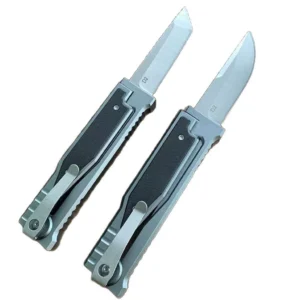
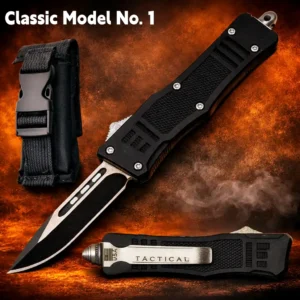
The safest OTF knife style for a first wholesale order is a double-action OTF with a simple drop-point blade, mid-size handle, plain edge, and low-drama finish. For most first-time buyers, that combination reduces return drivers, broadens retail appeal, simplifies QC, and makes repeat orders easier to match.
In wholesale, “safest” does not mean the most exciting model. It means the style with the lowest sell-through risk, the fewest avoidable complaints, and the best chance that your second order will match your first in action, finish, packaging, and parts fit. For OTF knives, that usually points away from extreme blade grinds, oversized novelty bodies, and flashy coatings, and toward a stable, proven platform you can inspect and reorder with confidence.
Three selection criteria that matter most on a first order
1. Return-driver control
The first question is not which OTF looks best in photos. It is which style creates the fewest customer complaints after delivery. In OTF knives, common return drivers include blade play that feels excessive to end users, misfires after break-in, chipped coatings, serrations that disappoint buyers expecting easy maintenance, and handle finishes that show scratches immediately.
A plain-edge drop point helps here because it is familiar, easy to explain, and easier for retailers and end users to maintain. A stonewashed or satin blade usually hides handling marks better than glossy black coatings. A mid-size aluminum handle is also a practical starting point because it feels substantial without moving into niche oversized territory.
2. Reorder stability
Your first wholesale order should test a platform that can be repeated. That means stable dimensions, common hardware, standard packaging, and a mechanism the supplier already builds in volume. If the style depends on a special grind, unusual inlay, custom colorway, or decorative milling, the odds of variation between batches go up.
For private-label and distribution buyers, reorder stability matters as much as first-order price. If the second shipment has a different switch feel, different glass-breaker shape, or noticeably different anodizing tone, you create customer-service noise and channel friction. A simple, established OTF platform is easier to keep consistent across MOQs and future production runs.
3. Shelf appeal without niche risk
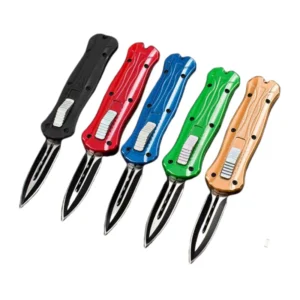
First orders should target the broad middle of the market. A drop-point blade and neutral black, gray, or OD-style handle color can work across marketplace sellers, independent stores, and general outdoor retail. By contrast, dagger blades, aggressive fantasy styling, bright colors, and heavy serration often narrow the buyer pool.
Broad appeal is especially important when you are still learning your channel. A style that can sell online, in-store, and through regional distributors is safer than one that depends on a very specific customer taste.
The safest starting configuration
If you need one practical recommendation, start with this specification set:
- Action: Double-action OTF
- Blade profile: Drop point
- Edge: Plain edge
- Blade finish: Stonewash or satin
- Handle size: Mid-size, pocketable, not oversized
- Handle material: Aluminum alloy with straightforward texturing
- Color: Black or another neutral tone
- Packaging: Clean retail box with clear model labeling and barcode option
This setup is safest because each choice removes a common friction point. Double-action OTF is the standard expectation in this category. Drop point is easier to merchandise than dagger shapes because it reads as more general-purpose. Plain edge avoids sharpening and expectation issues. Stonewash or satin reduces cosmetic complaints. Neutral handles widen channel compatibility and simplify repeat ordering.
If you want to review current platform options before committing, start with the wholesale OTF knife catalog and narrow by blade profile, finish, and handle size before discussing custom packaging or branding.
Best for each buyer type
Best for marketplace sellers
Choose a mid-size double-action OTF, drop point, plain edge, black handle, stonewashed blade. Marketplace buyers tend to generate more post-sale questions about finish wear, edge style, and everyday usability. A simple profile reduces misunderstanding and keeps listings easy to explain with accurate photos and short bullets.
Commercial reason: marketplace channels punish avoidable returns and inconsistent reviews. A neutral, familiar OTF style is easier to describe and less likely to trigger “not what I expected” feedback.
Best for independent stores
Choose a slightly more detailed but still conservative model, such as a drop-point OTF with tasteful handle milling or a two-tone hardware accent, while keeping the plain edge and practical finish. Independent stores often need something that looks good in the case without becoming too specialized.
Commercial reason: stores need a product that catches the eye but still sells to a walk-in customer who may be buying their first OTF.
Best for distributors
Choose the most standardized platform possible. Avoid unusual blade grinds, specialty coatings, or too many SKUs at launch. Ask for one base model in one or two colors with stable carton packing and consistent labeling.
Commercial reason: distributors need reorder reliability, straightforward QC, and low catalog complexity. The safest first order is the one that can be replenished without re-educating downstream accounts.
Best for gift or promotional channels
Choose a clean-handle OTF with restrained branding areas and presentable packaging. Keep the blade profile practical and the finish understated. Avoid aggressive styling that can limit corporate or seasonal gift use.
Commercial reason: packaging and presentation matter more in gift channels, and a simpler style adapts better to private-label or commemorative programs.
Tradeoffs: when not to choose the safest option
The conservative drop-point, plain-edge OTF is the safest first order, but it is not always the best fit for every buyer.
- Do not choose it as your only launch style if your customer base is strongly tactical and specifically asks for dagger blades. In that case, carry the safe drop point as the volume SKU and add one dagger variant in a smaller test quantity.
- Do not prioritize stonewash over all else if your retail environment is gift-focused and polished presentation drives sales. A cleaner satin finish may display better, but verify cosmetic tolerance carefully.
- Do not overbuild the first order with premium materials, multiple blade coatings, and many handle colors. The more variables you introduce, the harder it is to isolate what actually sells and what causes returns.
A first order should teach you something useful. If you start with too many style variables, your sell-through data becomes muddy and your reorder planning gets harder.
Mistakes first-time wholesale buyers make
- Starting with a dagger blade because it “looks more OTF.” Dagger styles have a real audience, but they are less universal than drop points and can create more hesitation in broad retail channels.
- Choosing combo or fully serrated edges too early. Serrations can be valid for certain users, but they narrow appeal and create more customer questions about sharpening and use case.
- Ordering too many finishes in one PO. Blackwash, satin, coated black, and colored handles may look like easy variety, but they increase QC complexity and slow clean reorders.
- Ignoring packaging details. A decent knife in weak packaging can still create damage claims, poor presentation, and relabeling labor. Confirm box strength, model stickers, barcode placement, and master carton packing.
- Skipping sample comparison. For OTFs, switch feel, firing consistency, blade centering behavior, and finish quality are hard to judge from photos alone. Sample approval is not optional on a first order.
- Buying on unit price alone. The cheaper OTF is not cheaper if it creates more returns, slower sell-through, or inconsistent repeat orders. Landed cost includes packaging, defect handling, replacement parts, and customer-service burden.
What to verify with the supplier before placing the PO
Use this checklist before final approval:
- MOQ: Confirm the minimum by model, color, and private-label packaging version.
- Lead time: Ask for standard production time and whether custom box printing changes the schedule.
- Sample policy: Verify whether pre-production samples match mass production hardware, finish, and packaging.
- QC process: Ask how firing action, lockup, finish defects, and packaging accuracy are checked before shipment.
- Allowed cosmetic tolerance: Clarify what counts as acceptable coating variation, handle marks, and blade play.
- Repeat order stability: Ask whether the same factory line, tooling, and component sources will be used on reorders.
- Packaging spec: Confirm retail box size, barcode options, inserts, manuals, and carton drop protection.
- Spare parts or service policy: Ask about springs, clips, screws, and replacement handling for wholesale accounts.
- Landed-cost logic: Confirm carton counts, shipping dimensions, and whether packaging choices affect freight efficiency.
If you are ready to compare options or request a sample-backed quote, use the OTF bulk inquiry form and ask for one standard platform plus one alternate finish, rather than a wide first assortment.
FAQ
Is a single-edge or double-edge look safer for a first order?
A single-edge drop point is usually safer. It appeals to more buyers, is easier to position as general-purpose, and creates less hesitation in mainstream retail channels.
Should a first order include coated black blades?
Usually not as the main SKU. Coated blades can sell well, but they also attract more cosmetic complaints if the finish shows wear quickly. Start with stonewash or satin unless your channel clearly prefers blacked-out styling.
How many SKUs should a first OTF order include?
Keep it tight. One core model and one controlled variant is usually easier to evaluate than a broad assortment. That helps you read sell-through, returns, and reorder demand more clearly.
What packaging choice is safest?
A sturdy, clearly labeled retail box with consistent inserts is the safest choice. It protects the knife, reduces relabeling work, and makes distributor and retail handling easier.
What is the safest private-label approach on a first run?
Use a proven standard platform with light branding changes, such as packaging and logo placement, before requesting major mechanical or cosmetic changes. That lowers risk on QC and repeat-order consistency.