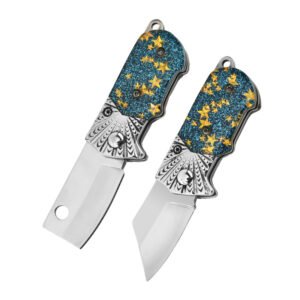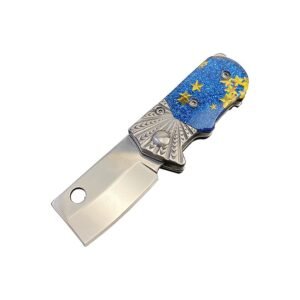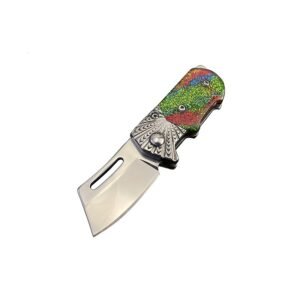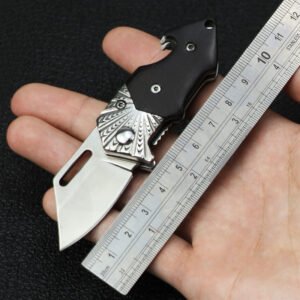


Are Mini OTF Knives Good Sellers? A Wholesale Verdict

Short answer
Mini OTF knives can sell well, but only in the right size band, price tier, and market. See what drives sell-through, where they miss, and how wholesale buyers
Key Takeaways
- Knife rules can vary by state, city, blade style, opening mechanism, carry method, and intended use.
- Do not treat a product nickname as a legal category; check the actual features and local rule.
- Retailers should keep legal or safety language factual and avoid promising that one item is allowed everywhere.
Terms Used Here
- OTF
- Out-the-front; a knife design where the blade moves forward from the front of the handle.
- Automatic knife
- A knife that opens by a spring-driven mechanism after the user activates a button, switch, or slider.
In this article
- 01 What makes mini OTF knives sell well
- 02 Where mini OTF knives underperform
- 03 A practical buying checklist for wholesale orders
- 04 Mini-case: one size sold, one size stalled
- 05 Common mistakes buyers make with mini OTF knives
- 06 The bottom line for wholesale buyers
- 07 Are mini OTF knives better than full-size OTF knives?
- 08 What blade length sells best in a mini OTF?
- 09 Who should avoid stocking mini OTF knives?
- 10 Do mini OTF knives work for private-label programs?
Yes, mini OTF knives can be good sellers, but only when the size, price, and use case match the buyer base. They usually sell best as compact everyday-carry items, gift-counter products, and add-on purchases, not as the main utility SKU for every dealer.
This advice is for wholesale buyers, distributors, private-label programs, and serious retailers deciding whether to stock smaller out-the-front autos. The tradeoff is simple: mini models often move faster at the counter because they are easy to pocket and easy to price, but they can disappoint users who expect full-hand grip, heavier cutting tasks, or a larger blade profile.
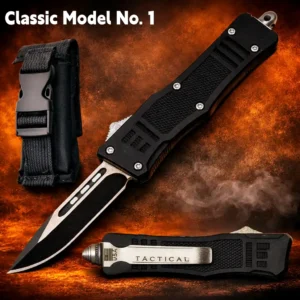
A mini OTF knife, for this article, means a smaller out-the-front automatic knife usually around a 1.9 to 2.75 inch blade and roughly a 3.25 to 4.25 inch closed handle. It is not the same thing as a standard OTF with a 3.0 to 3.75 inch blade, and that size difference matters for hand fit, local policy limits, and return rates.
Why this answer: it is based on common OTF product specs, repeat buying patterns in compact automatic knives, and the practical limits buyers report around hand size, task type, and local blade-length rules.
Evidence note: the claim comes from comparing typical mini OTF dimensions and price bands with common retail use patterns: compact carry, novelty interest, gift sales, and markets where shorter blades face fewer objections than larger autos.
What makes mini OTF knives sell well
Mini OTF knives usually sell when they solve a specific buying problem: customers want an automatic knife that feels smaller in the pocket, less intimidating in the hand, and easier to justify as a secondary carry piece. For many counters, that creates broader appeal than a large tactical-style OTF.
There are four measurable reasons they move:
- Blade length: A 2.1 inch or 2.4 inch blade attracts buyers who do light cutting such as opening boxes, cutting tape, trimming cord, or handling package straps.
- Handle length: A 3.5 to 4.0 inch handle fits small and medium hands better than oversized OTF frames, especially for customers who dislike bulky pocket clips.
- Price ceiling: Mini OTFs often sit in a lower wholesale and retail band than full-size models, which helps impulse purchase and multi-unit ordering.
- Carry context: They fit gift shops, smoke shops, outdoor counters, convenience-adjacent knife displays, and online stores that depend on compact visual appeal.
A realistic example: a regional reseller buys 120 units across two sizes. The 2.2 inch mini with a 3.6 inch handle sells steadily near the register because customers can hold it, fire it once, and understand it immediately. The 3.4 inch standard OTF gets fewer casual buyers but stronger interest from users who want more grip and cutting reach. In that case, the mini is the faster seller, but not the only one worth carrying.
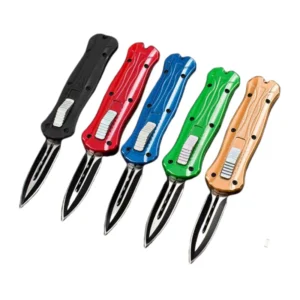
Mini OTFs also work well in private-label programs when the goal is a compact branded item rather than a hard-use tool. A smaller frame gives more room for color variation, simple logo placement, and giftable packaging without forcing the buyer into a high retail price.
Where mini OTF knives underperform
Mini OTF knives are not the best choice when the end customer expects a primary work knife. If the buyer base includes warehouse staff, tradespeople, ranch users, or customers with large hands, a mini can create friction: shorter grip, less leverage, and less confidence in tougher cuts.
Here are the common limits:
Hand fit: A 3.3 inch handle may only give a two-and-a-half or three-finger grip. That feels secure enough for opening mail, plastic wrap, or food packaging, but not for repeated utility cuts.
Task mismatch: A 1.9 inch blade is fine for tape and string. It is less satisfying for cardboard breakdown, heavy zip ties, hose trimming, or longer slicing motions.
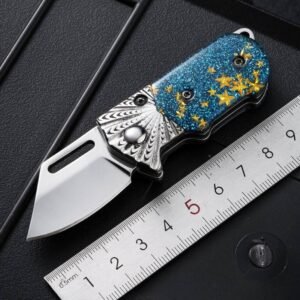
Expectation gap: Some buyers see the OTF mechanism and expect full-size performance. If the product photos do not show scale clearly, returns and complaints increase.
Perceived novelty risk: Extremely small models can drift from practical tool into novelty purchase. Novelty can sell, but reorder rates are less reliable than for compact-but-usable sizes.
This is where wholesale buyers make a mistake: they assume “smaller means broader market.” In OTF knives, that is only true up to a point. A 2.5 inch blade with a 4.0 inch handle can be broadly acceptable. A 1.75 inch blade with a tiny frame may attract attention but lose repeat demand after the first order.
A practical buying checklist for wholesale orders
If you are deciding whether mini OTF knives deserve shelf space or a private-label run, use this checklist before placing a larger order:
- Set the size band first. For stronger sell-through, target roughly 2.1 to 2.75 inch blades and 3.5 to 4.2 inch handles. Below that, utility drops quickly.
- Match the knife to the task type. Light package opening, cord, tape, and everyday pocket use support mini OTF demand. Hard-use utility does not.
- Check hand fit on a sample. Have at least two people with different hand sizes test deployment and grip. If the pinky falls off badly and the switch is stiff, returns are more likely.
- Audit carry context. Ask where the knife will actually be sold: counter display, online listing, gift section, or workwear retail. Minis do better in compact-display environments.
- Price for add-on buying. Mini OTFs often perform best when they feel reachable as a second knife, branded item, or gift purchase.
- State dimensions clearly. Include blade length, closed length, weight, and intended task type in sales materials. Mini OTF returns often come from scale confusion.
- Review policy constraints. Local automatic-knife rules and blade-length preferences can sharply change demand by state, city, or distributor territory.
If you need to compare available formats, start with an OTF knife catalog and sort by blade length before you sort by finish or handle color. Size is the first filter that changes sell-through.
Mini-case: one size sold, one size stalled
A private-label buyer supplying small outdoor stores tested two OTF autos with the same handle material and finish options. Model A had a 2.3 inch blade, 3.8 inch closed handle, and moderate thumb-slide resistance. Model B had a 1.8 inch blade, 3.1 inch closed handle, and a very compact frame.
Model A reordered in six weeks. Buyers described it as a “small real knife” suitable for pocket carry, opening feed bags, cutting line, and package work. Model B drew attention at first but slowed after the launch period. Customers liked the mechanism but often handled it, smiled, and chose something larger.
The lesson is not that tiny OTFs fail. The lesson is that usable mini sizes sell better than novelty mini sizes. For most wholesale accounts, the strongest mini OTF is the one that still gives a believable working grip.
Common mistakes buyers make with mini OTF knives
The first mistake is over-ordering the smallest frame because the sample feels fun. Sample appeal and reorder appeal are not the same thing.
The second mistake is ignoring switch effort. On a very small OTF, a stiff slider can feel harsher because there is less handle area to brace against. That matters for first impressions at the counter.
The third mistake is mixing all small OTFs into one bucket. A 2.7 inch blade mini and a 1.9 inch blade mini do not sell for the same reason. One competes as a compact tool; the other may compete as a novelty or key-pocket item.
The fourth mistake is vague merchandising. If the listing or display does not say “2.2 inch blade” and “light-duty cutting,” customers fill in the blanks themselves and may expect a larger working knife.
The fifth mistake is skipping territory review. In some markets, shorter blades are easier to place. In others, automatic-knife restrictions narrow the audience regardless of size. If you are buying for multiple regions, use the wholesale inquiry process early to confirm configuration and market fit through the wholesale inquiry form.
The bottom line for wholesale buyers
Mini OTF knives are good sellers when they stay on the practical side of small. The strongest performers usually have enough blade for everyday cutting, enough handle for a stable grip, and a price that makes sense as a compact automatic rather than a collector-only item.
If your customers want a light-duty OTF for pocket carry, gift purchase, or branded resale, minis deserve a place in the assortment. If your customers want one knife to do harder daily work, make the mini a secondary option and keep a standard-size OTF beside it.
A short rule worth remembering: small sells; too small stalls. In wholesale terms, that means compact utility models often reorder, while ultra-mini novelty sizes need tighter quantities and more careful account selection.
Are mini OTF knives better than full-size OTF knives?
No. They are better only for buyers who value smaller pocket size, lighter tasks, and lower price resistance. Full-size OTF knives usually win on grip, leverage, and broader utility.
What blade length sells best in a mini OTF?
For many accounts, around 2.1 to 2.75 inches is the safer zone. That range stays compact without losing too much practical cutting ability.
Who should avoid stocking mini OTF knives?
Retailers focused on work knives, heavy utility users, or customers with large hands should not rely on minis as the main OTF offering. They fit better as a secondary size option.
Do mini OTF knives work for private-label programs?
Yes, especially for compact branded products, gift-oriented retail, and lower-risk test runs. Just avoid frames so small that the mechanism becomes the only selling point.