

Are OTF Knives Better Than Folding Knives? A Clear Buying Guide

Short answer
Are OTF knives better than folding knives? Usually no. OTF knives are best for fast one-handed access and compact carry, while folding knives usually win for ha
Key Takeaways
- Knife rules can vary by state, city, blade style, opening mechanism, carry method, and intended use.
- Do not treat a product nickname as a legal category; check the actual features and local rule.
- Retailers should keep legal or safety language factual and avoid promising that one item is allowed everywhere.
Terms Used Here
- OTF
- Out-the-front; a knife design where the blade moves forward from the front of the handle.
- Automatic knife
- A knife that opens by a spring-driven mechanism after the user activates a button, switch, or slider.
- Folding knife
- A knife with a blade that pivots into the handle for storage.
In this article
- 01 Quick comparison: OTF vs folding knives
- 02 Best for daily utility
- 03 Best for heavy cutting
- 04 Best value for money
- 05 Maintenance and reliability
- 06 Carry comfort and access
- 07 Legal considerations
- 08 How to tell which is better for you
- 09 One misconception that confuses buyers
- 10 So, are OTF knives better than folding knives?
- 11 FAQ
- 12 Are OTF knives good for everyday carry?
No, OTF knives are not broadly better than folding knives. They are better for a few specific priorities: fast one-handed access, easy use with gloves, and compact carry. Folding knives are usually the better choice for harder cutting, lower cost, and simpler maintenance.
In plain English: an OTF is a specialist tool, while a folding knife is usually the safer all-around buy.
Quick comparison: OTF vs folding knives
- Best for daily utility: Tie. OTFs are convenient for short, repetitive tasks like opening boxes and cutting tape, while folders are often more comfortable for longer use.
- Best for heavy cutting: Folding knife. A solid folder usually feels more stable under pressure, especially when cutting dense material or working for longer periods.
- Best value: Folding knife. At the same price, especially at lower price points, folders often offer better blade steel, handle material, and overall durability.
- Best for fast one-handed access: OTF knife. A thumb slider can be quicker and easier to operate without changing grip much.
- Best for glove-friendly use: OTF knife. Many users find a broad slider easier to operate than a small thumb stud or nail nick.
- Best for easy cleaning and upkeep: Folding knife. A simple pivot-and-lock folder is usually easier to inspect, clean, and maintain.
- Best legal simplicity: Folding knife. Laws vary by location, but automatic OTF knives often face more restrictions than standard folders.
Best for daily utility
If your normal tasks are opening packages, cutting shrink wrap, slicing tape, or handling quick household jobs, both types can work well. An OTF knife has a real convenience advantage because the blade deploys and retracts straight out of the handle. That can feel efficient when one hand is busy or when you want to close the knife quickly after a short cut.
That said, many people still prefer a folding knife for everyday carry because it tends to offer a fuller handle shape and a more familiar grip. For repeated cuts through cardboard, rope, or plastic, that extra comfort matters more than deployment speed.
If your daily use is light and short, OTF can be a good fit. If your daily use is frequent and forceful, a folder is usually the better tool.
Best for heavy cutting
Folding knives are usually better for heavy cutting. This is especially true in budget and mid-priced ranges, where many folders have a simpler and sturdier structure than many OTFs at the same cost.
Why? A folder typically relies on a pivot, stop pin, and lock such as a liner lock, frame lock, back lock, or crossbar-style lock. That setup often feels more solid when you bear down on the blade. An OTF has a more complex internal mechanism because the blade has to travel in and out of the handle. That complexity is part of what makes the design appealing, but it can also make the knife feel less confidence-inspiring under twisting or sustained pressure.
This does not mean all OTF knives are weak. Better-made OTFs can be very useful and well built. But as a broad buying rule, folders are the safer choice for harder work.
Best value for money
For most buyers, folding knives offer better value. If you compare two knives at the same price, the folder often gives you more practical performance for the money.
That is especially true at lower price points. A budget folder may give you better steel, better edge retention, a stronger-feeling lock, and easier serviceability than a budget OTF. With OTFs, more of the cost goes into the firing mechanism, switch, springs, and internal track system. With folders, more of the budget often goes into the blade and handle.
If your goal is the best working knife per dollar, folding knives usually win. If your goal is a compact automatic format with fast deployment, an OTF may still be worth paying extra for.
Maintenance and reliability
Folders are usually easier to maintain. Dirt in a folder pivot is often easier to flush out or clean than lint, grit, or adhesive residue inside an OTF track and firing system.
This point is worth qualifying: not every OTF is unusually finicky, and not every folder is trouble-free. But many OTFs, especially cheaper ones, are more sensitive to debris and tolerance issues.
One concrete example: on a typical double-action OTF, the thumb slider moves a carriage inside the handle. If pocket lint or fine grit builds up in that track, the blade may fail to fully deploy or may misfire and stop before lockup. On a basic folding knife, the main moving parts are easier to see and access: the pivot, lock face, detent, and stop pin.
A specific buying signal: if you handle an OTF and the slider feels mushy, gritty, or inconsistent, that is a warning sign. A decent OTF should have deliberate resistance and a clean reset. On cheaper models, inconsistent deployment after light pocket debris is a common failure mode.
Carry comfort and access
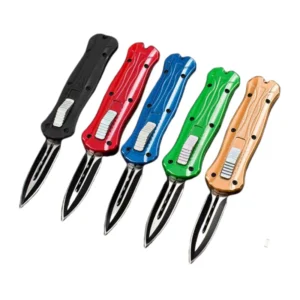
This is where OTF knives often make their strongest case. Many have a slim, rectangular shape that rides neatly in the pocket. Some users prefer that profile over a folder with a flipper tab, thumb stud, or wider scales.
OTFs can also be easier to access in tight spaces. If you are seated, wearing gloves, or using your other hand to hold something, the straight-line deployment can be more convenient than rotating open a blade around a pivot.
That convenience is real, but it matters most if fast access and compact carry are among your top priorities. If not, it may not outweigh the folder’s advantages in value and durability.
Legal considerations
This category matters more than many buyers expect. Laws vary widely by location, and automatic knives may be restricted differently from manual folding knives. In some places, ownership is allowed but carry is limited. In others, blade length, opening mechanism, or intended use may affect legality.
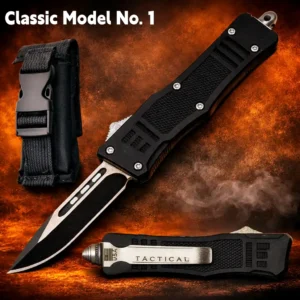
Do not assume the rules are the same everywhere. Verify your local and state laws before buying or carrying an OTF knife. If you want to browse examples of the format, an OTF knife collection can help you see the common designs, but legal compliance is still your responsibility.
How to tell which is better for you
- Choose an OTF if: quick straight-line deployment, compact pocket carry, and easy one-handed use matter most.
- Choose a folding knife if: durability, lower price, and easy upkeep matter most.
- Lean toward a folder if: you cut a lot of cardboard, rope, or dense material for extended periods.
- Lean toward an OTF if: your tasks are short, repetitive, and convenience-focused.
- Be cautious with budget OTFs: at lower price points, quality differences show up quickly in switch feel and firing consistency.
One misconception that confuses buyers
Misconception: if an OTF blade has a little movement, it must be defective.
Not necessarily. Many OTF knives have some blade play by design because the blade travels on an internal mechanism and needs to disengage safely if it hits resistance during deployment. A small amount of movement does not automatically mean the knife is broken. The real concern is inconsistent lockup, failure to fully deploy, or failure to reset after a misfire.
So, are OTF knives better than folding knives?
Usually no, not for most buyers. Folding knives are generally better as all-purpose tools because they cost less, handle hard cutting better, and are easier to maintain. OTF knives are better when you specifically want fast one-handed access, glove-friendly operation, and a slim carry profile.
If you want one knife to do almost everything well, buy a good folder. If you want a compact automatic knife for light-to-medium utility and easy deployment, an OTF can be the better fit.
FAQ
Are OTF knives good for everyday carry?
Yes, they can be excellent for light-to-medium daily tasks like opening boxes, cutting tape, and quick utility work. But if you want maximum value, easier maintenance, or better performance in harder cutting, a folding knife is usually the smarter everyday choice.