

Are OTF Knives Better Than Side Opening Automatics?

Short answer
Are OTF knives better than side-opening automatics? Yes for slim carry and one-hand retraction; no for dirt tolerance, simpler maintenance, and traditional cutt
Key Takeaways
- Knife rules can vary by state, city, blade style, opening mechanism, carry method, and intended use.
- Do not treat a product nickname as a legal category; check the actual features and local rule.
- Retailers should keep legal or safety language factual and avoid promising that one item is allowed everywhere.
Terms Used Here
- OTF
- Out-the-front; a knife design where the blade moves forward from the front of the handle.
- Automatic knife
- A knife that opens by a spring-driven mechanism after the user activates a button, switch, or slider.
- Folding knife
- A knife with a blade that pivots into the handle for storage.
In this article
- 01 Short answer: which one is actually better?
- 02 1. Deployment: OTF is more compact in motion
- 03 2. Debris tolerance: side-opening is usually the safer choice
- 04 What an OTF misfire actually looks like
- 05 3. Cutting ergonomics: side-opening often feels better in actual use
- 06 4. Maintenance and troubleshooting: side-opening is easier to live with
- 07 How to tell which one will annoy you less
- 08 5. Price and value: side-opening usually gives more utility per dollar
- 09 One misconception worth clearing up
- 10 Best for what? A direct answer matrix
- 11 So, are OTF knives better than side opening automatics?
- 12 FAQ
- 13 Are OTF knives more reliable than side-opening automatics?
- 14 Which style is better for everyday carry?
- 15 What should a first-time automatic knife buyer choose?
Usually no—unless your top priority is one-hand retraction and a very slim carry profile. For most buyers, a good side-opening automatic is the better all-around tool because it is typically easier to maintain, more tolerant of lint and grit, and more comfortable in longer cutting sessions. OTF is better if you want straight-out deployment and fast one-switch open-and-close.
In plain English: choose an OTF for compact carry and convenient retraction; choose a side-opening automatic for simpler ownership and more traditional cutting performance.
| Knife style | Best for | Main drawbacks | Debris tolerance | Maintenance | Cutting comfort | Price/value |
|---|---|---|---|---|---|---|
| OTF automatic | Slim pocket carry, straight-line deployment, one-hand retraction | More sensitive to lint, grit, and weak slider actuation | Usually lower | Usually needs more careful cleaning and lighter lubrication | Often good for short tasks, less ideal for prolonged cutting if the handle is flat | Often costs more for the mechanism |
| Side-opening automatic | General everyday use, dirtier work environments, familiar knife feel | Needs side clearance to open, usually not as convenient to close one-handed | Usually higher | Usually simpler to inspect, flush, and troubleshoot | Often better for repeated cardboard, rope, and utility cuts | Usually stronger practical value at the same budget |
Short answer: which one is actually better?
If you define “better” as better tool for real work and easier ownership, side-opening automatics usually win.
If you define “better” as better carry shape and better one-hand open-and-close convenience, OTF knives usually win.
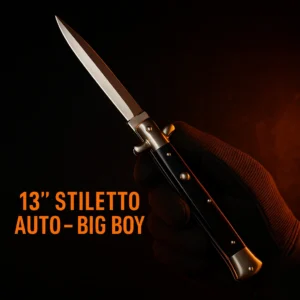
The important point is that these are not equal mechanisms with different looks. They behave differently in the pocket, under dirt, and in the hand. That matters more than marketing terms like “advanced” or “tactical.”
1. Deployment: OTF is more compact in motion
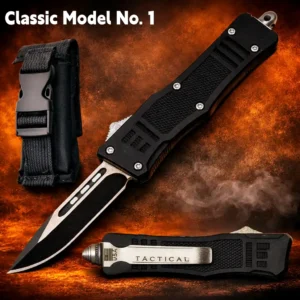
An OTF sends the blade straight out the front. A side opener swings the blade out on a pivot. That sounds like a small difference, but it changes how the knife works around shelves, inside a vehicle, or when your off hand is busy.
Observable test: hold the closed knife next to a wall or box edge. A side opener needs room for the blade to arc open. An OTF does not; the blade travels on the centerline of the handle.
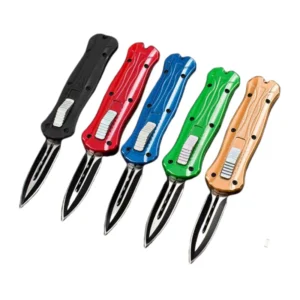
This is the clearest reason some users prefer OTFs. On a double-action OTF, the same thumb slider opens and retracts the blade. For quick utility tasks, that is genuinely convenient.
Real-world example: when breaking down a box beside a shelving unit, an OTF can be used as: thumb on the slider, push forward, blade locks out, make the cut, pull the slider back, blade retracts, pocket the knife. A side opener can open quickly too, but closing usually involves a separate button-and-fold sequence or two distinct hand motions.
Verdict on deployment: OTF is better if tight-space opening and one-hand retraction matter more than anything else.
2. Debris tolerance: side-opening is usually the safer choice
This is where many first-time buyers get surprised. OTFs are not automatically unreliable, but they are usually less forgiving of pocket lint, fine grit, and incomplete slider travel.
A side-opening automatic also has springs and locking parts, but its mechanism is often easier to keep running when the knife sees dusty pockets, work pants, or dirty jobsite conditions.
What an OTF misfire actually looks like
The classic OTF failure mode is a misfire. The blade starts out, stops short, and does not fully lock. On many double-action OTFs, this happens because the blade met resistance, the track was dirty, or the user did not drive the slider all the way with firm pressure. The blade may sit partially extended or free enough to reset rather than locking solidly open. That is usually a safety behavior, not a catastrophic breakage.
Buyer cue: if you test an OTF and the slider feels slick, vague, or mushy, expect more frustration. A better OTF usually has clear traction and a firm, repeatable stroke.
Quality-tier caveat: this matters most in cheaper OTFs. Well-made examples from established makers such as Microtech have a stronger track record than bargain models, but even high-quality OTFs are still generally more debris-sensitive than a good side opener.
Verdict on debris: side-opening is better if the knife will live in linty pockets, dusty trucks, work bags, or dirty environments.
3. Cutting ergonomics: side-opening often feels better in actual use
Many OTF handles are slim, straight, and rectangular. That shape carries well, but it does not always feel best when you are cutting for several minutes.
Side-opening automatics are usually closer to standard folding knives in handle shape. They often have more contour, more palm fill, and a grip angle that feels more natural for repeated utility cuts.
Simple test before buying: imagine cutting ten feet of cardboard or several lengths of rope. Which handle looks easier to squeeze firmly without creating hot spots? In many cases, the side opener wins.
This is not universal. Some OTFs are comfortable enough for daily tasks, and some side openers are too thin or too aggressive in the handle. But as a category, side-openers more often feel like tools, while OTFs more often feel optimized for carry and mechanism.
Verdict on cutting comfort: side-opening is usually better if the knife will be used for repeated cutting rather than quick, short tasks.
4. Maintenance and troubleshooting: side-opening is easier to live with
If you want the lower-fuss automatic, side-opening usually wins. The mechanism is still specialized, but it is generally easier to understand, inspect, and flush clean.
OTFs ask for a bit more discipline. Dirt inside the chassis matters more. Too much oil can attract more debris. Weak actuation can mimic a mechanical problem. If you buy an OTF, you are buying into a mechanism that rewards clean tracks and proper thumb pressure.
How to tell which one will annoy you less
- If you dislike maintenance, choose side-opening.
- If you often carry in gym shorts, work pants, or linty pockets, choose side-opening.
- If you want to retract the blade quickly without changing grip, choose OTF.
- If you want a knife that feels closest to a normal folder, choose side-opening.
- If the unique slider action is the main reason you want an automatic, choose OTF.
Practical maintenance boundary: if you know you will not clean the knife until it starts acting up, a side opener is the safer purchase.
5. Price and value: side-opening usually gives more utility per dollar
At similar quality levels, OTFs often cost more because the mechanism is more complex and harder to execute well. You are paying for the out-the-front action, the internal track system, and the fit needed to make that action feel crisp.
Side-opening automatics usually make value easier to understand. More of your budget often goes into blade, handle, lockup, and cutting performance instead of into a more specialized deployment system.
Buyer rule: if your budget is limited and your goal is a practical user, side-opening is usually the better value. If the exact feature you want is one-switch deployment and retraction, the added cost of an OTF may be worth it because a side opener does not duplicate that experience.
One misconception worth clearing up
Misconception: OTF knives are more advanced, so they must be better.
Reality: OTF knives are more specialized, not automatically more useful. They solve a specific set of preferences very well. That is different from being the best automatic knife format for most users.
Best for what? A direct answer matrix
- Best for fast one-hand open and close: OTF
- Best for dirty or lint-heavy carry: Side-opening automatic
- Best for slim pocket carry: OTF
- Best for long cutting sessions: Side-opening automatic
- Best for first-time automatic buyers: Side-opening automatic
- Best for buyers who specifically want slider-driven action: OTF
So, are OTF knives better than side opening automatics?
No for most people. A side-opening automatic is usually the better all-around choice because it is easier to maintain, more tolerant of debris, and more comfortable for normal cutting tasks.
Yes for a narrower type of buyer. An OTF is better if you specifically want straight-out deployment, very slim carry, and the convenience of opening and retracting the blade with the same control.
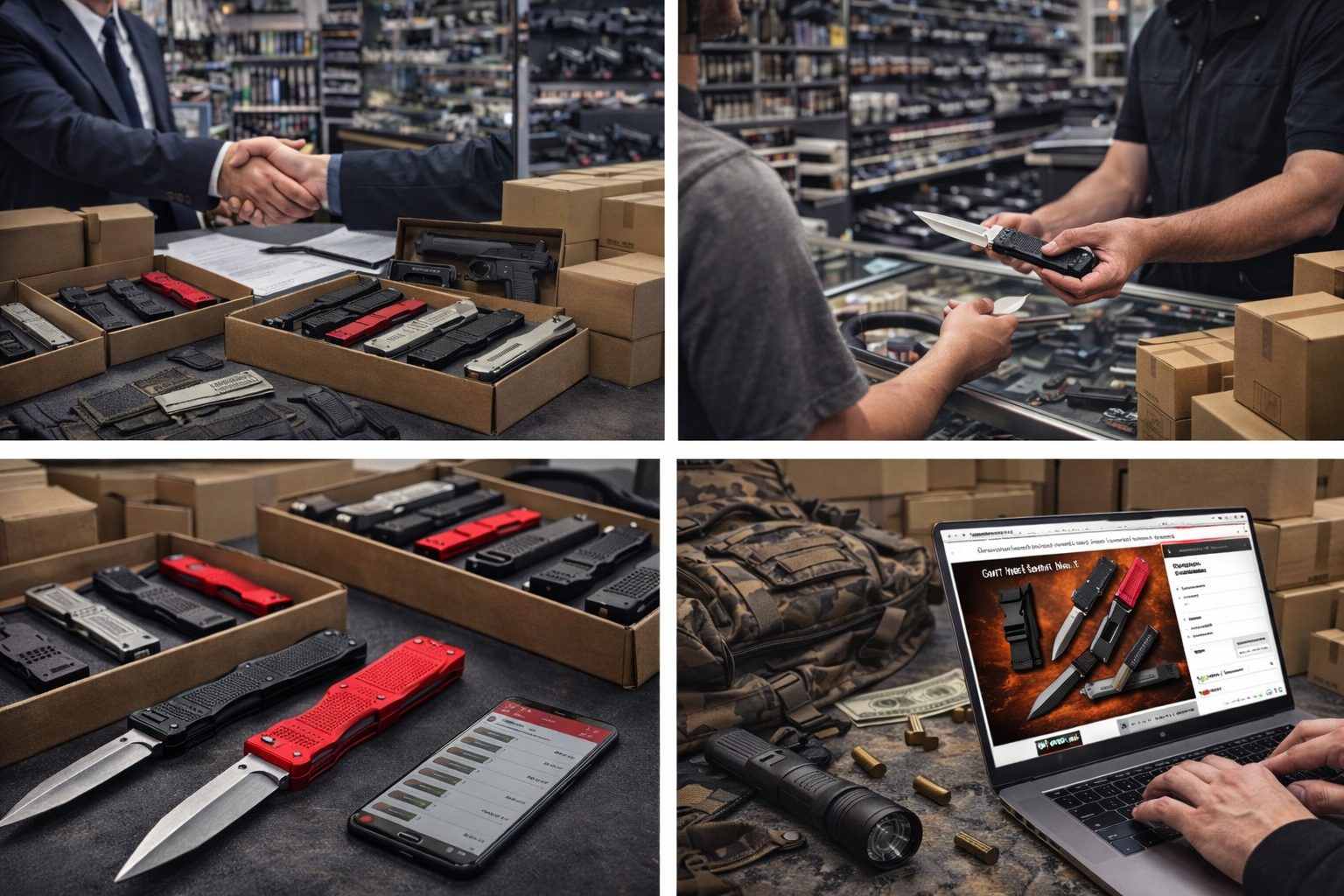
If you want to compare current designs after deciding which mechanism fits your use, see the OTF knife collection or the broader utility and self defense category.
FAQ
Are OTF knives more reliable than side-opening automatics?
Usually not in dirty conditions. A well-made OTF can be dependable, but side-opening automatics are generally more forgiving of lint, grit, and imperfect actuation.
Which style is better for everyday carry?
OTF is better for slim carry and quick retraction. Side-opening is better for buyers who want easier upkeep and a more traditional working knife feel.
What should a first-time automatic knife buyer choose?
Choose a side-opening automatic if you want the simplest ownership experience. Choose an OTF if the main reason you are buying is the slider, straight-line deployment, and one-hand retraction.