

Can Cold Weather Affect an OTF Knife?


Short answer
Yes, cold weather can affect an OTF knife by slowing the action, thickening lubricant, and making weak springs or debris more noticeable. Learn what is normal,
Key Takeaways
- Knife rules can vary by state, city, blade style, opening mechanism, carry method, and intended use.
- Do not treat a product nickname as a legal category; check the actual features and local rule.
- Retailers should keep legal or safety language factual and avoid promising that one item is allowed everywhere.
Terms Used Here
- OTF
- Out-the-front; a knife design where the blade moves forward from the front of the handle.
In this article
- 01 What cold weather does to OTF mechanics
- 02 Normal behavior vs defect indicators
- 03 How to tell the common causes apart
- 04 1) Thick or excessive lubricant
- 05 2) Pocket lint, grit, or dried residue in the track
- 06 3) Moisture, condensation, or frost
- 07 4) Weak spring or worn lock interface
- 08 Safe checks you can do without disassembly
- 09 What not to do
- 10 When cold weather means the knife needs service
- 11 FAQ
- 12 Can an OTF knife freeze shut?
- 13 Is slower deployment in winter always a problem?
- 14 Should I add more oil in winter?
- 15 Can cold weather weaken the spring permanently?
Yes. Cold weather can affect an OTF knife by making the action feel slower, making lubricant thicken, and exposing small problems in the spring, switch, track, or lockup that were less obvious at room temperature. A slight change in deployment speed can be normal; repeated misfires, a sticky thumb slide, or failure to lock open or closed is not.
Quick triage:
- Normal: the thumb slide feels a bit stiffer, the blade fires slightly slower, and the knife works normally again after warming up indoors.
- Maybe: one occasional hesitation in very low temperatures, especially after pocket lint, moisture, or old oil has built up in the chassis.
- Stop-use: repeated failure to lock, partial deployment, a blade that comes off track, a slide that jams hard, or visible moisture, frost, or corrosion inside the opening.
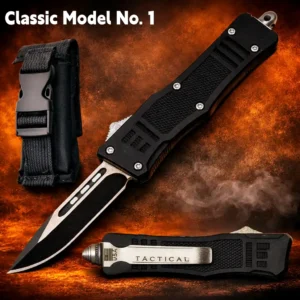
In an OTF, the exact parts affected are the thumb slide, firing spring or spring assembly, blade tang, internal track or rails, and the locking interface that catches the blade in the open and closed positions. Cold does not usually “damage” a healthy OTF by itself. What it often does is reduce tolerance for friction, thick oil, dirt, or weak spring energy.
What cold weather does to OTF mechanics
An OTF knife depends on stored spring energy moving the blade straight through the handle on a guided path. That path has less margin for drag than a manual folder. In cold weather, three things matter most.
- Lubricant gets thicker. If the knife has too much oil, or a lubricant heavier than the maker recommends, the blade tang and track can drag more in the cold. The result is slower deployment or a failure to fully lock.
- Metal contracts slightly. This is usually not enough to hurt a quality knife, but in a knife already running dirty or tight, small dimensional changes can make friction more noticeable.
- Moisture becomes a bigger problem. Snow, condensation, and pocket humidity can combine with lint and grit. In freezing conditions, that contamination can briefly interfere with the switch, track, or lock faces.
The key point is simple: cold weather usually reveals an existing issue faster than it creates a new one. If an OTF only struggles when cold, look first for excess lube, debris in the track, moisture, or a spring that is already marginal.
Normal behavior vs defect indicators
Here is the most useful comparison for owners trying to decide whether their knife is acting normally.
- Normal cold-weather behavior: the thumb slide needs a little more force; the firing sound is slightly duller; deployment is a touch slower; performance returns after the knife dries and warms.
- Defect indicator: the blade stops short repeatedly, does not lock open, or retracts unexpectedly after deployment attempts.
- Normal cold-weather behavior: one isolated misfire after the knife was exposed to snow, then normal function after drying.
- Defect indicator: repeated misfires indoors and outdoors, especially with the same ammunition-like “half launch” every time, which can point to spring weakness, track drag, or lock interface wear.
- Normal cold-weather behavior: slight extra resistance at the start of the thumb slide travel.
- Defect indicator: a gritty, scraping, or notchy slide feel, which suggests lint, grit, rust specks, or damage in the switch path.
A good rule: if the symptom disappears fully after the knife reaches room temperature and dries out, cold was probably amplifying contamination or heavy lubricant. If the symptom persists warm and clean, treat it as a mechanical problem, not a weather problem.
How to tell the common causes apart
Several cold-related issues can look similar from the outside. These signs help separate them.
1) Thick or excessive lubricant
- The action feels sluggish rather than gritty.
- The thumb slide moves, but the blade lacks full travel or lockup energy.
- The problem is worse after the knife has been heavily oiled.
- Performance improves after warming indoors.
This is common in OTFs because the blade tang and track need low drag. Many makers specifically caution against over-lubrication and recommend only the lubricant type and amount listed in their manual or service instructions.
2) Pocket lint, grit, or dried residue in the track
- The slide feels scratchy or inconsistent.
- The knife may work one cycle and fail the next.
- You may see lint around the blade opening.
- The issue is not limited to freezing temperatures.
On an OTF, contamination near the blade opening can migrate to the internal rails and interfere with the blade tang or locking surfaces.
3) Moisture, condensation, or frost
- The problem starts after snow, rain, or moving between cold outdoors and warm indoors.
- The knife may feel normal at first, then worsen after pocket carry.
- You may notice tiny water droplets near the blade slot or switch.
- Corrosion spots or discoloration may appear later if moisture stays trapped.
Condensation is easy to miss. A cold knife brought indoors can collect moisture internally even if it never touched snow directly.
4) Weak spring or worn lock interface
- The knife misfires warm and cold, but cold makes it happen more often.
- The failure pattern is repeatable.
- The blade may stop at nearly the same point each time.
- The knife has seen heavy use, prior hard impacts, or unknown disassembly.
Cold does not usually create a weak spring, but it can reduce the system’s margin enough that a borderline spring assembly can no longer overcome drag.
Safe checks you can do without disassembly
For most owners, the right first step is observation and basic external care, not opening the handle. Many makers warn that disassembly can void warranty coverage or create reassembly problems in double-action OTF mechanisms. Follow the maker’s manual first if one is available.
- Warm the knife to room temperature while closed. If the action returns to normal, cold plus drag was likely the trigger.
- Inspect the blade opening and thumb slide area. Look for lint, grit, moisture, or visible residue. These are the first places contamination shows up.
- Cycle the knife only a few times, not repeatedly. Repeated misfires can batter the lock faces or worsen a jam if debris is present.
- Dry the exterior fully. If the knife was exposed to snow or condensation, let it dry before further testing.
- Use only the maker’s lubrication guidance. If the manual specifies a light lubricant, a dry-film product, or a very small amount, do not substitute a heavy oil. If the maker says “run nearly dry,” respect that. OTFs are more sensitive to excess lube than many manual folders.
If you are comparing inventory samples or evaluating designs, a simple cold-weather check is useful: test the same knife clean and dry at room temperature, then after a period in a cold environment, and note whether the change is slight and reversible or severe and repeatable. Buyers reviewing current OTF knife models often use this kind of practical function check because OTF reliability depends more on internal drag control than on blade steel alone.
What not to do
- Do not flood the knife with oil. This is one of the most common ways to make a cold-weather OTF worse.
- Do not force the thumb slide aggressively through a jam. If the blade is off track or the lock is not engaging, extra force can damage the switch, spring interface, or lock faces.
- Do not disassemble the handle unless the maker explicitly allows it and you know the mechanism. Many OTF manuals direct owners to factory service for internal issues.
- Do not use a heat gun, open flame, or high heat to “fix” freezing. Rapid heating can damage finishes, seals, or lubricants and may trap more condensation later.
When cold weather means the knife needs service
Cold-weather slowdown by itself is usually manageable. Service is the better answer when the symptom points to a mechanical fault rather than temperature alone.
Arrange service or stop carrying the knife if you see any of these:
- Repeated failure to lock open or closed after the knife is dry and back at room temperature.
- Persistent gritty or scraping slide feel, especially if accompanied by visible rust, metal particles, or track debris.
- Blade derailing or partial deployment that requires a reset over and over.
- A sudden major change in action with no obvious moisture or dirt cause.
- Signs of corrosion inside the blade opening or around the switch.
For buyers evaluating batches, samples, or private-label builds, cold testing is worth documenting because it can reveal whether the mechanism has enough spring margin and clean enough track geometry for real-world use. If you need to discuss model specs or service expectations at order stage, use the wholesale inquiry form to ask about lubrication guidance, warranty handling, and cold-weather function checks before committing.
FAQ
Can an OTF knife freeze shut?
Yes, in some conditions. Moisture, condensation, or slush around the blade opening or internal track can interfere with the slide and locking parts. That is more likely than the metal itself “freezing” from temperature alone.
Is slower deployment in winter always a problem?
No. A slightly slower or stiffer action can be normal in low temperatures. It becomes a problem when the blade repeatedly fails to lock, stops short, or the slide feels jammed or gritty.
Should I add more oil in winter?
Usually not unless the maker’s manual specifically says to. On OTFs, excess oil often causes more drag in cold weather. Follow the manufacturer’s lubrication guidance exactly, especially on quantity and product type.
Can cold weather weaken the spring permanently?
Normal winter temperatures usually do not permanently weaken a healthy OTF spring. If the knife keeps misfiring after warming up and drying out, the spring or another internal part may already have been worn, damaged, or contaminated.