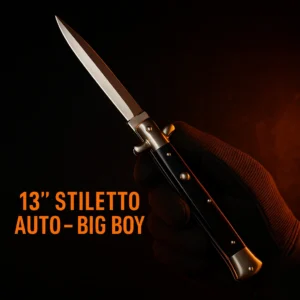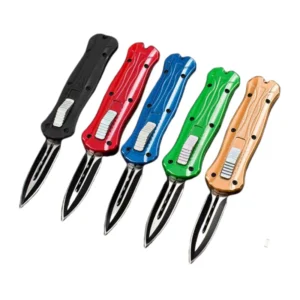


Can You Use an OTF Knife for Hunting?

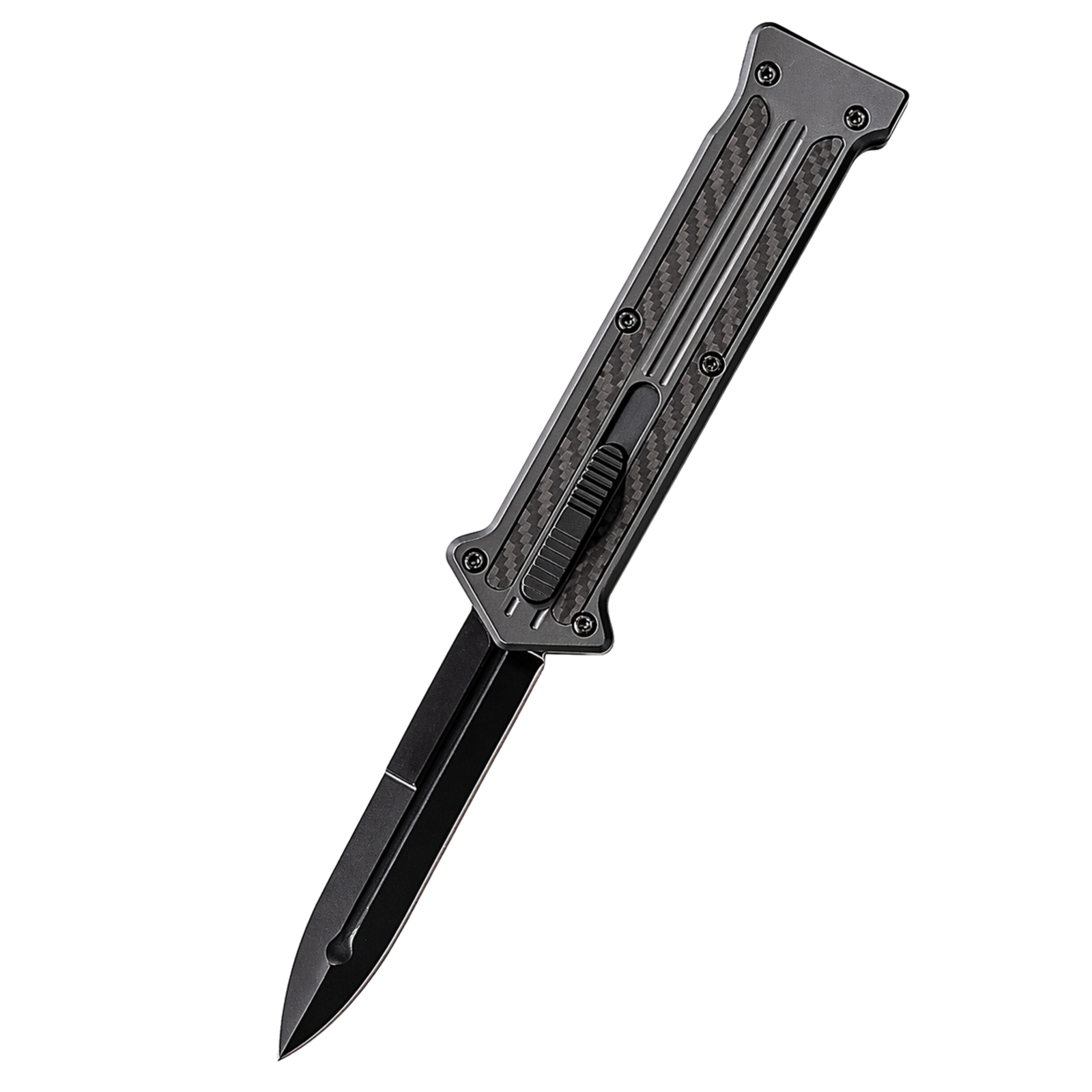
Short answer
Yes, but mostly for hunting support tasks and light cuts. Learn when an OTF knife works in the field, where it falls short on game processing, which blade shape
In this article
- 01 Best uses for an OTF on a hunting trip
- 02 Task-based answer: small game vs big game
- 03 Birds and small game
- 04 Deer, hogs, and larger game
- 05 Where an OTF struggles in animal processing
- 06 Clear wrong-tool scenarios
- 07 Pass/fail checklist: is an OTF a good fit for your hunt?
- 08 Best blade shape for hunting-related OTF use
- 09 Best overall: single-edge drop point
- 10 Also workable: single-edge spear point
- 11 Usually poor choices
- 12 Edge geometry matters more than style
- 13 Legal and carry caveats: three separate checks
- 14 The best setup for most hunters: two knives
- 15 FAQ
- 16 Can an OTF knife be my only hunting knife?
- 17 Is an OTF good for field dressing?
- 18 What is the best OTF blade style for hunting tasks?
- 19 Are OTF knives legal to carry while hunting?
- 20 What is the smartest way to carry an OTF on a hunt?
Yes—but only if you match it to the task, the animal, and the rules where you hunt.
For hunting, an OTF knife makes the most sense as a fast-access support knife for tape, cord, zip ties, food packs, and a few light, controlled cuts. It is usually a poor primary choice for full field dressing, skinning, joint work, or any job that is bloody, gritty, forceful, or prolonged. The practical decision comes down to three factors: what cutting jobs you actually do in the field, how much animal processing you expect, and whether OTF possession, carry, and site rules all allow it.
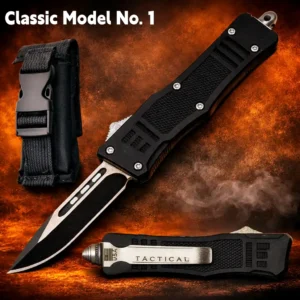
If you are comparing models, start with a practical OTF knife collection and think in terms of hunting support use, not one-knife-does-everything marketing.
Best uses for an OTF on a hunting trip
An OTF is at its best when the cut is short, clean, and controlled. Quick one-handed access can be genuinely useful when your other hand is holding gear, a pack strap, or a blind pole. That does not make it a dedicated hunting knife. It makes it a convenient field utility knife.
Tasks where an OTF can work well:
- Cutting tape on gear, batteries, or hand-warmer packs
- Trimming cord for blinds, decoys, drag lines, or pack organization
- Removing zip ties from tags, brackets, or new equipment
- Opening food packs, snack wrappers, and freeze-dried meal pouches
- Making a few shallow starting cuts in light field work
- Caping-sized detail cuts where you want a narrow, controllable tip
A realistic example: a whitetail hunter climbs into a stand before daylight, uses the knife to cut tape on a scent-free battery pack, trims cord on a gear hook, removes zip ties from a replacement strap, and opens a food pouch at midday. After a successful shot, the same knife may be fine for a careful opening cut and a few membrane cuts if a proper fixed blade is also on hand for the rest of the job.
That is a believable OTF role in the field: quick-access utility first, light cutting second.
Task-based answer: small game vs big game
Birds and small game
For birds, rabbits, and squirrels, an OTF can be more workable than many people think—especially if the knife has a thin single edge and the processing is light. Small animals usually require less force, shorter cuts, and less work around heavy joints than deer or hogs. Even so, a simple fixed blade or slip-joint is often easier to clean and easier to choke up on for fine work.
Where an OTF may be acceptable here:
- Light breasting-out work on birds
- Small, precise cuts on rabbits or squirrels
- General camp and gear tasks before and after the hunt
Deer, hogs, and larger game
This is where the limits show up quickly. A deer or hog asks more from a knife: longer skinning passes, more contact with blood and fat, more hide resistance, and more chances to work around cartilage, connective tissue, and dirty hair. If your plan includes full gutting, skinning, quartering, or joint work, an OTF is not the ideal primary tool.
On bigger game, an OTF is best limited to:
- A starting cut
- Short detail cuts
- Tag and gear tasks
For the actual animal breakdown, a fixed blade is still the better answer.
Where an OTF struggles in animal processing
The reason is not mystery or internet myth. It is tool design.
An OTF has a moving blade and an internal deployment mechanism. In ordinary pocket use, that may be fine. In game processing, the knife can be exposed to blood, fat, tissue, hair, dirt, sand, and moisture. Those contaminants do not automatically make the knife fail, but they create more maintenance risk than a simple fixed blade, which has no internal action to foul.
In practical terms, an OTF becomes less ideal when:
- The knife is repeatedly pushed through hide and membrane
- Hair and grit collect around the blade opening
- Blood and fat make the handle and switch slick
- You are wearing gloves and need absolute simplicity
- The job lasts long enough that easy rinsing and wipe-down matter
This is the key firsthand-style judgment many hunters arrive at after real field use: an OTF can do some processing cuts, but it is less forgiving when the work gets messy. A fixed blade tolerates abuse, contamination, and repeated wash-and-wipe cycles better because there is simply less going on mechanically.
Clear wrong-tool scenarios
These are the situations where an OTF is usually the wrong choice, not just a second-choice option:
- Skinning an entire deer or hog from start to finish
- Twisting through joints or cartilage
- Prying at bone, pelvis, or sternum
- Cutting frozen tissue with force
- Working in muddy or sandy conditions with no backup knife
- Any hunt where one knife must do all processing and be easy to fully clean on site
If that sounds like your normal hunting day, skip the idea of using an OTF as your only field knife.
Pass/fail checklist: is an OTF a good fit for your hunt?
- Pass: Your main knife tasks are tape, cord, zip ties, food packs, and other quick utility cuts.
- Pass: You may need one-handed access while handling gear.
- Pass: Your animal work is limited to a few light, careful cuts.
- Pass: You are also carrying a fixed blade for real processing.
- Pass: The knife is a single-edge profile with usable slicing geometry.
- Fail: You want one knife for field dressing, skinning, and joint work.
- Fail: You expect heavy blood, fat, hair, and grit exposure with no chance to clean the knife.
- Fail: You are choosing a double-edge dagger mainly because it looks tactical.
- Fail: Your hunt requires the knife to pry, twist, or work against bone.
Best blade shape for hunting-related OTF use
Best overall: single-edge drop point
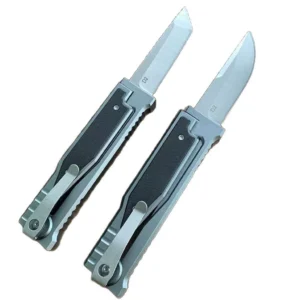
If you insist on carrying an OTF on a hunt, a single-edge drop point is usually the most useful shape. It offers a controllable tip, some belly for slicing, and a safer unsharpened spine for wet or gloved handling. That matters more in hunting than aggressive styling.
Also workable: single-edge spear point
A single-edge spear point can work if the grind is thin enough to slice well. It is still usually less natural than a drop point for hide and membrane work, but it can serve as a practical utility profile.
Usually poor choices
- Double-edge dagger: Less safe hand placement, less useful belly, and poorer fit for controlled field cuts.
- Tanto: Good for puncture-oriented tasks, but often awkward on curved slicing cuts and hide work.
Edge geometry matters more than style
For hunting support use, thin-to-medium edge geometry generally cuts better than an overly thick edge. A thick edge can feel strong in the hand but wedge more in hide and membrane. Partial serrations may help on synthetic cord or straps, but a plain edge is usually better if the knife may touch food or animal tissue.
Legal and carry caveats: three separate checks
Many articles stop at “check local law,” but the useful distinction is this: knife legality, carry legality, and hunting-site rules are separate questions.
- Knife legality: Is an OTF legal to own in your state or locality?
- Carry legality: Even if legal to own, is it legal to carry concealed, in a vehicle, or on your person in the field?
- Site or land rules: Public wildlife areas, parks, leased land, outfitters, and private landowners may set their own restrictions.
So an OTF may be legal in general but still restricted where you hunt or how you transport it. That is especially important on public land, at managed hunting areas, or when crossing state lines.
The best setup for most hunters: two knives
For most real hunting use, the best answer is a two-knife setup:
- OTF knife: quick-access utility, packaging, cord, zip ties, and a few light cuts
- Fixed blade: field dressing, skinning, joint work, and messy animal processing
This setup lets each tool do what it is actually good at. You keep the convenience of an automatic pocket knife without forcing it into jobs where a fixed blade is safer, simpler, and easier to clean.
If you are shopping with that use case in mind, focus on practical blade shape, grip security, and carry reliability rather than tactical styling or novelty features.
FAQ
Can an OTF knife be my only hunting knife?
Only for very light use. If you may dress deer, hogs, or other large game, it should not be your only knife.
Is an OTF good for field dressing?
It can handle a few careful cuts, but it is not the best tool for full field dressing. Fixed blades are simpler, easier to clean, and better suited to messy work.
What is the best OTF blade style for hunting tasks?
A single-edge drop point is usually the best choice because it gives better control, safer handling, and more useful slicing shape than a dagger or tanto.
Are OTF knives legal to carry while hunting?
Sometimes. You need to check three things separately: whether the knife is legal to own, whether it is legal to carry the way you plan to carry it, and whether the specific hunting area or landowner allows it.
What is the smartest way to carry an OTF on a hunt?
As a secondary utility knife, paired with a fixed blade for processing. That is the setup that makes the most practical sense for most hunters.