




How Strong Is the Lockup on an OTF Knife?

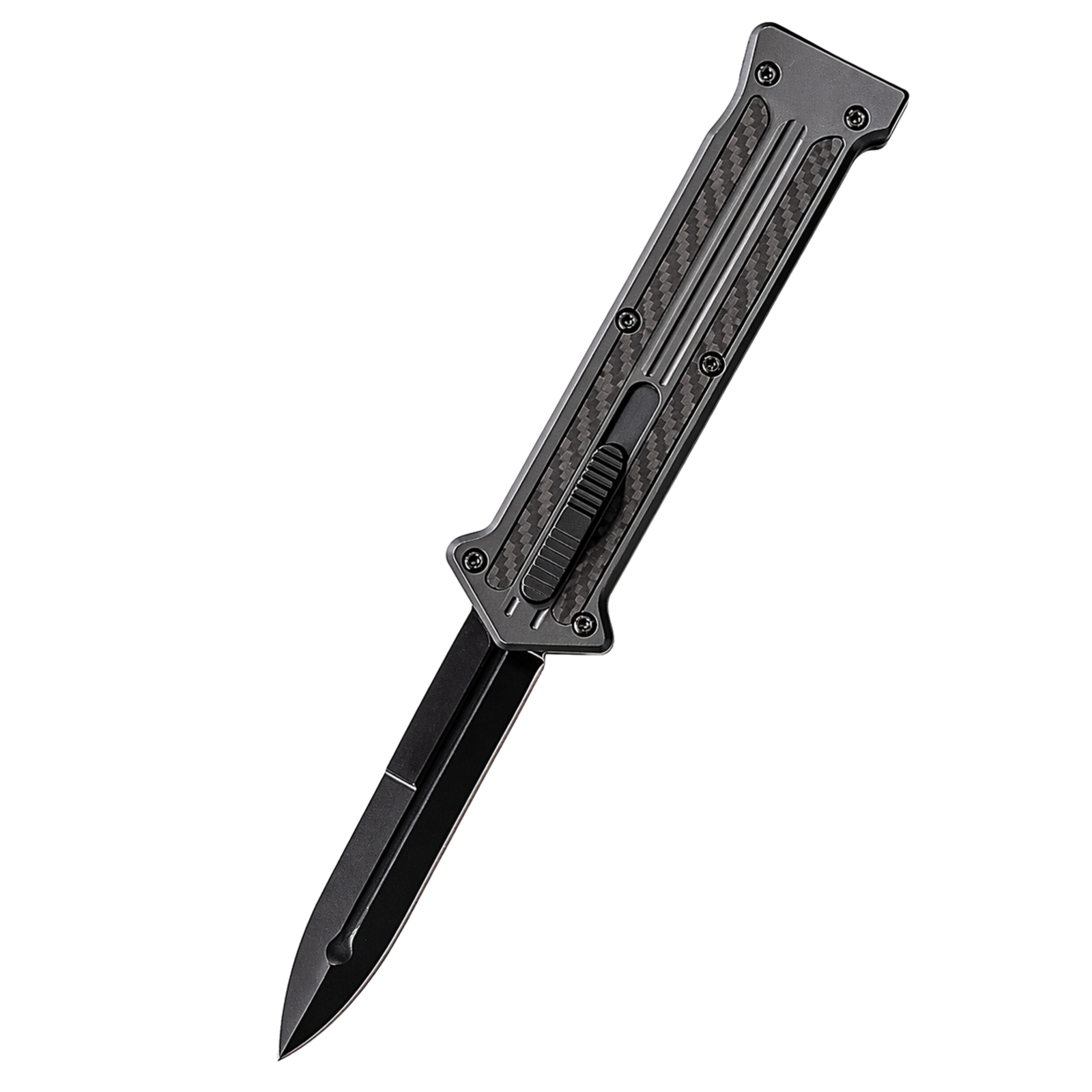
An OTF knife usually locks securely enough for normal cutting and daily utility work, but its lockup often feels slightly less rigid than a good side-opening automatic or fixed blade because the blade rides in internal tracks and locks through a carriage-and-sear system that needs some clearance to deploy and reset.
That means two things can be true at once: a little blade play can be normal, and a bad lockup is still a real problem. The useful question is not whether an OTF feels perfectly motionless in hand. The useful question is whether it reaches full lockup every time, stays locked during ordinary cutting pressure, and keeps the same feel over repeated use.
Why OTF lockup usually feels different
Most double-action OTF knives do not lock like a liner lock or frame lock, where a springy bar wedges directly behind the blade tang. Instead, the blade travels forward and backward inside the handle on rails or tracks. A moving carriage, driven by spring tension through the thumb slider, pushes the blade out. At full travel, internal lock surfaces engage and stop the blade in the open position.
That design has tradeoffs. To move quickly, the blade needs clearance in the tracks. The carriage and lock surfaces also need enough tolerance to disengage and reset if the blade is obstructed during deployment. If everything were fitted with near-zero clearance, friction and debris sensitivity would go up, and reliability could actually get worse.
So when people ask, “How strong is the lockup on an OTF knife?” the mechanical answer is: usually strong enough for intended cutting, but not usually bank-vault rigid.
In practical terms, slight side-to-side movement or a small amount of front-to-back movement is common on many sound OTFs. What is not normal is collapse under ordinary cutting pressure, inconsistent full engagement, or play that gets noticeably worse very quickly.
What a good OTF lockup feels like
A healthy OTF lockup is more about consistency than absolute tightness. Across repeated openings and closings, you want the same stop point, the same engagement feel, and no signs that the mechanism is only catching partway.
Observable signs of a good lockup include:
- A clear, repeatable stop at full extension.
- Light, consistent blade movement rather than loose or changing movement.
- No tendency for the blade to pull out of lock during normal slicing or box cutting.
- No random failures to fully open when the knife is clean and used normally.
- No sudden change in feel after a short session of cycling.
By contrast, a problematic lockup often shows up as inconsistency: one opening feels solid, the next feels soft; one unit has slight play, another from the same batch rattles; or the blade occasionally stops short and needs to be reset.
Normal play vs problematic play
This is where many buyers and first-time users misread the design. On an OTF, some movement can be acceptable. The question is how much, in which direction, and whether it affects use.
Usually acceptable
- Slight side play you can feel only when deliberately checking by hand.
- A small amount of front-to-back movement that stays the same over time.
- A faint mechanical sound from the blade or carriage when handled, without any failure to lock.
Usually a warning sign
- Visible wobble during light hand pressure.
- An audible rattle that was not present when new and keeps increasing.
- Open-position disengagement during ordinary cutting.
- Partial lockup or occasional failure to reach full extension.
- One side of the blade appearing to sit unevenly in the handle channel after deployment.
A simple real-world example: if an OTF opens with a little wiggle but cleanly cuts tape, cardboard, and plastic strapping without trying to retract or unlock, that is often within the normal behavior of the design. If another OTF feels tight at first but every tenth cycle stops short or develops obvious front-to-back knock after a short period, that is the worse knife even if the initial hand feel seemed more impressive.
Why OTFs are usually less rigid than side-opening knives
| Knife type | Typical lock rigidity | Normal blade play | Best matched use |
|---|---|---|---|
| Double-action OTF | Moderate to good | Slight play is common | Fast one-handed utility cutting |
| Side-opening automatic | Good to very good | Usually less than OTF | General cutting with stronger lock feel |
| Fixed blade | Highest | None in normal condition | Harder use and maximum rigidity |
The reason is mechanical, not just brand quality. A side-opening automatic still pivots on a blade tang and usually locks with a button lock, plunge lock, liner lock, or similar interface that braces the blade more directly. A fixed blade has no folding or sliding lock interface at all. An OTF has to combine spring-driven travel, stopping surfaces, and reset behavior in a narrow handle. That makes it excellent for quick deployment, but it usually does not produce the same dead-solid feel as a fixed blade.
Two concrete examples that help set expectations
Example 1: Acceptable play. A double-action OTF opens reliably for dozens of cycles. You can feel a slight side-to-side tick if you deliberately move the blade by hand, but the amount stays the same. It cuts boxes, tape, and light rope without unlocking or changing feel. That is a normal, serviceable OTF lockup.
Example 2: Problematic lockup. Another knife feels sharp and snappy out of the box, but after repeated openings the blade starts showing more front-to-back movement. Once in a while it does not fully lock open unless the slider is pushed very hard. That points to a mechanism, tolerance, or wear issue, even if the knife still looks good externally.
What to check on an OTF knife
Keep this simple and observable. Do not test by striking the spine, prying, or forcing the blade. Those methods are unsafe and do not reflect intended use.
- Full lockup: Does the blade reach the same fully open position every time?
- Consistency: After repeated cycles, does it still feel the same?
- Blade movement: Is any play slight and stable, or loose and increasing?
- Engagement feel: Does the end of travel feel positive, or mushy and uncertain?
- Track smoothness: Does the blade travel cleanly, without scraping or gritty drag?
- Use behavior: During normal cutting, does the knife stay locked without hesitation?
If you only remember one line, remember this: slight, consistent play can be normal; changing play or unreliable engagement is not.
What affects lockup quality from one OTF to another
Lockup strength is not identical across all OTF knives. It can vary with handle machining, track finish, carriage geometry, spring tuning, blade fit, and the hardness and finish of the lock-contact surfaces. Even blade shape can matter a little. A dagger, tanto, or drop-point version of the same platform may not feel exactly the same in deployment because weight distribution and grind details change how the blade travels.
Some practical product-identification cues are more useful than generic marketing claims:
- Whether the action feels consistent across multiple samples, not just one.
- How cleanly the blade centers and rides in the channel.
- Whether the slider effort feels smooth rather than rough or masking friction.
- Whether play is similar from unit to unit.
- Whether the knife stays stable after repeated opening and closing, not just on the first few cycles.
Those details tell you more about real lockup quality than phrases like “rock solid” or “heavy duty.”
For buyers evaluating samples
If you are comparing OTF samples for retail or distribution, keep this section secondary to the main user question: judge reliability by consistency, not by the tightest single sample. A slightly looser-feeling sample that locks open every time may be the better product than a tighter-feeling sample with occasional short-stroking or uneven engagement.
Useful buyer criteria include batch consistency, post-cycle stability, smoothness of the tracks, and whether lockup remains acceptable after ordinary handling and light debris exposure. If you need to compare current models, the OTF knife catalog is the logical starting point. If you are reviewing multiple samples and need specification or support details, use the wholesale inquiry page.
FAQ
Is some blade play normal on an OTF knife?
Yes. Slight play is common on many OTFs and does not automatically mean the knife is defective.
Are OTF knives safe for normal cutting?
Generally yes, if the knife locks consistently and is used for ordinary utility work rather than abuse.
What is the clearest sign of a bad OTF lockup?
Inconsistent full engagement is the biggest red flag, especially if the blade sometimes stops short or the play keeps increasing.
Should an OTF feel as solid as a fixed blade?
No. A fixed blade is inherently more rigid because it has no sliding lock mechanism.