
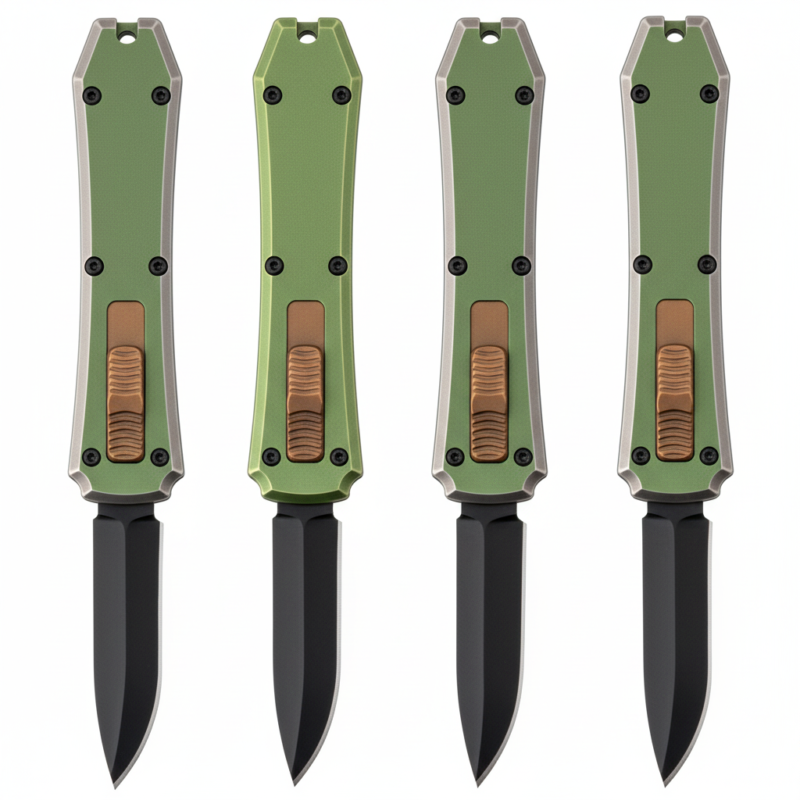
Short answer
Most OTF knives sharpen best at 18 to 20 degrees per side. Use 20 DPS for durability, 18 DPS as the default, and 17 DPS only for thin single-edge OTFs used main
Key Takeaways
- Start with a mild method and increase pressure or abrasion only when the blade condition requires it.
- Edge angle, steel type, corrosion level, and handle material all affect the right care method.
- For wholesale assortments, simple care instructions help customers keep knives useful longer.
Terms Used Here
- OTF
- Out-the-front; a knife design where the blade moves forward from the front of the handle.
- Folding knife
- A knife with a blade that pivots into the handle for storage.
- Fixed blade
- A knife with a blade that does not fold or retract into the handle.
In this article
- 01 Quick decision table: 17, 18, or 20 DPS?
- 02 Why OTF knives usually do best in this angle range
- 03 Angle choice by blade style
- 04 Single-edge OTFs
- 05 Dagger or double-edge OTFs
- 06 Tanto OTFs
- 07 Simple framework: choose the angle by use, not by hype
- 08 What about 15 DPS?
- 09 Is 20 DPS too blunt?
- 10 One short troubleshooting note: dull edge or something else?
- 11 Best practice when you sharpen an OTF
- 12 Quick FAQ
- 13 Can I sharpen an OTF at 15 degrees per side?
- 14 Is 20 DPS too blunt for an OTF?
- 15 Should double-edge OTF knives be sharpened at the same angle on both sides?
- 16 What is the safest default if I do not know the factory angle?
- 17 What if my OTF still feels dull after sharpening?
Yes: most OTF knives should be sharpened at 18 to 20 degrees per side. Use 18 DPS as the default, go to 20 DPS for better edge durability, and only drop to 17 DPS if the knife is a thin single-edge OTF used mostly for light slicing. If an OTF still feels dull right after sharpening, suspect a burr or an angle mismatch before you blame the mechanism.
That range works for most production OTFs because their blades are usually narrow, their factory bevels are commonly in this neighborhood, and their tips and edge shoulders can become fragile if you over-thin them. OTF knives are built around compact blade geometry and reliable in-and-out travel, so chasing an ultra-low angle often gives you a short-lived sharp edge rather than a stable one.
Quick decision table: 17, 18, or 20 DPS?
| OTF blade type | Best starting angle | When to use it | Why |
|---|---|---|---|
| Single-edge OTF | 18 DPS | Best all-around choice for everyday cutting | Balances bite, control, and edge life |
| Single-edge OTF, thin behind the edge | 17 DPS | Light slicing, paper, tape, soft packaging | Improves slicing, but edge is less stable |
| Single-edge utility OTF | 20 DPS | Cardboard, plastic straps, rougher use | Better resistance to rolling and chipping |
| Dagger or double-edge OTF | 18 to 20 DPS per side | Most common safe range | Preserves symmetry and protects the narrow point |
| Tanto OTF | 19 to 20 DPS | Utility cutting, reinforced tip use | The front edge and secondary point benefit from more support |
If you do not know what angle your OTF had from the factory, start by matching the existing bevel. On most production models, that usually lands close to 18 to 20 degrees per side anyway.
Why OTF knives usually do best in this angle range
The sharpening angle on an OTF is not decided by the opening mechanism alone. What matters more is the blade geometry that usually comes with OTF designs.
Many OTF blades are relatively narrow from spine to edge, with tips that are fine and easy to damage if the edge is thinned too aggressively. Common production OTF grinds also are not usually as thick and overbuilt as hard-use fixed blades, but they are often not thin enough behind the edge to support very low angles like 15 DPS for long. That is why 18 to 20 DPS tends to be the durable middle ground: keen enough to cut well, but thick enough to keep the apex from folding, chipping, or going dull quickly.
Another reason is factory variance. Not every OTF uses the same steel, heat treatment, or grind thickness. A tougher steel can sometimes support a slightly lower angle, while a harder but less tough steel may chip if sharpened too thin. Since most owners do not have exact behind-the-edge measurements, 18 DPS is the safest default recommendation across common OTF blade styles.
General guidance: sharpen for the way the edge will actually be used, not for the lowest number your sharpener can produce.
Angle choice by blade style
Single-edge OTFs
Single-edge OTF knives are the most flexible and the easiest to maintain. For most of them, 18 DPS is ideal. It gives a clean, useful edge without making the blade feel delicate. If the knife is used mainly for opening boxes, cutting tape, and everyday utility work, moving up to 20 DPS often makes more sense than going lower.
Use 17 DPS only when three things are true: the blade is fairly thin behind the edge, the steel is decent, and the knife is used mostly for slicing softer materials. If you start seeing edge rolling or the knife loses sharpness very quickly, the angle is probably too low for that blade or that use.
Dagger or double-edge OTFs
Dagger OTFs should usually stay in the 18 to 20 DPS per side range. Their symmetrical shape and narrow tip make them look like they should be sharpened very fine, but that often backfires. A lower angle can leave the point and edge shoulders too fragile, especially if both edges are actually sharpened and used.
The main rule here is consistency. Match both sides as closely as possible. Uneven angles can make one edge cut better than the other and can weaken the point. Even if one edge is more decorative or lightly used, keeping both sides close helps preserve the blade’s symmetry.
Tanto OTFs
Tanto OTFs often benefit from a slightly more conservative angle, usually 19 to 20 DPS. The front edge segment and the secondary point are useful for utility cuts, but they can chip or feel toothy and rough if taken too thin. Treat the forward section as the part that needs the most support.
Simple framework: choose the angle by use, not by hype
- Choose 20 DPS if you want durability first, cut a lot of cardboard or abrasive packaging, or tend to use more force than finesse.
- Choose 18 DPS if you want the best all-around result on a typical OTF.
- Choose 17 DPS only if the blade is thin, the use is mostly slicing, and you are willing to touch up the edge more often.
A common owner mistake is seeing a very sharp kitchen or folding knife angle online and copying it onto an OTF without checking the existing bevel. The result is often an edge that feels impressive for a few cuts, then quickly loses bite or develops tiny chips near the tip.
What about 15 DPS?
For most OTF knives, 15 DPS is too low as a default sharpening angle. Some thin single-edge blades can take it for specialized slicing, but most production OTFs are better off with more edge support. If you sharpen an OTF at 15 DPS and then use it on cardboard, clamshell packaging, zip ties, or anything that puts side stress on the edge, you are more likely to see rolling, chipping, or fast dulling.
In other words, 15 DPS can work in narrow cases, but it is usually not the practical recommendation for an everyday OTF.
Is 20 DPS too blunt?
No. On an OTF, 20 DPS is not too blunt for normal use. It is often the better choice for users who care more about edge retention through rough materials than about maximum slicing aggression. A well-finished 20 DPS edge can still cut paper cleanly, break down boxes effectively, and hold up better than a more delicate edge ground too thin.
If your knife feels dull at 20 DPS, the problem may be the sharpening quality rather than the angle itself. A clean apex and proper deburring matter as much as the number.
One short troubleshooting note: dull edge or something else?
Keep this contrast simple:
- Normal dullness: the knife still deploys and retracts normally, but it drags on paper or crushes cardboard.
- Likely non-edge issue: the action becomes sluggish, inconsistent, or starts misfiring.
If the knife cuts badly but still fires crisply, sharpening is the right place to look. If the knife suddenly feels dull right after sharpening, suspect a leftover burr or failure to hit the true apex. If the action changes at the same time, the problem is probably not just sharpening.
Best practice when you sharpen an OTF
- First, inspect the existing bevel and try to match it.
- Start at 18 DPS unless you have a clear reason to go higher or lower.
- Use light pressure, especially on narrow dagger or spear-style blades.
- Deburr carefully. A wire edge can make a knife feel sharp for one cut and dull on the next.
- For double-edge OTFs, keep both sides even.
You can browse blade styles in the OTF knife catalog if you want to compare common single-edge, dagger, and tanto profiles before deciding how conservative your sharpening angle should be.
Quick FAQ
Can I sharpen an OTF at 15 degrees per side?
Usually not as a general rule. Most OTF knives hold up better at 18 to 20 DPS. Reserve 15 DPS for unusually thin blades and light slicing use only.
Is 20 DPS too blunt for an OTF?
No. It is often the best choice for durability and everyday utility work.
Should double-edge OTF knives be sharpened at the same angle on both sides?
Yes. Matching both sides helps preserve symmetry, point strength, and consistent cutting feel.
What is the safest default if I do not know the factory angle?
18 DPS. It is the most reliable starting point for most OTF knives.
What if my OTF still feels dull after sharpening?
First suspect a burr, incomplete apexing, or an angle mismatch. If the knife deploys normally, the issue is usually the edge, not the mechanism.