

What Is an OTF Auto Knife? A Clear Guide for Buyers and Resellers

Short answer
Learn what an OTF auto knife is, how the mechanism works, how it differs from side-opening automatics, and what wholesale buyers should check before purchasing.
Key Takeaways
- Knife rules can vary by state, city, blade style, opening mechanism, carry method, and intended use.
- Do not treat a product nickname as a legal category; check the actual features and local rule.
- Retailers should keep legal or safety language factual and avoid promising that one item is allowed everywhere.
Terms Used Here
- OTF
- Out-the-front; a knife design where the blade moves forward from the front of the handle.
- Automatic knife
- A knife that opens by a spring-driven mechanism after the user activates a button, switch, or slider.
- Folding knife
- A knife with a blade that pivots into the handle for storage.
In this article
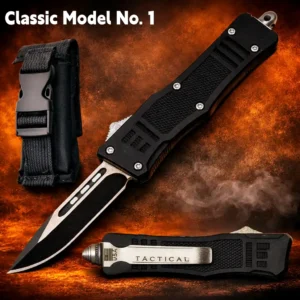
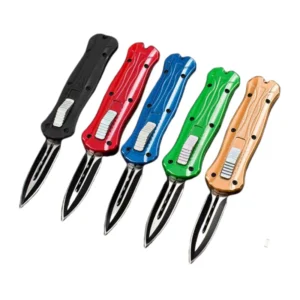
An OTF auto knife is an automatic knife whose blade deploys straight out of the front of the handle using an internal spring and sliding actuator. OTF stands for out the front. Unlike a side-opening automatic, which swings open on a pivot, an OTF knife sends the blade forward in line with the handle. For buyers, that simple definition matters because the mechanism, safety features, parts tolerances, and service needs are different from other automatic knives.
In practical terms, OTF knives are bought for fast one-handed operation, compact carry, and a distinctive mechanical feel. They are also a category where build quality varies sharply from one factory to another. A wholesale buyer should not treat all OTF autos as interchangeable. The slide action, lockup feel, spring system, blade track, and reliability under repeated cycling are what separate a dependable OTF from a return-prone one.
If you are comparing inventory options, start with a focused OTF automatic knife catalog and evaluate each model as a mechanism first and a style item second. In this category, good looks do not fix weak internals.
How an OTF auto knife works
An OTF auto knife uses a spring-driven mechanism inside the handle. The user pushes a thumb slide or button along a track. That movement tensions or releases the spring system, which drives the blade forward through an opening at the front of the handle. The blade then locks into the open position. On many models, especially double-action OTFs, moving the slider back in the opposite direction retracts the blade into the handle.
There are two main mechanism types:
- Single-action OTF: the blade fires out automatically, but retraction is manual. These are less common in broad retail programs and often appeal to collectors or buyers looking for a more specialized format.
- Double-action OTF: the same control both deploys and retracts the blade. This is the most common commercial format because it is convenient and easy for end users to understand.
The key parts usually include the blade, firing spring or springs, carrier, sear or locking surfaces, internal track, slider, chassis, and handle scales or shell. The better these parts are machined and fitted, the smoother the action and the lower the chance of misfires, excessive blade play, or early wear.
A useful short definition for buyers is this: An OTF auto knife is a front-deploying automatic knife that depends on internal spring force and track alignment rather than a side pivot. That is the feature that shapes every purchasing decision in this category.
What makes OTF knives different from other automatic knives
The biggest difference is blade path. A side-opening automatic rotates around a pivot, while an OTF blade travels on a straight line. That changes the user experience and the manufacturing demands.
OTF vs side-opening automatic
- Deployment path: OTF blades move forward out of the handle; side-openers swing sideways.
- Handle design: OTF handles must house a linear mechanism, so internal space and track precision matter more.
- Pocket profile: OTFs often feel slim and rectangular, which many users like for pocket carry.
- Action feel: OTFs have a sliding, mechanical firing sensation; side-openers feel more like a snap on a pivot.
- Maintenance sensitivity: OTFs are usually more affected by lint, grit, and poor internal tolerances.
- Blade play: Some amount of blade movement is more common in OTF knives than in well-built manual folders. Buyers should judge whether it is acceptable, not assume zero play.
This is where many new resellers make a mistake: they compare OTFs to ordinary folding knives and expect the same lockup feel. That is not the right benchmark. A better question is whether the knife fires consistently, retracts correctly, locks safely, and stays within normal play for its mechanism class.
Another common mistake is overvaluing cosmetic upgrades while ignoring the action. A coated blade, glass breaker, pocket clip, or CNC pattern may help sell-through, but repeated customer complaints usually come from inconsistent deployment, weak springs, rough sliders, and poor fit inside the chassis.
What wholesale buyers should check before ordering
For wholesale and private-label programs, an OTF auto knife should be judged as a repeatable mechanical product, not just a sample that looks good in hand. One strong sample does not guarantee a stable production run.
Use this practical checklist when reviewing OTF models:
- Cycle consistency: Test repeated deployment and retraction on multiple samples, not one piece. Look for misfires, partial lockup, or sluggish return.
- Slider resistance: The actuator should feel deliberate but not harsh. If it is too stiff, customer satisfaction drops. If it is too light, accidental activation risk can increase.
- Blade track smoothness: The blade should travel cleanly without scraping, grinding, or obvious side drag.
- Lockup quality: Check open and closed positions. Minor movement can be normal, but rattling, uneven lock surfaces, or inconsistent stop points are warning signs.
- Spring reliability: Ask about spring material, expected cycle life, and replacement support. Springs are wear parts in this category.
- Handle construction: Review chassis rigidity, screw quality, finish consistency, and whether the body flexes under hand pressure.
- Blade centering in the channel: The blade should sit evenly in the handle path and not appear to rub one side.
- Edge and tip protection: Confirm the front opening does not expose the edge in a way that causes shipping damage or user complaints.
- Safety function: Many OTFs are designed so the blade stops if it meets resistance during firing. Verify that this function works as intended.
- After-sales practicality: Ask how misfires, spring issues, and parts service will be handled at volume.
For distributors, one of the most quotable truths in this category is: OTF returns usually come from tolerance problems, not from styling problems. That is why pre-shipment inspection standards matter.
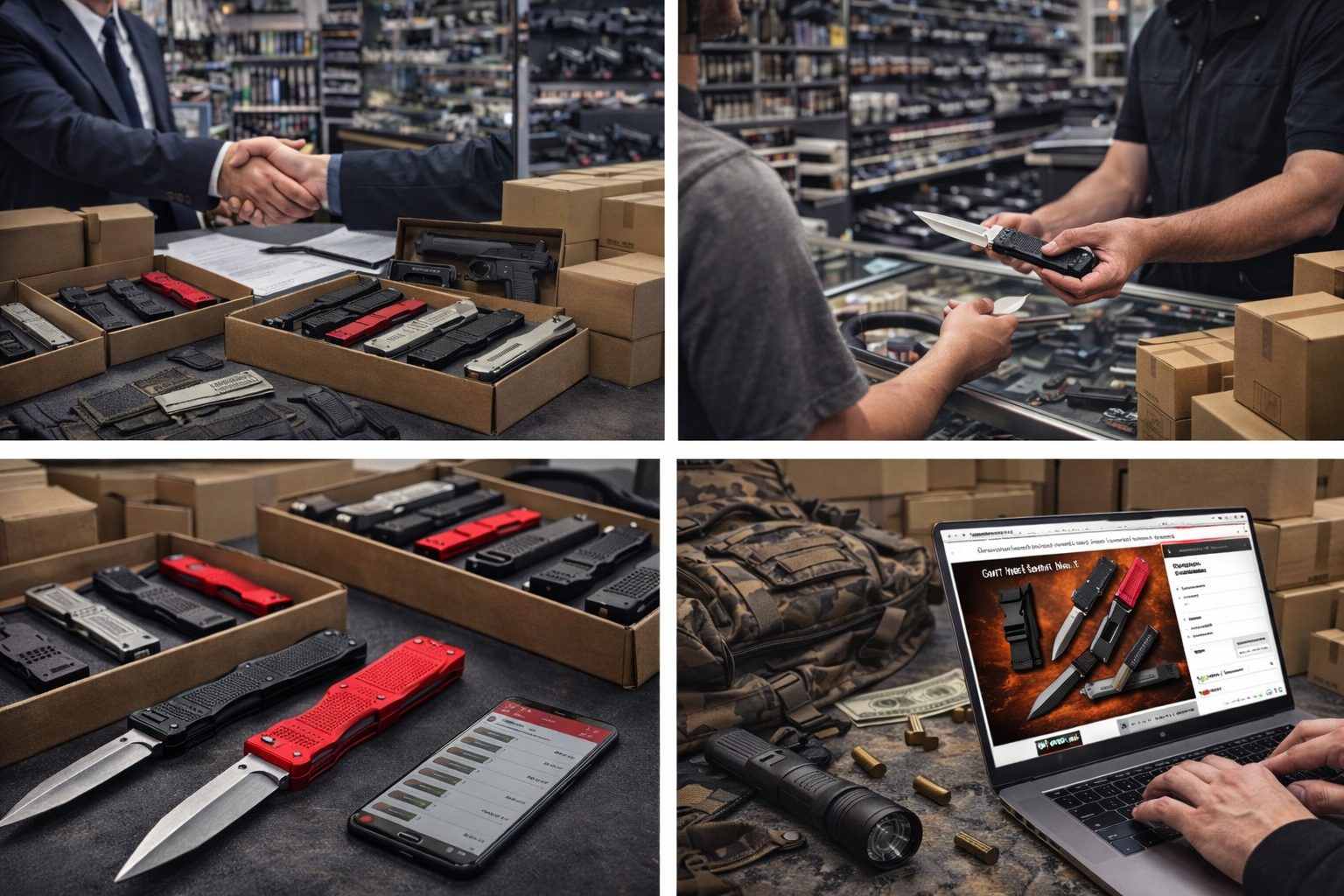
If you are sourcing for resale, private label, or multi-store distribution, it is smart to start the conversation early through the wholesale inquiry form and define your requirements for testing, packaging, branding, and service support before committing to a full run.
Common buying mistakes and how to avoid them
OTF autos can sell very well, but they punish vague buying decisions. The most common mistakes are avoidable.
- Buying only on sample appearance: Always inspect a batch standard, not just a hand-picked sample.
- Ignoring user strength: Some sliders are too stiff for a broad retail audience. Match actuator force to your customer base.
- Assuming all double-action mechanisms feel the same: They do not. Small internal differences create big differences in reliability and perceived quality.
- Overpromising zero blade movement: Set realistic expectations. Explain normal mechanism behavior to dealers and end customers.
- Skipping contamination testing: Pocket lint and fine debris can affect OTF action. Test realistic carry conditions, not only clean bench conditions.
- Choosing too many variants too early: Start with proven core SKUs before adding blade shapes, colors, and handle finishes.
A practical comparison for first-time buyers is this:
- Good OTF program: consistent firing, acceptable lockup, manageable slider force, low defect rate, clear service process, and a focused SKU range.
- Weak OTF program: flashy styling, inconsistent action, frequent spring issues, no parts plan, and too many cosmetic variants masking mechanical inconsistency.
Private-label buyers should also think about packaging and instructions. OTF knives often need a short, clear user guide on safe operation, retraction, and what to do if the blade comes off track or fails to fully deploy. This reduces avoidable returns caused by unfamiliarity rather than actual defects.
Who should buy an OTF auto knife and what to ask the supplier
An OTF auto knife is a strong category fit for buyers serving customers who value one-handed automatic operation, compact carry, and a modern mechanical design. It is especially attractive in tactical, novelty, collector, and premium everyday-carry assortments. It is less ideal for programs that need the simplest possible maintenance profile or the lowest service burden.
Before placing an order, ask direct questions:
- Is the model single-action or double-action?
- What is the tested cycle performance across a production batch?
- What blade steel and handle material are used on this exact SKU?
- How much blade movement is considered normal for this model?
- What inspection steps are done before shipment?
- Are springs or internal parts serviceable if needed?
- What packaging, labeling, and private-brand options are available?
The best short answer to the original question is this: An OTF auto knife is an out-the-front automatic knife that deploys its blade straight from the front of the handle using an internal spring mechanism. For serious buyers, the real issue is not just what it is, but how well it is built. In OTF knives, smooth action, repeatable lockup, and controlled tolerances are the difference between a product that sells through and a product that comes back.
That is why experienced buyers evaluate OTF autos as mechanical systems first. When the mechanism is right, the style, branding, and retail presentation have a much better chance to succeed.