

What Makes an OTF Knife High Quality?

Short answer
Learn what actually makes an OTF knife high quality, from deployment reliability and lockup to machining consistency, returns risk, and wholesale inspection poi
Key Takeaways
- Start with a mild method and increase pressure or abrasion only when the blade condition requires it.
- Edge angle, steel type, corrosion level, and handle material all affect the right care method.
- For wholesale assortments, simple care instructions help customers keep knives useful longer.
Terms Used Here
- OTF
- Out-the-front; a knife design where the blade moves forward from the front of the handle.
- Automatic knife
- A knife that opens by a spring-driven mechanism after the user activates a button, switch, or slider.
In this article
- 01 The core signs of quality in an OTF knife
- 02 What matters more than steel names on an OTF
- 03 How wholesale buyers should evaluate quality before placing volume orders
- 04 Quick comparison: high-quality OTF vs. risky OTF
- 05 Mistakes to avoid when judging OTF quality
- 06 Does a premium blade steel automatically mean a high-quality OTF?
- 07 Is some blade play normal on an OTF knife?
- 08 What is the best single test for OTF quality?
- 09 What should wholesalers prioritize first?
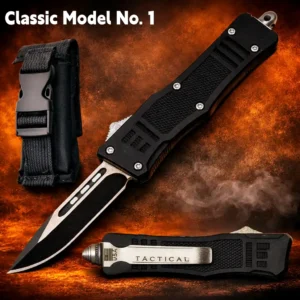
A high-quality OTF knife is defined first by reliable deployment and retraction, consistent lockup, and precise internal fit—not by marketing claims or blade steel alone. The default recommendation is to choose an OTF with repeatable action, tight machining, and low failure rates in batch testing; the factors that change that recommendation are intended use, price tier, return tolerance, and whether you are buying for private label or open resale.
This is the buyer problem the article resolves: two OTF knives can look similar in photos, use similar steel names, and sit near the same price, yet one produces warranty claims and customer complaints while the other sells through cleanly. In OTF knives, quality is less about a single premium material and more about how the firing mechanism, lock geometry, spring system, switch track, and body tolerances work together over repeated cycles.
The core signs of quality in an OTF knife
On an out-the-front knife, quality is observable. You do not need to guess. A good unit should open and retract with the same feel across repeated cycles, the switch should travel smoothly without gritty spots, and the blade should lock with predictable engagement every time.
- Reliable firing: The blade should deploy and retract fully without frequent misfires. One occasional failure in a long stress test may happen on any mechanical product, but repeated short-cycle failures are a red flag.
- Consistent lockup: OTF knives normally have some blade play by design. High quality does not mean zero movement; it means controlled, consistent movement within a normal range, without rattling, uneven lockup, or changing feel from one cycle to the next.
- Precise switch action: The thumb slide should have enough resistance to prevent accidental activation, but not so much that users feel binding or sharp drag. Rough switch channels often predict early wear complaints.
- Clean internal tolerances: Good machining shows up as smooth travel, centered blade path, and fewer deployment issues when the knife is dusty, lightly dirty, or used rapidly.
- Repeatable assembly quality: For wholesale buyers, a high-quality OTF is not just one good sample. It is a product line with low variation from unit to unit.
A simple quote buyers can use is this: “In an OTF knife, quality is the consistency of the mechanism under repetition.” That is more useful than chasing the longest feature list.
What matters more than steel names on an OTF
A common mistake is to judge an OTF mainly by blade steel, coating color, or handle texture. Those things matter, but they do not answer the main quality question. OTF knives are mechanism-heavy products. If the action is weak or inconsistent, premium steel will not save the knife from returns.
The parts that deserve close attention are specific to the OTF platform:
- Spring quality and calibration: The spring must deliver enough force for positive deployment without producing harsh, unreliable action. Weak or inconsistent springs are a major source of batch problems.
- Carrier and track finish: Rough internal tracks increase friction. That can cause misfires, inconsistent reset, and a “crunchy” feel that customers notice immediately.
- Locking interface geometry: The lock surfaces need to engage cleanly and repeatably. Sloppy geometry can create excess play, uneven wear, or a lock feel that changes after a short break-in period.
- Switch and button construction: Cheap switch parts often loosen, bind, or wear quickly. On an OTF, the switch is not cosmetic hardware; it is part of the user’s trust in the mechanism.
- Body alignment: Handle halves, screws, and internal channel alignment all affect blade travel. Small machining errors show up fast in an OTF because the blade rides a defined path.
One misconception unique to OTF knives is that any blade play means poor quality. That is not correct. Many sound OTF designs have some front-to-back or side-to-side movement because of how the double-action mechanism locks and releases. The real question is whether the play is stable and expected, or excessive and inconsistent. A knife with slight, consistent play can be much higher quality than one that feels tight at first but starts misfiring after a week.
How wholesale buyers should evaluate quality before placing volume orders
Retail shoppers can test one knife. Wholesale buyers need to predict how a run will perform across dozens, hundreds, or thousands of units. That requires a different standard. If you are sourcing from an OTF knife catalog, ask for samples from the same production standard you expect in bulk, not a hand-picked display piece.
Use this practical inspection checklist on multiple units, not just one:
- Cycle test each sample 50 to 100 times. Note any failures to deploy, failures to retract, weak lockup, or switch drag that increases as the test continues.
- Compare switch force across units. If one knife is smooth, one is stiff, and one is gritty, the issue is not taste—it is inconsistency.
- Check blade path and tip seating. The blade should travel cleanly and seat properly when closed, without rubbing marks that suggest misalignment.
- Inspect screw fit and body finish. Poorly seated hardware, uneven gaps, and inconsistent anodizing or coating often correlate with weaker process control overall.
- Test under realistic handling. Fire the knife in normal grip, with dry hands and slightly sweaty hands. A switch that only feels acceptable on a clean bench may frustrate customers in actual use.
- Ask about replacement parts and warranty handling. A high-quality wholesale program is not just a better knife; it is also a supplier response plan when a mechanical product does fail.
For distributors and private-label buyers, the hidden cost is rarely the unit price alone. It is the total landed cost after returns, replacements, support emails, and reputation damage. A slightly more expensive OTF with better action consistency can be the cheaper product in real business terms.
Quick comparison: high-quality OTF vs. risky OTF
- Deployment: High-quality OTFs fire with uniform force; risky OTFs vary from unit to unit.
- Blade play: High-quality OTFs have controlled, consistent play; risky OTFs feel loose, uneven, or get worse quickly.
- Switch feel: High-quality OTFs feel smooth with deliberate resistance; risky OTFs feel gritty, sticky, or sharp-edged in travel.
- Batch consistency: High-quality OTFs behave similarly across samples; risky OTFs produce “good one, bad one” feedback.
- Return risk: High-quality OTFs generate fewer early complaints; risky OTFs create support burden even if they look attractive online.
That comparison matters because OTF buyers often overvalue visible features and undervalue mechanism consistency. In this category, the internals decide whether the product is premium, acceptable, or a problem.
Mistakes to avoid when judging OTF quality
The easiest buying mistakes are also the most expensive.
- Do not judge by first fire only. A knife can feel impressive on the first deployment and still fail after repeated cycles. OTF quality shows itself under repetition.
- Do not equate heavier action with better quality. A very stiff switch is not automatically more durable. It may simply reflect poor tuning or rough internal surfaces.
- Do not chase zero play as the only goal. On an OTF, a realistic lockup with dependable function is better than a knife tuned so tightly that reliability suffers.
- Do not ignore unit-to-unit variation. One excellent sample does not prove production consistency. Wholesale buyers should always test several pieces.
- Do not buy feature-rich samples without support terms. Because OTFs are mechanism-dependent, after-sale handling matters more here than on simpler manual folders.
If you are buying for resale, your best default move is to favor proven mechanism consistency over flashy upgrades. If you are buying for private label, add one more filter: confirm that the supplier can keep that same action and fit standard over repeat orders. When you are ready to discuss volume needs, packaging, or batch requirements, use the wholesale inquiry form to start with the right specifications.
Does a premium blade steel automatically mean a high-quality OTF?
No. Premium steel can improve edge retention or corrosion resistance, but it does not fix poor spring tuning, rough tracks, weak lockup, or inconsistent assembly.
Is some blade play normal on an OTF knife?
Yes. Some play is normal on many OTF designs. What matters is whether it is controlled, consistent, and stable over repeated use.
What is the best single test for OTF quality?
A repeated cycle test across multiple units is the best quick indicator. Reliable deployment and retraction over time tell you more than appearance or spec sheets.
What should wholesalers prioritize first?
Prioritize action consistency, low failure rate, and supplier support. Those three factors usually predict resale success better than cosmetic upgrades alone.