

What Steel Is Best for Wholesale OTF Knives?


Short answer
A practical wholesale guide to the best steel for OTF knives, with clear recommendations on D2, 154CM, S35VN, MOQ, QC, repeat orders, corrosion risk, and landed
Key Takeaways
- Knife rules can vary by state, city, blade style, opening mechanism, carry method, and intended use.
- Do not treat a product nickname as a legal category; check the actual features and local rule.
- Retailers should keep legal or safety language factual and avoid promising that one item is allowed everywhere.
Terms Used Here
- OTF
- Out-the-front; a knife design where the blade moves forward from the front of the handle.
- Fixed blade
- A knife with a blade that does not fold or retract into the handle.
In this article
- 01 Why this matters on an OTF
- 02 D2 vs 154CM vs S35VN for wholesale OTF buying
- 03 When to choose 154CM, and when to skip it
- 04 When D2 makes sense, and the mistakes buyers make
- 05 A wholesale decision checklist: steel, cost, and repeat-order stability
- 06 How to place the steel in your lineup
- 07 FAQ
- 08 Is D2 good enough for wholesale OTF knives?
- 09 Why is 154CM often the best choice?
- 10 Should wholesale buyers jump to S35VN or M390?
- 11 What is the biggest steel mistake in OTF wholesale?
Verdict: 154CM is usually the best steel for wholesale OTF knives because it gives the cleanest balance of edge retention, corrosion resistance, sharpening ease, and repeatable factory output at a workable landed cost. Main exception: choose D2 when your price target is aggressive and the knife is aimed at light utility or collector carry, and step up to S35VN or M390 only when the customer will pay for the upgrade and your QC can support it.
Who should buy what: distributors, private-label buyers, and resellers building a broad catalog should start with 154CM; value-driven importers and promo-focused sellers can use D2 carefully; higher-end specialty retailers can justify S35VN or M390. Buyers should skip expensive steels if the OTF will be sold mainly on price, if corrosion complaints are rare in the target market, or if repeat-order steel consistency matters more than headline specs.
The tradeoff is simple: edge retention vs toughness vs corrosion resistance vs sharpening. On an OTF, that tradeoff matters more than on a basic folder because the mechanism already adds service variables; if the blade steel also creates rust claims, chipping complaints, or difficult warranty sharpening, your total cost rises fast.
Why this matters on an OTF
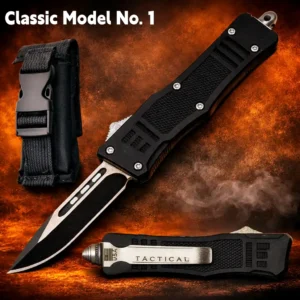
An OTF knife is not just a blade blank with a handle. The mechanism adds springs, tracks, buttons, tolerances, and more points where dirt, moisture, and user neglect can turn into returns. That means steel choice should support the actual use case instead of fighting it.
Mechanism-specific note: OTF blades commonly have more blade play than a manual folder by design, so buyers should not chase ultra-hard, wear-focused steel unless the factory’s heat treat and grind are very consistent. A steel that looks impressive on paper can become expensive if the edge chips during light utility use or if warranty claims rise because customers expect “premium steel” to solve every issue.
In wholesale, steel selection affects more than retail talking points:
- MOQ planning: higher-end steels often require larger minimums or mixed-finish compromises.
- Lead time: D2 and 154CM are usually easier to source consistently than newer or more expensive powder steels.
- Sample policy: one sample can look excellent, but repeat batches may shift in grind quality or heat treat.
- QC burden: harder-to-process steels raise the need for edge, lockup, and finish inspection.
- Landed cost: steel upgrades add not just blade cost, but scrap risk, slower production, and sometimes packaging expectations.
D2 vs 154CM vs S35VN for wholesale OTF buying
If you need one practical compare-against set, use D2, 154CM, and S35VN. These three cover the majority of real wholesale decisions.
- D2: lowest common step-up from entry steel. Good wear resistance for the price, but less forgiving in sweaty pocket carry or wet climates because it is not truly stainless.
- 154CM: the best middle ground. Stainless enough for normal carry, easier to explain to buyers, easier to maintain, and usually less risky than D2 or S35VN in repeat wholesale production.
- S35VN: stronger premium positioning with better corrosion resistance and good overall balance, but only worth it if your customer base recognizes the name and pays enough to cover the added cost and QC expectations.
Short answer span: If you sell OTF knives in volume, 154CM is the safest all-around wholesale steel. D2 wins on low entry cost. S35VN wins only when the market supports a higher retail and tighter quality control.
Two concrete comparison points matter most:
- Corrosion in real carry: in a sweaty pocket or humid coastal market, 154CM clearly reduces rust complaints compared with D2.
- Wholesale margin discipline: moving from 154CM to S35VN often raises cost more than it raises sell-through unless the brand, packaging, and dealer channel already support a premium tier.
Where do M390 and MagnaCut fit? M390 can work for premium collector-oriented OTFs, but it is usually a narrower wholesale play because retail buyers expect flawless fit, finish, and branding when they see that steel. MagnaCut can be compelling on paper, especially for wet-climate carry, but many wholesale buyers are still better served by stable 154CM supply unless their factory has a proven record with it.
When to choose 154CM, and when to skip it
Choose 154CM when:
- You need one steel that can cover broad dealer demand.
- Your target use is light utility, daily carry, and giftable retail rather than hard-use marketing.
- You want a stainless option without pushing retail too high.
- You need repeat orders with fewer surprises in finishing and sharpening.
- Your market includes humid regions, sweaty-pocket carry, or casual users who will not oil the blade often.
Skip 154CM when:
- Your retail positioning is aggressively price-led and every dollar matters.
- You are building a very high-end line where customers specifically ask for S35VN, M390, or MagnaCut.
- Your sales channel is mostly collector drops where steel name recognition drives demand more than practical use.
A realistic scenario: if the knife will ride in a sweaty pocket in summer, open boxes, cut zip ties, and occasionally sit uncleaned for a week, 154CM is easier to live with than D2. That matters because many OTF returns are not dramatic failures; they are minor rust spots, dull edges, or sticky action caused by neglected maintenance and poor storage.
When D2 makes sense, and the mistakes buyers make
D2 makes sense when the OTF is meant to hit a clear entry price band and the expected use is light utility, occasional carry, or collector ownership. In wholesale terms, D2 can help you keep MOQ manageable, preserve dealer margin, and offer multiple handle variants without blowing up landed cost.
But buyers make three common mistakes with D2 OTFs:
- They sell it into the wrong climate. In wet regions or for users who carry against the body, D2 can create avoidable after-sale complaints if the finish, storage, and user care are not considered.
- They overpromise on “hard use.” OTF buyers often use these knives for quick, light tasks. Marketing D2 as if it solves every abuse scenario is a warranty trap.
- They ignore finish and coating quality. On D2, blade finish matters. Poor coating prep or uneven stonewash can make corrosion perception worse, even before actual rust becomes severe.
Mechanism-specific note: OTFs are more likely than simple fixed blades to be pocket-carried with lint and moisture around the opening. If you choose D2, insist on clear care instructions in packaging and test whether the blade finish holds up after repeated deployment and wipe-down cycles.
A wholesale decision checklist: steel, cost, and repeat-order stability
Use this checklist before locking in a steel for your next OTF program:
- Target retail band: What retail price must the knife hit after freight, duty, packaging, and dealer margin?
- MOQ: Is the factory MOQ different by steel, finish, or blade shape?
- Lead time: Does the quoted lead time stay stable on repeat orders, or only on the first run?
- Sample policy: Can you approve a steel-specific pre-production sample, not just a generic sample?
- Heat treat consistency: Will the supplier provide hardness range targets batch to batch?
- QC points: Check edge finish, deployment reliability, lockup, blade centering in channel, coating adhesion, and visible corrosion after basic humidity exposure.
- Packaging: Will the knife ship with oil paper, desiccant, or care instructions if using D2?
- Returns logic: Which steel lowers customer-service cost in your channel, not just unit cost on the invoice?
- Repeat-order stability: Can the factory deliver the same steel, finish, and grind six months later without major variation?
A useful sourcing rule is this: the cheapest blade steel is not the cheapest program if it creates rust claims, sharpening complaints, or inconsistent repeat batches.
If you are comparing current models, it helps to review a live wholesale OTF knife catalog by price tier and handle style first, then match steel to the actual market slot instead of choosing steel in isolation.
How to place the steel in your lineup
For many buyers, the smartest lineup is not one steel across everything. It is a two-tier structure:
- Tier 1: D2 for opening price points, collector colorways, and lower-risk trial SKUs.
- Tier 2: 154CM for core catalog models that need broader appeal and fewer corrosion headaches.
Add S35VN only if you have a clear premium lane with stronger packaging, cleaner finishing, and a retailer base that asks for it by name. If your current OTF line is still proving demand, jumping straight to high-cost steel can tie up cash in inventory that looks impressive but turns slowly.
Private-label buyers should also think about after-sale service. If your brand offers sharpening support or replacement handling, 154CM is often easier operationally than more wear-focused premium steels. That can matter more than a spec-sheet upgrade.
When you are ready to compare MOQs, samples, and steel availability for a private-label or distribution order, use the OTF bulk inquiry form and ask for batch-specific details, not just headline steel names.
FAQ
Is D2 good enough for wholesale OTF knives?
Yes, if the target is price-sensitive and the expected use is light utility or collector carry. It is a weaker fit for wet climates, sweaty-pocket carry, or channels with high after-sale sensitivity to rust.
Why is 154CM often the best choice?
Because it balances corrosion resistance, edge performance, sharpening ease, and manufacturing consistency well enough to reduce problems across large orders.
Should wholesale buyers jump to S35VN or M390?
Only when the retail channel supports the higher price and the factory can maintain consistent heat treat, grind, and finish quality. Premium steel without premium QC is not a real upgrade.
What is the biggest steel mistake in OTF wholesale?
Choosing steel by marketing value alone and ignoring climate, maintenance habits, and repeat-order consistency. On OTFs, service cost and customer complaints can erase the benefit of a lower blade cost or a flashier steel name.