
Short answer
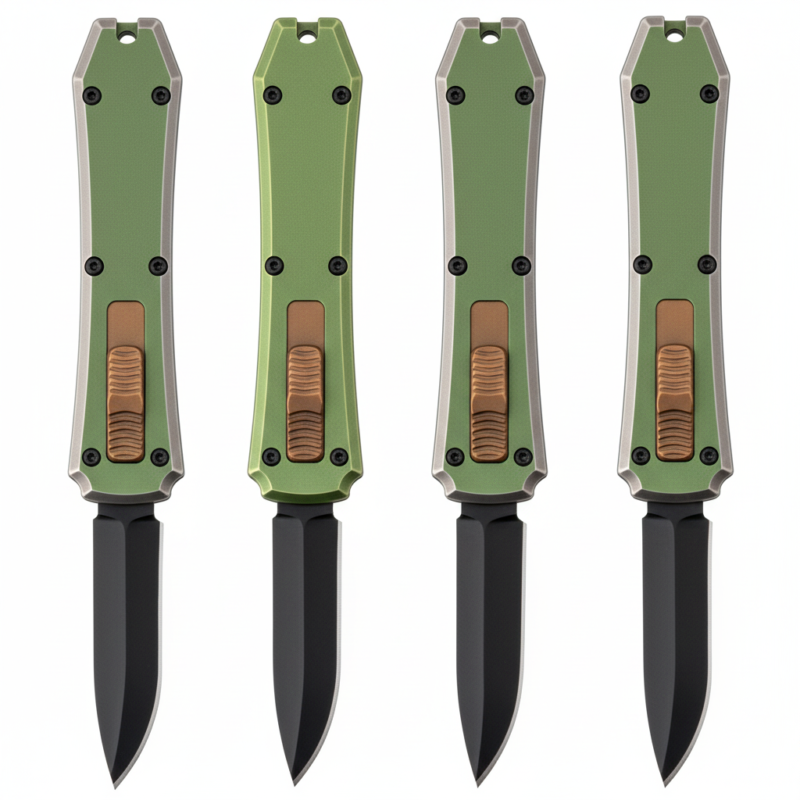
For most everyday buyers, a single-edge drop point is the lowest-risk OTF blade style. Learn why it is easier to orient, retract, clean, and carry than dagger,
Key Takeaways
- Knife rules can vary by state, city, blade style, opening mechanism, carry method, and intended use.
- Do not treat a product nickname as a legal category; check the actual features and local rule.
- Retailers should keep legal or safety language factual and avoid promising that one item is allowed everywhere.
Terms Used Here
- OTF
- Out-the-front; a knife design where the blade moves forward from the front of the handle.
- Automatic knife
- A knife that opens by a spring-driven mechanism after the user activates a button, switch, or slider.
- Fixed blade
- A knife with a blade that does not fold or retract into the handle.
In this article
- 01 Quick ranking by handling risk
- 02 Why OTFs change the safety discussion
- 03 Why the single-edge drop point usually wins
- 04 How the other common blade styles compare
- 05 Single-edge spear point
- 06 Single-edge tanto
- 07 Double-edge dagger
- 08 Why the answer changes for budget vs. premium OTFs
- 09 One concrete buying mistake to avoid
- 10 What to check before you buy
- 11 FAQ
- 12 Is a double-edge OTF ever the right choice?
- 13 Is a tanto unsafe?
- 14 Does steel matter as much as blade shape?
- 15 What should a first-time buyer choose?
For most everyday buyers, a single-edge drop point is the lowest-risk OTF blade style. The main exception is when a buyer specifically wants a more specialized point shape for precise piercing or prefers the look of a dagger and understands the extra handling tradeoffs.
Here, “safest” means relative handling safety among common OTF blade profiles, not a guarantee that any automatic knife is safe in all hands. This conclusion is based on practical handling logic, common retail use patterns, and maintenance simplicity in real OTF ownership: pocket carry, moisture exposure, repetitive deployment and retraction, light utility cuts, and occasional cleaning near the front opening.
Why this profile usually comes out ahead on an OTF specifically:
- It gives you one clearly non-sharp side during grip changes. On an OTF, people often deploy, rotate the knife slightly in hand, make a short cut, then retract. A defined spine is easier to track by touch and sight.
- Its tip is usually less puncture-prone than a dagger. A drop point still cuts well, but it is generally less needle-like than a double-edge profile.
- It is easier to inspect and clean around repeated deployment. With one main edge and one obvious spine, wiping lint, tape residue, or moisture off the blade near the opening is more straightforward.
Quick ranking by handling risk
| Blade style | Relative handling risk | Why it lands here |
|---|---|---|
| Single-edge drop point | Lowest | Clear spine, forgiving tip, easy orientation during deployment and retraction |
| Single-edge spear point | Low | Still has one safe side, but the point is usually more piercing-focused |
| Single-edge tanto | Moderate | Safe side remains clear, but the tip and edge transition are less forgiving in routine cuts |
| Double-edge dagger | Highest | Two sharpened sides make grip changes, wiping, and quick orientation less forgiving |
This ranking is not about which blade looks best. It is about which shape gives ordinary users the most margin for error in the way OTFs are commonly handled.
Why OTFs change the safety discussion
Some knife advice is true across all folders and fixed blades, but OTFs add their own handling pattern. The blade comes straight out the front, the opening is at the end of the handle, and users often make more short open-close cycles than they would with a manual knife. That creates a few moments where blade shape matters more than it might on a standard folder.
First, orientation after deployment matters. With a manual knife, the opening motion itself often helps the user confirm where the edge is. With an OTF, the blade is already out and locked as soon as the switch completes its travel. If the blade has one obvious spine, the user can confirm orientation faster before cutting.
Second, retraction changes hand behavior. Many people finish a quick cut, shift their grip, and retract immediately. A single-edge blade leaves less ambiguity about where fingers should not drift during that transition.
Third, cleaning is more front-end focused. Pocket lint, adhesive, dust, and moisture tend to collect around the blade opening and on the exposed portion of the blade. A blade with one working edge is simpler to wipe down without accidentally touching a second sharpened side.
That is why the safest choice for a mainstream buyer is not just about cutting performance. It is about how easy the blade is to understand at a glance and manage through repeated real-life use.
Why the single-edge drop point usually wins
A drop point works well because it combines three things mainstream users benefit from: a clear spine, a moderate tip, and predictable utility cutting. Those traits matter more on an OTF than on a display knife because the tool gets handled in short bursts.
Consider a common scenario: you pull the knife from a pocket, deploy it one-handed, cut packing tape, trim a loose strip of plastic wrap, then retract it while standing. In that sequence, the safest blade style is the one that makes edge orientation obvious and does not punish a minor mistake with an extra sharpened side or an overly aggressive point.
Another example is post-use cleaning. After cutting a few boxes, adhesive and cardboard dust may be stuck near the edge. On a single-edge drop point, most users can brace the thumb on the spine side and wipe away from the edge more confidently. On a double-edge dagger, that same quick cleanup requires more care because either side may be sharp enough to bite.
How the other common blade styles compare
Single-edge spear point
This is the closest alternative. It still gives the user one non-sharp side, which is the biggest safety advantage over a dagger. The tradeoff is that spear points often put more emphasis on a centered, more acute tip. That can be useful for precise work, but it is slightly less forgiving when a mainstream user is just opening packages or making short utility cuts.
Single-edge tanto
A single-edge tanto remains safer than a double-edge blade because the spine is still clear. Where it loses ground is in everyday cut behavior. The more abrupt tip geometry and edge transition can catch material or feel less intuitive in slicing tasks. For buyers who know they want that shape, it can be fine. For the broad middle of the market, it usually is not the easiest profile to live with.
Double-edge dagger
This is usually the least forgiving option for mainstream buyers. The problem is not that a dagger cannot cut well. The problem is that it removes the obvious safe side. During deployment, grip adjustment, wiping, or quick retraction, that increases the chance of accidental contact. Many dagger-style OTFs are bought because they look dramatic, not because they are the best fit for opening boxes, cutting cord, or handling damp daily carry conditions.
Why the answer changes for budget vs. premium OTFs
Blade shape is the main factor here, but price tier still matters because OTFs are mechanical knives. Differences in tolerances, grind consistency, switch feel, and finish quality affect how predictable the knife feels in use.
In budget OTFs, the case for a single-edge drop point gets stronger. Lower-cost models may have more variation in deployment feel, edge symmetry, coating quality, or blade play. A simpler, more intuitive blade profile helps offset that by making orientation and cleaning easier. Budget steels also tend to prioritize easier sharpening over long edge retention, so a single sharpened edge is friendlier for ordinary owners.
In premium OTFs, the gap narrows, but it does not disappear. Better machining and more consistent grinds can make spear points and tantos feel more controlled. Corrosion resistance may also improve with better blade steel and finishing, which matters for pocket moisture and sweat. Even so, higher build quality does not change the basic fact that a double-edge blade gives the user fewer safe reference points during handling.
So the answer changes by degree, not by direction: premium quality can make specialized blade shapes easier to own, but the lowest-risk default for most people is still a single-edge drop point.
One concrete buying mistake to avoid
Do not choose a double-edge dagger as your first OTF just because it photographs well. It is one of the most common mismatches between appearance and use. A buyer may think they want the most aggressive-looking option, then discover that routine tasks such as package opening, quick wipe-downs, and casual pocket carry are simply easier with a single-edge blade.
If this is your first time comparing models in a catalog of OTF knives, start by filtering for single-edge shapes before deciding on finish, steel, or handle style.
What to check before you buy
- Spine visibility: Can you instantly tell which side is not sharpened, especially in low light or with a dark blade coating?
- Tip aggression: Is the point moderate enough for daily utility work, or is it optimized mainly for piercing?
- Deployment feel: Does the knife open and retract predictably, without making orientation feel rushed?
- Cleaning access: After cutting tape or carrying in a linty pocket, is the blade shape easy to wipe down safely?
- Sharpening burden: If edge retention is average, will you realistically maintain one edge well, or ignore two edges badly?
- Carry environment: If the knife will see sweat, humidity, or wet packaging, prioritize corrosion resistance and a blade shape that is easy to inspect.
FAQ
Is a double-edge OTF ever the right choice?
Yes, for buyers who specifically want that profile and understand the tradeoffs. It is just not the lowest-risk choice for the average user.
Is a tanto unsafe?
No. It is simply less forgiving than a drop point for routine cutting and a little less intuitive for many first-time OTF owners.
Does steel matter as much as blade shape?
For this question, no. Steel affects corrosion resistance, edge retention, and sharpening frequency. Blade shape affects how easy the knife is to orient, handle, retract, and clean.
What should a first-time buyer choose?
A single-edge drop point in a corrosion-resistant steel is the simplest, safest starting point for most everyday use.
If you need product-specific guidance before ordering, you can use the buyer support form for a short recommendation.