

Which OTF Knife Sizes Sell Best in the US? A Wholesale Market Observation

Short answer
For US wholesale buyers, mid-size OTF knives with roughly 3.0 to 3.5 inch blades and 7.5 to 8.5 inch overall length tend to reorder best across channels. See th
Key Takeaways
- Knife rules can vary by state, city, blade style, opening mechanism, carry method, and intended use.
- Do not treat a product nickname as a legal category; check the actual features and local rule.
- Retailers should keep legal or safety language factual and avoid promising that one item is allowed everywhere.
Terms Used Here
- OTF
- Out-the-front; a knife design where the blade moves forward from the front of the handle.
- Automatic knife
- A knife that opens by a spring-driven mechanism after the user activates a button, switch, or slider.
- EDC
- Everyday carry; gear intended for regular daily tasks.
In this article
- 01 Observed reorder strength by size band
- 02 Why this size band performs best on OTF knives
- 03 What the evidence supports, and what it does not
- 04 Channel comparison: where each size band works best
- 05 General retail counters
- 06 Online resale
- 07 Mixed dealer distribution
- 08 Tactical or collector-led stores
- 09 Decision guide for wholesale buyers
- 10 Best quick test
- 11 When this changes
- 12 Mistakes that distort size planning
- 13 Bottom line
- 14 FAQ
- 15 Do mini OTF knives sell better than mid-size models?
- 16 What size tends to work best for online OTF sales?
- 17 Does overall length matter as much as blade length on an OTF?
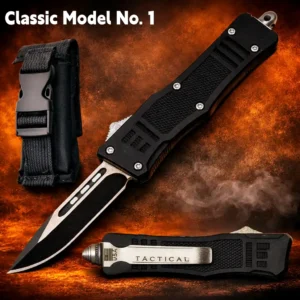
Short answer: In our B2B observation of the US market, mid-size OTF knives with roughly 3.0 to 3.5 inch blades and 7.5 to 8.5 inch overall length sell through most consistently. These are practical wholesale ranges, not national POS statistics, and they describe what tends to reorder best across mixed retail channels rather than what every store should stock.
Methodology: This article reflects a review of US-bound wholesale orders and reorders placed over the last 18 months, including repeat dealer accounts, online resellers, and mixed retail distributors. For this piece, “US market” means orders shipping to US business customers; it does not mean a census of all US retail sales. We use these findings as a practical wholesale benchmark, then compare them against public market signals such as common bestselling size formats seen on major knife retailer listings and manufacturer lineups.
The main variables that change the answer are sales channel, local legal environment, target buyer preference, and price band. Automatic-knife rules and marketplace policies vary, so size planning should match the channel and jurisdiction without treating this article as legal advice.
Observed reorder strength by size band
| Blade length | Overall length | Observed reorder strength | Channels where it tends to fit best | Typical role |
|---|---|---|---|---|
| 2.5 to 2.9 in. | 6.75 to 7.4 in. | Moderate | Online EDC, gift-oriented retail, lighter-carry assortments | Supporting SKU |
| 3.0 to 3.5 in. | 7.5 to 8.5 in. | Strongest | General knife retail, mixed dealer accounts, broad online resale | Core volume range |
| 3.75 in. and up | 8.75 in. and up | Selective | Tactical-heavy stores, collector displays, showcase-led counters | Niche or attention SKU |
This table is directional, not absolute. The point is not that compact and large OTFs do not sell. The point is that the 3.0 to 3.5 inch band shows the most reliable reorder behavior across different dealer types, which is usually the clearest sign of broad demand in wholesale.
Why this size band performs best on OTF knives
OTF size performance is not just generic knife retail math. The mechanism changes the package in ways buyers notice quickly.
1. Handle-to-blade proportion matters more on OTFs. Because the blade retracts into the chassis, an OTF needs more handle length than a manual folder with a similar blade. At very small sizes, some buyers feel they are carrying a lot of body for a modest cutting edge. Mid-size models usually land in the range where the knife still feels worth the pocket space.
2. Button travel and firing feel improve with enough chassis length. On many small OTFs, the control area can feel cramped. On many large OTFs, the firing action may still feel impressive, but the overall knife can seem less practical for daily carry. Mid-size frames often hit the best balance of thumb access, mechanism feel, and carry comfort.
3. Grip confidence rises fast once the handle reaches a usable length. A mid-size OTF is more likely to give average adult hands a solid three- or four-finger grip without becoming bulky in the pocket. That matters at the counter, where “good in hand” often drives the sale.
4. The value story is easier to understand. Buyers tend to read mid-size OTFs as real daily-use tools. Mini models can be seen as backup or novelty purchases; oversized models often become specialty buys.
What the evidence supports, and what it does not
The evidence here is strongest for wholesale reorder behavior, not for total US consumer unit share. Reorders matter because they reflect what dealers chose to buy again after initial sell-through. That makes them useful for answering a B2B question like which size is safest to stock.
For external corroboration, the broader knife market also gives a useful proxy: many established OTF product lines from major brands cluster around the roughly 3-inch to mid-3-inch blade range, and large online knife retailers often feature their highest-visibility OTF models in that same middle lane. That does not prove exact national market share, but it does support the idea that the market center is compact-to-mid, with mid-size as the strongest general-purpose format.
Channel comparison: where each size band works best
If you are buying for resale, the better question is not only “What sells best?” but also “What sells best where?”
General retail counters
The most dependable size is still 3.0 to 3.5 inches. Customers can handle the knife, test the firing action, and judge grip comfort immediately. Mid-size OTFs usually feel substantial without crossing into awkward carry.
Online resale
Online performance often shifts slightly shorter, but not by much. Listings in the roughly 2.8 to 3.4 inch blade range tend to be easier for buyers to say yes to because the dimensions look safer on a spec sheet. Buyers who cannot handle the knife in person are more cautious about bulk and weight.
Mixed dealer distribution
For accounts serving sporting goods stores, knife shops, and general outdoor retailers, mid-size remains the safest center. It creates the fewest objections across dealer types and usually gives the cleanest reorder forecasting.
Tactical or collector-led stores
Larger OTFs can earn a place here, especially when visual presence matters. But they are usually better as selective add-ons than as the main inventory bet.
Worked example: if a buyer needs one opening size class with the highest chance of broad US sell-through, the middle band is the default. Compact sizes can support it; large sizes can add variety; neither is usually the safest anchor for volume.
Decision guide for wholesale buyers
Use this simple buyer rubric:
- If you sell across mixed channels: center the assortment on 3.0 to 3.5 inch blades.
- If your business is mainly online and carry-focused: stay in compact-to-mid, avoiding overly bulky frames.
- If your audience is tactical or collector-heavy: keep mid-size as the base, then add a smaller number of larger showpiece models.
- If you are testing a new line: start with one proven mid-size chassis before expanding into multiple lengths.
This approach is less exciting than chasing extremes, but it usually produces better first reorders.
Best quick test
- If the knife feels bulky for the blade it delivers, demand is usually narrower.
- If first reactions are “good in hand” and “easy to carry,” you are near the strongest size zone.
- If your opening buy has more large OTFs than mid-size OTFs, recheck the plan.
When this changes
There are real edge cases. Compact OTFs can outperform mid-size in gift-heavy, lighter-carry, or discretion-focused channels. Large OTFs can do better in collector, tactical, or display-led environments where visual impact is part of the appeal. Price also matters: entry-level buyers often lean toward practical carry sizes, while premium buyers may tolerate more specialization.
Mistakes that distort size planning
- Using photo impact as a demand signal. Large OTFs often look strong in images but reorder less consistently than mid-size knives.
- Judging by blade length alone. On OTFs, overall length, closed length, thickness, and control placement matter almost as much as blade length.
- Overbuying mini formats. Small OTFs have a place, but they are usually safer as supporting SKUs than as the core of the buy.
- Launching too many sizes at once. Splitting demand across several body sizes can make it harder to identify what truly works.
Bottom line
If the question is which OTF knife sizes sell best in the US, the most accurate wholesale answer is: mid-size models, especially those around 3.0 to 3.5 inch blades and 7.5 to 8.5 inch overall length. That range tends to give the best balance of carry comfort, usable blade length, grip confidence, and OTF mechanism packaging.
For buyers comparing current models, see OTF knife buying options. For larger dealer programs, the bulk quote request page is the right place to discuss size mix and channel fit.
FAQ
Do mini OTF knives sell better than mid-size models?
Usually no. Mini OTFs do sell, especially in lighter-carry and gift-oriented channels, but mid-size models are typically the more dependable volume driver in wholesale.
What size tends to work best for online OTF sales?
Online, the strongest range is often slightly shorter than in-store, but still close to the market center: roughly 2.8 to 3.4 inches of blade, assuming the knife still offers a comfortable grip and reasonable overall proportions.
Does overall length matter as much as blade length on an OTF?
Yes. On OTF knives, overall length can matter nearly as much as blade length because the internal mechanism affects handle size, carry bulk, grip area, and firing feel. That is why two knives with similar blade lengths can sell very differently.