
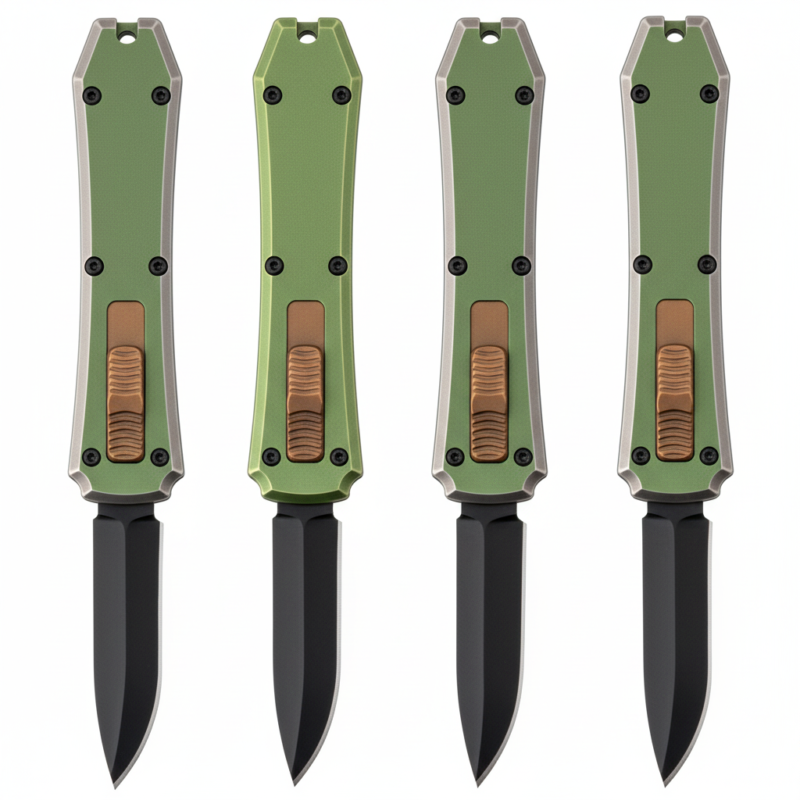
Short answer
Yes, double edge OTF knives are practical for specific priorities like piercing and symmetry, but for package opening, cardboard, rope, detail cuts, carry comfo
Key Takeaways
- Knife rules can vary by state, city, blade style, opening mechanism, carry method, and intended use.
- Do not treat a product nickname as a legal category; check the actual features and local rule.
- Retailers should keep legal or safety language factual and avoid promising that one item is allowed everywhere.
Terms Used Here
- OTF
- Out-the-front; a knife design where the blade moves forward from the front of the handle.
- Automatic knife
- A knife that opens by a spring-driven mechanism after the user activates a button, switch, or slider.
- EDC
- Everyday carry; gear intended for regular daily tasks.
In this article
- 01 Quick comparison: double edge vs single edge OTF
- 02 Where double edge OTF knives are genuinely practical
- 03 Piercing and tip-first work
- 04 Symmetry and orientation
- 05 Collector or tactical preference
- 06 Where double edge OTF knives feel less practical in real use
- 07 Package opening
- 08 Cardboard breakdown
- 09 Rope, nylon straps, and fibrous material
- 10 Detail cuts near a surface
- 11 Carry comfort and handling details people notice quickly
- 12 Sharpening burden: a practical issue many buyers underestimate
- 13 Who should choose double edge, and who should avoid it?
- 14 Legal practicality: narrower answer, not broad legal advice
- 15 What the evidence can and cannot show
- 16 How this was checked
- 17 FAQ
- 18 Are double edge OTF knives good for everyday carry?
- 19 Are double edge OTF knives better for self-defense than utility?
- 20 Do double edge OTF knives cut cardboard well?
- 21 Are double edge OTF knives harder to sharpen?
- 22 So, are double edge OTF knives practical?
Yes, double edge OTF knives can be practical. But for most everyday cutting jobs, a single edge OTF is usually the more practical choice because it gives you a safe spine, better control in close work, easier sharpening, and fewer legal headaches in some places.
First, define the terms. In OTF knives, double edge (D/E) usually means a dagger-style blade sharpened on both sides, while single edge (S/E) means one sharpened edge and one unsharpened spine or partial swedge; current maker product pages use these terms consistently at the model level (evidence type: catalog/spec sheet; Microtech Knives product pages, accessed 2026-05-27, https://microtechknives.com/).
Short verdict: Choose a double edge OTF if you specifically want a dagger profile, strong piercing geometry, and symmetrical looks. Choose a single edge OTF if your real tasks are opening packages, cutting cardboard, trimming material, or doing controlled utility cuts.
Quick comparison: double edge vs single edge OTF
| Task or factor | Double edge OTF | Single edge OTF |
|---|---|---|
| Package opening | Works, but less forgiving near fingers and surfaces | Usually better control with a safe spine |
| Cardboard breakdown | Can cut well, but hand placement is less secure | Usually the easier everyday option |
| Rope and straps | Adequate, no special advantage | Usually easier to guide in draw cuts |
| Detail cuts | Less comfortable for close work | Better for careful trimming and zip ties |
| Piercing | Main strength | Good, but usually less optimized |
| Sharpening | Two edges to maintain evenly | Simpler for most owners |
| Legality | May trigger dagger or double-edge rules | Often simpler, though automatic-knife laws still apply |
Where double edge OTF knives are genuinely practical
Double edge OTF knives are practical when your idea of practical includes piercing performance, ambidextrous cutting orientation, or a dagger profile you intentionally want.
Piercing and tip-first work
This is the clearest advantage. A centered dagger grind usually creates a narrow, acute tip that enters material cleanly. If the job is mostly penetration rather than long slicing cuts, a D/E blade makes sense.
Symmetry and orientation
Some users like that either side can be used as the working edge. In simple cuts, that can feel natural because you do not have to think about keeping the sharpened side oriented one specific way.
Collector or tactical preference
Practicality is not only about cardboard. If the buyer specifically wants the classic dagger look, the D/E format is practical because it matches that goal directly. Catalogs can confirm that D/E and S/E are both established blade styles in the OTF category, but they cannot prove one is better for daily utility by themselves (evidence type: catalog/spec sheet; Microtech Knives, accessed 2026-05-27, https://microtechknives.com/).
Where double edge OTF knives feel less practical in real use
This is where the difference becomes obvious. Most owners use a knife for ordinary cutting tasks, and a true double edge creates a few handling compromises.
Package opening
Opening taped boxes, mailers, and plastic packaging rewards control more than symmetry. With a single edge blade, you can angle the spine toward your thumb or index finger and know exactly which side is safe. On a true double edge, there is no full safe thumb spine, so close work feels less forgiving. That matters when you are cutting toward a seam, working around contents, or trying not to scratch what is inside.
Cardboard breakdown
Cardboard is one of the best reality checks for knife practicality. Long cuts through corrugated board often involve choking up slightly and steering the blade through resistance. A single edge OTF usually gives you a better reference surface and more confidence during repeated cuts. A double edge can still do the job, but the lack of a safe spine makes grip adjustments more cautious than they need to be.
Rope, nylon straps, and fibrous material
Rope and strapping usually reward edge placement and draw-cut stability. In that kind of cut, the second sharpened edge does not help much. What helps more is knowing where your support hand and thumb can rest while you pull the edge through the material. For many users, that makes S/E easier to control.
Detail cuts near a surface
Trimming a zip tie without gouging plastic, shaving a corner off gasket material, cleaning up packaging, or making a careful shallow cut all favor one working edge and one clearly safe side. On a D/E blade, the opposite edge stays exposed during the kind of close work where your fingers naturally want more contact and guidance.
Carry comfort and handling details people notice quickly
The biggest day-to-day issue with a double edge OTF is not whether it cuts. It does. The issue is how it feels while doing normal tasks.
- No true thumb spine: many common utility grips rely on light thumb pressure against an unsharpened spine.
- More edge exposure during close work: when cutting in tight spaces, the non-working edge is still there, which can make the knife feel busier and less forgiving.
- More cautious hand placement: even experienced users often adjust grip more deliberately on a D/E blade.
Those are small differences on paper, but they are the exact kind of differences that decide whether a knife feels easy to live with every day.
Sharpening burden: a practical issue many buyers underestimate
Double edge blades ask more from the owner. You are maintaining two edges instead of one, and if you sharpen by hand, you also need to keep the bevels reasonably even so the tip stays centered and the blade shape does not drift over time.
For someone who already sharpens confidently, that may be acceptable. For a casual owner, it usually means more time, more chances to round the tip, and more opportunities to end up with one edge sharper than the other. If you want low-maintenance utility, single edge is the easier answer.
Who should choose double edge, and who should avoid it?
Choose a double edge OTF if you:
- want a dagger-style blade on purpose
- care most about piercing geometry
- prefer symmetrical looks and handling
- do not mind extra sharpening work
Avoid a double edge OTF if you:
- mainly open boxes and packages
- cut cardboard, rope, or plastic straps often
- like to brace a thumb on the spine for control
- want the simplest legal and maintenance path
That is the cleanest buying rule: D/E is best when the blade style itself is the point; S/E is best when the job itself is the point.
Legal practicality: narrower answer, not broad legal advice
Legal practicality matters because some jurisdictions regulate automatic knives, some regulate daggers or double-edged blades, and some regulate both. That means a double edge OTF may be legal in one place, restricted in another, and treated differently from a single edge automatic in a third (evidence type: law; AKTI State Knife Laws, accessed 2026-05-27, https://www.akti.org/state-knife-laws/).
The practical takeaway is simple: do not assume a D/E OTF is treated the same as an S/E OTF just because both are OTF automatics. Check your state and local rules before buying or carrying. This is not legal advice.
What the evidence can and cannot show
The sources can verify blade terminology, confirm that both D/E and S/E OTFs are established commercial formats, and show that legal treatment can differ by jurisdiction (evidence type: catalog/spec sheet and law; Microtech Knives and AKTI, accessed 2026-05-27, https://microtechknives.com/ ; https://www.akti.org/state-knife-laws/). They cannot, by catalog presence alone, prove that double edge is the better everyday choice for most users.
How this was checked
Method: reviewed current maker product pages to confirm D/E and S/E terminology, checked a major retailer category to confirm both blade styles are actively sold in the market, and reviewed AKTI state law summaries to confirm that automatic-knife rules and double-edge or dagger rules can differ. Review date: 2026-05-27.
- Microtech Knives product pages for D/E and S/E terminology and active OTF model examples (evidence type: catalog/spec sheet; accessed 2026-05-27, https://microtechknives.com/)
- Benchmade product pages for current OTF blade-style examples and naming conventions (evidence type: catalog/spec sheet; accessed 2026-05-27, https://www.benchmade.com/)
- Blade HQ automatic knives category for current retail availability across automatic knife blade styles (evidence type: retailer count; accessed 2026-05-27, https://www.bladehq.com/cat–Automatic-Knives–40)
- AKTI State Knife Laws for state-level legal summaries involving automatics and dagger-style restrictions (evidence type: law; accessed 2026-05-27, https://www.akti.org/state-knife-laws/)
If you want to compare current models by blade style, start with the OTF knife catalog.
FAQ
Are double edge OTF knives good for everyday carry?
They can be, but they are usually not the easiest EDC option. For normal daily cutting, most users will find a single edge OTF more comfortable and easier to control.
Are double edge OTF knives better for self-defense than utility?
They are generally more associated with piercing-oriented geometry than with utility cutting. For ordinary work tasks, that geometry is usually less useful than a single edge blade with a safe spine.
Do double edge OTF knives cut cardboard well?
Yes, but the issue is not cutting ability. The issue is control and hand placement during repeated cuts, where a single edge blade is usually easier to use.
Are double edge OTF knives harder to sharpen?
Yes. You have two edges to maintain, and keeping both sides even takes more time and care.
So, are double edge OTF knives practical?
Yes, for buyers who specifically want piercing performance, symmetry, or dagger styling. No, if by practical you mean the best tool for boxes, rope, detail cuts, easy maintenance, and the simplest carry choice.