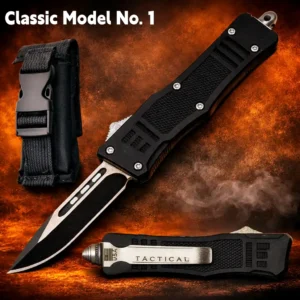


Are OTF Knives Durable Enough for Heavy Use?

Short answer
Learn when OTF knives are durable enough for heavy use, what normal blade play looks like, common failure points, and how wholesale buyers can judge reliability
In this article
- 01 What “durable enough” means for an OTF knife
- 02 Where OTF knives hold up well—and where they do not
- 03 How to judge an OTF for heavy use before buying in volume
- 04 Comparison: what to expect from an OTF under heavy use
- 05 Mistakes to avoid when choosing an OTF for demanding users
- 06 Bottom line for buyers and resellers
- 07 Is blade play on an OTF always a bad sign?
- 08 Can an OTF be a true work knife?
- 09 What is the clearest warning sign of poor OTF durability?
- 10 How should a buyer test a sample by hand?
Yes—some OTF knives are durable enough for heavy daily cutting, but they are not the best choice for every kind of abuse, and durability depends more on build quality, internal consistency, and maintenance tolerance than on the fact that the knife is automatic.
A common misconception is that any blade movement means an OTF is weak. That is not correct. Some blade play is normal on many OTF designs, while repeated misfires, worsening looseness, switch drag, and inconsistent lockup are the real warning signs. If the question is heavy use, the right test is not “does it feel like a fixed blade?” but “does it open and cut consistently over repeated normal work?”
What “durable enough” means for an OTF knife
For OTF knives, durability and reliability are related but not identical.
- Durability means the knife can withstand repeated opening, closing, pocket carry, and real cutting tasks without developing major problems too quickly.
- Reliability means it deploys and retracts consistently under normal conditions.
- Lockup feel is how solid the blade feels when open.
- Blade play is the small amount of side-to-side or front-to-back movement you may feel at the tip or spine.
Those terms matter because buyers often reject a good OTF for “play” that is actually normal, or accept a poor one because it feels tight on day one. A heavy-use OTF should be judged by repeated function, not just first impression.
In plain English:
- Normal: slight blade play, crisp deployment, consistent retraction, no grinding feel in the switch, and no change after repeated openings.
- Borderline: a little more play than expected but still consistent firing, occasional sensitivity to pocket lint, or a switch that feels stiff but not erratic.
- Warning sign: misfires, partial deployment, blade looseness that gets worse quickly, rattling that increases over time, or a knife that works only when held in one position.
That distinction is especially important for resellers and private-label buyers reviewing samples from a catalog of OTF knives. A sample can feel acceptable in hand yet still fail consistency checks after a short cycle test.
Where OTF knives hold up well—and where they do not
An OTF can handle frequent cutting of cardboard, shrink wrap, strapping, tape, plastic sheeting, and similar day-to-day materials if the knife has a well-fitted chassis, a dependable spring system, and a blade steel matched to the job. That is the kind of heavy use many warehouse staff, retail workers, contractors, and serious users actually mean.
Where OTFs are less ideal is twisting, prying, digging into hard material, or using the blade as a screwdriver substitute. Those tasks stress the lockup and internal drive system in ways that simpler manual knives or fixed blades tolerate better. This does not make OTFs fragile; it means their design has more moving parts and tighter internal timing.
OTF knives are also less dirt-tolerant than many manual folders. That is not alarmism. The mechanism depends on a track, spring energy, and clean enough internal travel to complete deployment. Pocket lint, fine grit, and sticky residue can interfere sooner than they would on a basic manual knife with a thumb stud and washer pivot.
What this means in practice: if the end user will open boxes all day and wants fast one-handed deployment, a quality OTF may be durable enough. If the end user regularly twists in hardwood, scrapes metal, or works in heavy dust without routine cleaning, a manual work knife may be the safer recommendation.
How to judge an OTF for heavy use before buying in volume
The best buying decisions come from observable pass/fail checks, not broad claims like “premium quality” or “military grade.”
One useful by-hand test is simple: open and close the sample repeatedly at a steady pace, then check whether the blade still locks and retracts with the same feel. You are not looking for zero play. You are looking for consistency.
- Pass: repeated deployment remains crisp, the switch returns cleanly, and blade movement does not noticeably worsen.
- Borderline: one hesitation during a long test, but normal function resumes after resetting and there is no growing looseness.
- Fail: multiple misfires, partial lockup, switch drag that increases, or a need to “baby” the action to get reliable opening.
For wholesale or distributor evaluation, inspect these areas:
- Deployment consistency: cycle several times with normal thumb pressure, not exaggerated force.
- Retraction consistency: make sure closing is as dependable as opening.
- Switch feel: it should feel deliberate, not mushy, gritty, or sharply uneven.
- Blade play trend: a small amount can be normal; rapid increase is not.
- Chassis fit: look for uneven body seams, visible gaps, or hardware that loosens early.
- Edge retention in intended media: test on actual work materials such as cardboard or plastic banding.
- Reset behavior after a failed fire: if a safety mechanism triggers, it should reset predictably.
One mistake buyers make is overvaluing a hard initial firing action. A very stiff switch can feel “strong,” but if it causes user fatigue or inconsistent thumb travel, field reliability may actually drop. Another mistake is judging durability only by blade steel. Steel matters, but an OTF with good steel and poor internal tuning is still a risky heavy-use product.
Comparison: what to expect from an OTF under heavy use
- Strong candidate for heavy daily cutting: consistent action, stable lockup feel, moderate and unchanged blade play, easy reset, clean internal fit, and no sharp decline after repeated opening.
- Acceptable for moderate use: cuts well, occasional sensitivity to lint or debris, some normal movement at the blade, but no pattern of misfires.
- Not a heavy-use choice: frequent deployment failures, worsening rattle, loose hardware, switch binding, or clear dependence on careful handling to work.
Consider a real scenario: a retail chain wants a private-label OTF for stockroom employees who break down cartons, cut tape, and trim plastic wrap throughout the day. In that case, the knife does not need pry-bar toughness. It needs repeatable deployment, decent edge retention, and manageable maintenance. If sample units begin misfiring after exposure to cardboard dust and lint, that is a practical reliability issue even if the knife still looks solid in hand.
For that reason, serious buyers should ask not only “What steel is this?” but also “How does it behave after repeated cycles and light contamination?” If you are comparing samples or planning a branded run, a direct OTF support inquiry is the right place to ask about mechanism consistency, sample evaluation, and expected maintenance needs.
Mistakes to avoid when choosing an OTF for demanding users
Heavy use exposes weak assumptions quickly. These are the most common buying mistakes.
- Confusing lockup feel with zero movement: some movement can be normal in OTFs; worsening movement is the concern.
- Testing only a few dramatic openings: reliability is about repeated normal cycles, not one impressive snap.
- Ignoring debris tolerance: OTFs can be excellent cutters, but they generally need cleaner internals than simpler manual knives.
- Assuming every user will maintain the knife well: if the customer base is rough on tools, choose a design with forgiving operation and simple cleaning habits.
- Using “heavy use” to include prying or twisting: that is misuse for most OTFs and should not be the benchmark.
- Skipping inspection of hardware and body fit: loose screws, uneven scales, or poor finish alignment often predict bigger reliability issues later.
Safe handling matters too. A knife that is functioning poorly should be cleaned, inspected, and taken out of service if problems continue. Users should keep fingers clear of the blade path, avoid testing lock strength through unsafe impact methods, and avoid forcing the mechanism when debris or resistance is present.
Bottom line for buyers and resellers
OTF knives can be durable enough for heavy use when “heavy use” means repeated cutting and repeated deployment, not prying, twisting, or neglect. The best indicator is consistent performance over time: stable action, acceptable lockup feel, normal blade play that does not worsen, and predictable behavior after routine carry and cutting.
For wholesale buying, the safest approach is to evaluate samples with repeated cycle checks, real material cutting, and simple contamination awareness. In this category, the strongest product is not the one that feels most rigid in the hand for ten seconds. It is the one that keeps working the same way after the novelty wears off.
Is blade play on an OTF always a bad sign?
No. Some blade play is normal on many OTF knives. The concern is increasing play, poor lockup feel, or movement combined with misfires.
Can an OTF be a true work knife?
Yes, for many cutting tasks. It can be a practical work knife for frequent slicing and utility cuts, but it is usually a poorer choice for prying, twisting, or very dirty environments without maintenance.
What is the clearest warning sign of poor OTF durability?
Repeated inconsistent deployment is the clearest warning sign. A knife that misfires, partially opens, or becomes looser after short use is a stronger concern than minor initial blade play.
How should a buyer test a sample by hand?
Open and close it repeatedly with normal thumb pressure, then check for the same lockup feel, the same switch resistance, and no noticeable increase in looseness. Consistency is the pass standard.