
Short answer
Yes, some OTF knives can handle hard cutting tasks, but only the right build, blade grind, lockup, and steel make them suitable. Learn what to inspect, what is
Key Takeaways
- Start with a mild method and increase pressure or abrasion only when the blade condition requires it.
- Edge angle, steel type, corrosion level, and handle material all affect the right care method.
- For wholesale assortments, simple care instructions help customers keep knives useful longer.
Terms Used Here
- OTF
- Out-the-front; a knife design where the blade moves forward from the front of the handle.
- Automatic knife
- A knife that opens by a spring-driven mechanism after the user activates a button, switch, or slider.
- Fixed blade
- A knife with a blade that does not fold or retract into the handle.
In this article
- 01 What “hard cutting tasks” means for an OTF
- 02 What separates a work-capable OTF from a light-duty one
- 03 Blade thickness and grind
- 04 Steel and heat treatment consistency
- 05 Lockup and blade play
- 06 Internal track and spring quality
- 07 What this means in practice
- 08 Simple inspection tests buyers can do by hand
- 09 Comparison: where OTF knives do well and where they do not
- 10 Mistakes buyers and resellers should avoid
- 11 Bottom line
- 12 Are OTF knives good for cardboard all day?
- 13 Is blade play on an OTF always a problem?
- 14 What is the fastest pass/fail test for hard-use suitability?
- 15 Should a reseller stock dagger OTFs for work customers?
Yes, some OTF knives can handle hard cutting tasks, but not every OTF is built for that job. The short qualifier is important: a well-made OTF can cut dense cardboard, heavy plastic strapping, rope, rubber hose, and similar materials reliably, while a light-duty or novelty model may develop play, misfires, or edge damage much sooner.
A common misconception is that all OTF knives are too fragile for serious work simply because the blade deploys from the front. That is not accurate. The better question is whether a specific OTF has the blade geometry, internal tolerances, spring quality, lockup, and steel to tolerate repeated resistance without becoming loose or unreliable.
What “hard cutting tasks” means for an OTF
For OTF knives, hard cutting does not mean prying, twisting in a cut, batoning wood, or scraping metal. Those are misuse cases. Hard cutting means repeated slicing or pull-cutting through materials that create drag and side pressure, such as:
- Double-wall cardboard and pallet wrap
- Nylon rope and woven straps
- Rubber hose and gasket material
- Thick plastic packaging and banding
- Dense foam, felt, and synthetic fabric
In plain English, the knife is working hard when the blade meets steady resistance for many cuts in a row. That kind of work tests three things fast: edge retention, lock stability, and whether the blade tracks cleanly in and out after debris enters the handle.
An OTF is usually a better fit for controlled cutting than for abusive torque. If the user’s job includes twisting the blade sideways to open staples, lifting paint-can lids, or levering apart wood, a fixed blade is the safer recommendation.
What separates a work-capable OTF from a light-duty one
When buyers ask whether OTF knives can handle hard cutting tasks, the answer depends less on the opening style and more on the build details.
Blade thickness and grind
A very thin, hollow-ground blade may feel razor sharp on day one but can be less forgiving in dense material. For tougher cutting, buyers usually want a practical middle ground: enough thickness behind the edge to avoid chipping, but not so thick that the knife wedges badly in cardboard or hose.
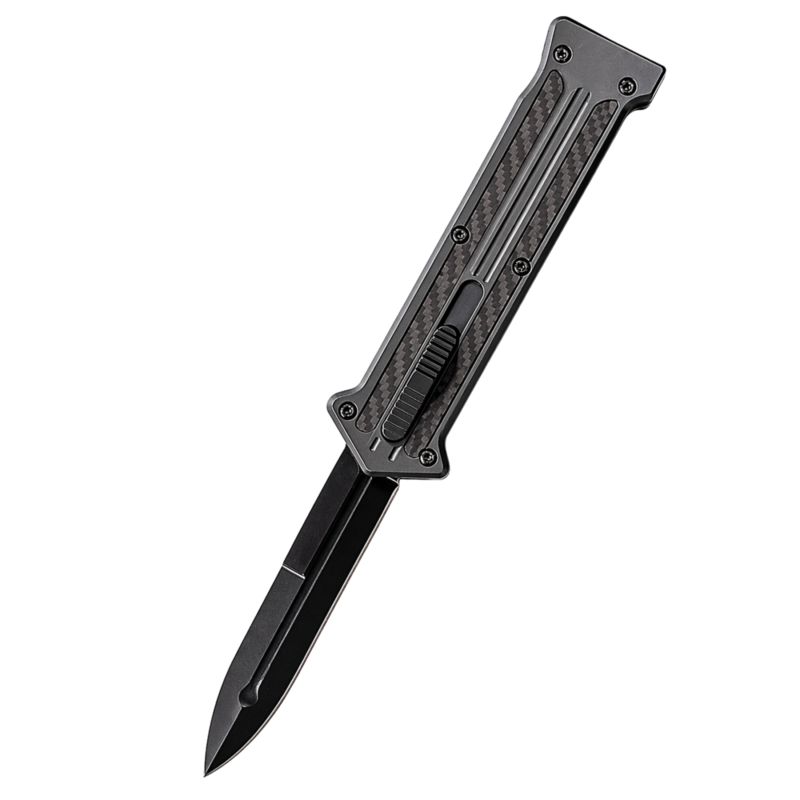
Single-edge drop-point and spear-point profiles are often easier to sell into work-oriented channels because they offer more usable edge and simpler sharpening. Double-edge dagger profiles look aggressive, but they are often less practical for repeated utility cuts.
Steel and heat treatment consistency
Steel choice matters, but consistency matters more. A premium steel with poor heat treatment can underperform a more common steel done correctly. For hard cutting, look for steels known for balanced wear resistance and toughness rather than chasing a label alone. In wholesale buying, edge stability across a batch is a stronger sign of quality than one sample that arrives extremely sharp.
Lockup and blade play
Most OTF knives have some blade movement. That is normal. The pass/fail question is how much and in what direction.
- Normal: slight front-to-back or side-to-side movement that does not increase noticeably under ordinary cutting.
- Borderline: movement that is easy to feel and makes precise cuts less confident, but the knife still deploys and retracts consistently.
- Warning sign: play that grows quickly after a short cutting session, causes visible off-center tracking, or comes with failed deployment.
If a seller claims “zero play” on every OTF, treat that cautiously. A small amount of play is common in the design. What matters is whether the blade stays stable enough for the intended work and whether tolerances remain consistent over time.
Internal track and spring quality
Hard cutting often creates lint, cardboard dust, adhesive residue, and small plastic fragments. A work-capable OTF should continue cycling after normal contamination, not just when clean on a display table. Rough internal machining, weak springs, or poorly fitted sliders show up quickly when the knife is exposed to debris.
What this means in practice
If the end user is breaking down cartons all day, cutting shrink wrap, and trimming plastic straps, a sturdy single-edge OTF from a proven production line can do the job well. If the same user also pries, twists, or digs with the blade, the issue is not that the knife is OTF; the issue is that the task exceeds what an automatic sliding mechanism is meant to tolerate.
A useful real-world example is a warehouse receiver opening palletized shipments. That person may make dozens of cuts in cardboard, film, tape, and nylon banding in one shift. In that scenario, a dependable OTF can be practical because one-handed deployment is fast and gloves are common. But the knife should have a blade shape suited to utility work, predictable lockup, and a handle that does not become slick with dust or stretch wrap residue.
Simple inspection tests buyers can do by hand
You do not need a lab to screen OTF knives for hard-cutting suitability. A few repeatable checks reveal a lot.
- Cycle test: Deploy and retract the knife repeatedly at a steady pace. Listen for changes in sound and feel for hesitation in the slider. A good sample stays consistent. A warning sign is increasing drag, partial lockup, or a blade that needs wrist motion to finish travel.
- Blade play check: With the blade deployed, gently test side-to-side and front-to-back movement by hand. Slight movement is normal. A fail is movement that feels loose enough to shift the cutting line noticeably.
- Cardboard drag test: Make several long cuts through heavy cardboard. Afterward, check whether deployment remains crisp and whether the edge shows rolling or chipping. If the action becomes erratic after simple cardboard work, that model is not a strong hard-use candidate.
- Track contamination check: After those cuts, inspect the opening and slider area for trapped debris. Then cycle the knife again. A robust OTF should tolerate ordinary dust without immediate malfunction.
- Edge recovery check: Run the edge lightly across paper after the test cuts. A knife intended for work should still cut cleanly. If sharpness falls off dramatically after a short session, the edge geometry or heat treatment may be too soft or too brittle.
For wholesale screening, test multiple samples from the same lot. One good unit proves little. Batch consistency is what protects returns and reputation.
Comparison: where OTF knives do well and where they do not
- Good fit: repetitive slicing, one-handed access, glove use, warehouse receiving, packaging breakdown, rope and strap cutting, emergency-access utility.
- Poor fit: prying, twisting, digging, heavy lateral pressure, striking, or tasks where dirt and grit are extreme and cleaning is unlikely.
- Best buyer match: customers who value speed and convenience but still understand that an OTF is a cutting tool, not a pry bar.
That is why assortment matters. A catalog should not treat every OTF as a hard-use work knife. Buyers comparing options in an OTF knife catalog should separate utility-oriented models from collector-style or novelty pieces based on blade shape, action consistency, and construction quality.
Mistakes buyers and resellers should avoid
The most expensive mistake is buying on appearance alone. OTF knives can look substantial while hiding weak internals, rough tracks, or inconsistent lock surfaces.
- Do not judge by deployment speed alone. A fast opening knife can still have poor lock stability under load.
- Do not confuse thick blades with strength. Excessively thick geometry can cut worse in dense material and create more drag.
- Do not ignore debris tolerance. Hard cutting creates dust and residue. If the action only works when spotless, field performance will disappoint.
- Do not oversell “tactical” styling as work capability. Buyers using knives for shipping, receiving, maintenance, or farm chores need utility-first designs.
- Do not evaluate only one sample. For distributors and private-label buyers, the risk is not one failure; it is inconsistent batches that increase warranty claims.
A practical buying checklist is simple:
- Choose a useful blade profile for the end market, usually single-edge over dagger.
- Confirm slight play is controlled and consistent, not excessive.
- Run repeated deployment and cardboard-cut tests on several samples.
- Check whether action remains reliable after ordinary debris exposure.
- Review fit and finish across the batch, not just the best unit.
- Match the model to real tasks, not marketing language.
For wholesale programs, this is also where communication matters. If you are sourcing for a work-oriented retail line, use the wholesale inquiry form to specify intended use, target price band, blade style preference, and your acceptable tolerance for play and action variation.
Bottom line
OTF knives can handle hard cutting tasks when they are built for repeated resistance, not just fast deployment. The strongest indicators are stable lockup, practical blade geometry, consistent action after debris exposure, and batch-to-batch reliability. The warning signs are growing play, failed cycling after simple cardboard work, and models designed more for appearance than utility.
Are OTF knives good for cardboard all day?
Some are. A well-made utility-focused OTF can handle repeated cardboard cutting, but cheaper models often show action problems once dust and adhesive build up.
Is blade play on an OTF always a problem?
No. Slight play is normal on many OTF knives. It becomes a problem when it increases quickly, affects cut control, or comes with deployment failures.
What is the fastest pass/fail test for hard-use suitability?
Cycle the knife repeatedly, make several long cuts through heavy cardboard, then cycle it again. If action consistency drops sharply or the blade feels noticeably looser, that is a fail for serious work use.
Should a reseller stock dagger OTFs for work customers?
Usually not as the main option. For utility-focused customers, single-edge blade shapes are typically easier to use, sharpen, and explain at the counter.