
Short answer
Yes, an OTF knife can accidentally open in a pocket, but it is uncommon on well-designed models carried alone with the actuator protected. Risk rises with light
In this article
- 01 Short answer: when pocket opening happens
- 02 Main causes of accidental opening
- 03 1. Low actuator resistance
- 04 2. Pocket clutter
- 05 3. Exposed slider position
- 06 4. Poor carry orientation or weak clip setup
- 07 5. Lint, grit, and wear
- 08 Why the OTF mechanism helps, and why it can still fail
- 09 What if the blade only partially deploys?
- 10 Safest carry habits for pocket use
- 11 Wrong tool: when pocket carry is a bad idea
- 12 How to evaluate whether a specific model is pocket-safe enough
- 13 Common mistakes to avoid
- 14 FAQ
- 15 Is accidental pocket opening common?
- 16 Are double-action OTF knives safer than single-action models in the pocket?
- 17 Can lint really affect pocket safety?
- 18 What is the safest simple rule?
Yes, an OTF knife can accidentally open in the pocket. On a well-designed model carried alone with the actuator protected, it is uncommon, but the risk goes up when the slider is light, the pocket is crowded, the actuator sits exposed, or lint and grit affect the mechanism.
The practical takeaway is simple: dedicated-pocket carry lowers the chance of accidental opening, but it does not eliminate it. Designs vary by maker, so check the manufacturer’s manual and test safely under realistic pocket conditions rather than assuming every OTF behaves the same.
Short answer: when pocket opening happens
An OTF opens only if the actuator is moved far enough to complete enough of the firing cycle for the blade to leave the handle. In a pocket, that usually means one of four things happened: something pressed directly on the slider, the knife shifted into a bad orientation, debris changed how the mechanism felt, or the design itself offered too little resistance.
Three common real-world examples:
- Keys or a flashlight in the same front pocket rubbing or pressing against the slider while walking.
- Driving or sitting with the knife clipped near the waistband so the seat belt, chair edge, or your hip presses the actuator.
- Squatting, kneeling, or climbing ladders at work where the pocket mouth compresses against the handle over and over.
These are not rare fantasy scenarios. They are the normal ways pocket pressure builds during daily carry.
Main causes of accidental opening
1. Low actuator resistance
The most direct cause is a slider that moves too easily. Smooth action is not automatically a safety feature. If the actuator can be pushed by casual rubbing instead of deliberate thumb pressure, pocket opening becomes more likely.
2. Pocket clutter
Coins, key heads, lighters, earbuds cases, multitools, and even a thick seam inside the pocket can contact the slider. Repeated light pressure is often more realistic than one dramatic shove.
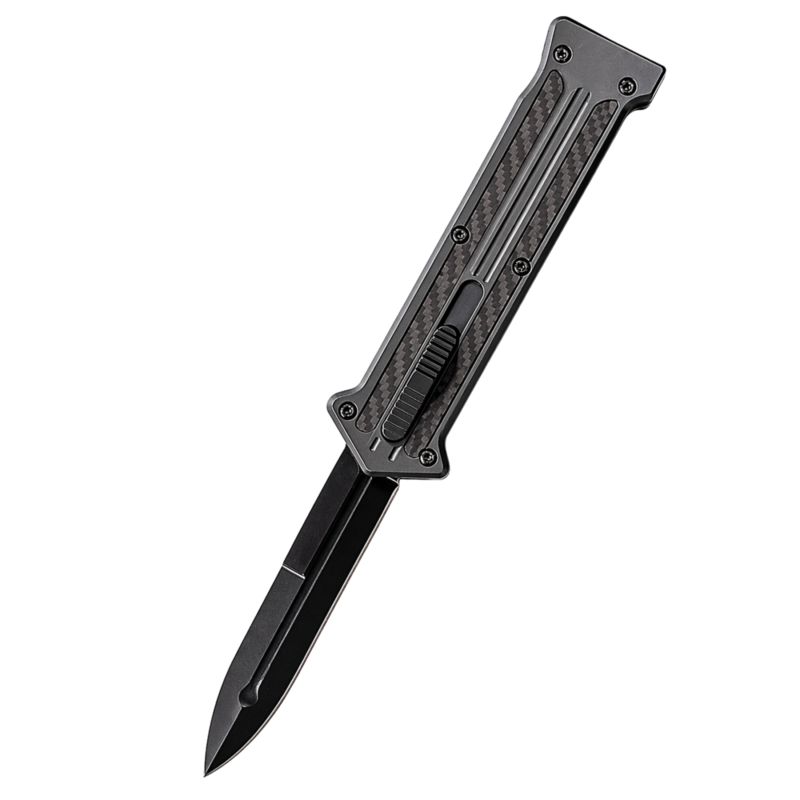
3. Exposed slider position
Some handles leave the actuator proud and easy to hit. Others recess it slightly or shield it with handle contours. A slider that sits exposed near the pocket opening is easier to press accidentally.
4. Poor carry orientation or weak clip setup
If the clip allows the knife to rotate, ride too high, or shift during movement, the actuator may end up facing the pressure point instead of away from it. A loose clip screw or weak clip tension can make this worse over time.
5. Lint, grit, and wear
OTF knives are more sensitive to pocket debris than many simple manual folders. Lint in the actuator channel, grit in the track, or general wear in the control surfaces can change how the slider feels and how consistently the blade retracts or resets.
These are field observations, not universal rules for every model. The point is that accidental opening is usually a combination problem: design, carry method, and pocket environment all matter.
Why the OTF mechanism helps, and why it can still fail
Many double-action OTF knives are designed so the blade can disconnect from the drive system if it hits resistance during deployment. That matters in a pocket because fabric or another object may interrupt the blade before it fully locks open. In some cases, this reduces how forcefully the blade continues forward.
That said, this is not a fail-safe guarantee. If the actuator gets a full push and the blade has a clear path, the blade can still protrude. Even a partial deployment is a problem because you may not realize it happened until you reach into the pocket.
So the fair safety summary is this: the mechanism may reduce some consequences of interrupted deployment, but it does not make pocket opening impossible and it does not make a partially deployed blade harmless.
What if the blade only partially deploys?
This is the most important part for actual injury prevention. A partially deployed OTF can be more confusing than a fully closed knife because the blade may be exposed just enough to cut during retrieval, yet not obviously locked open.
If you suspect the knife may have opened in the pocket:
- Do not blindly reach in around it.
- Remove the knife by the clip or the handle body if possible.
- Point it away from your hand and body before checking the slider.
- Reset and inspect it outside the pocket.
Do not assume that because an OTF often stops when obstructed, any partial opening is automatically safe. The real hazard is contact during retrieval.
Safest carry habits for pocket use
If your goal is to reduce accidental opening risk as much as practical, these habits matter more than marketing claims:
- Carry the knife alone in a dedicated pocket. This is the single best habit. No keys, coins, or other tools in the same pocket.
- Clip it in a consistent orientation. Keep the actuator facing the direction least likely to receive pressure from your body or the pocket seam.
- Check full closure before pocketing. Make sure the blade is fully retracted and the slider is at rest.
- Inspect the clip and screws. If the clip loosens, the knife can rotate into a worse position.
- Clean pocket lint regularly. Especially with denim, work pants, or dusty environments.
- Be cautious after heavy movement. After driving long periods, climbing, kneeling, or gym-style movement, verify the knife is still fully closed before reaching casually into that pocket.
A use-case-specific maintenance note: denim lint and fine jobsite dust are common causes of inconsistent OTF feel. If the slider suddenly feels lighter, rougher, or less positive than usual, stop carrying it loose in the pocket until it is cleaned and checked according to the maker’s instructions.
Wrong tool: when pocket carry is a bad idea
Sometimes the safest answer is not “carry more carefully,” but “do not use this carry method.” Pocket carry is a poor choice in these situations:
- Same pocket as keys, coins, or metal tools.
- Loose athletic shorts or thin pockets where the knife rotates freely and gets pressed unpredictably.
- Heavy grit, sand, drywall dust, or shop debris that can contaminate the mechanism quickly.
- Frequent blind retrieval where you repeatedly grab into the pocket without looking.
In those cases, a different knife style or a different carry method may be safer.
How to evaluate whether a specific model is pocket-safe enough
If you are comparing models, focus on observable features instead of broad claims like “tactical” or “premium.”
- Actuator resistance: It should require deliberate thumb pressure, not casual rubbing.
- Slider protection: Recessed controls or raised handle shoulders help reduce accidental contact.
- Clip geometry: A stable clip that keeps the knife from rotating is a real safety advantage.
- Consistency after pocket carry: Test after several days in actual pants pockets, not only on a clean bench.
- Reliable reset behavior: If the blade is interrupted, the knife should reset predictably according to the manufacturer’s instructions.
A modest but useful trust check is to compare your observations with the manufacturer’s manual. If the maker gives specific cleaning, lubrication, or carry warnings, follow those over general internet advice.
For those reviewing multiple models, the main product category is here: OTF knives. If you need help with product-specific questions, the support contact is here: buyer support form.
Common mistakes to avoid
- Assuming all double-action OTFs are equally safe in the pocket. They are not.
- Testing only in an empty pocket. Real carry includes seams, movement, and other items.
- Confusing strong spring force with safe carry design. Spring strength alone does not prevent slider actuation.
- Ignoring lint because the knife still “works.” Pocket safety problems often show up as inconsistency before outright failure.
FAQ
Is accidental pocket opening common?
On a well-made OTF carried alone in a dedicated pocket, it is generally uncommon. It becomes more likely with exposed sliders, cluttered pockets, poor clip orientation, or dirty mechanisms.
Are double-action OTF knives safer than single-action models in the pocket?
Often, but not automatically. Many double-action designs are better suited to everyday pocket carry, yet the exact slider design and carry conditions still matter more than the label alone.
Can lint really affect pocket safety?
Yes. Lint and grit can change slider feel, interfere with travel, and make the mechanism less predictable. That matters directly for a knife carried in a pocket every day.
What is the safest simple rule?
Carry the OTF alone in its own pocket, keep the actuator protected from pressure, and stop using pocket carry if the knife starts feeling inconsistent or contaminated.