

What Are the Advantages of an OTF Automatic Knife?

Short answer
Learn the real advantages of an OTF automatic knife, where it performs best, what users misjudge, and how to decide if OTF carry fits your work or daily use.
Key Takeaways
- Knife rules can vary by state, city, blade style, opening mechanism, carry method, and intended use.
- Do not treat a product nickname as a legal category; check the actual features and local rule.
- Retailers should keep legal or safety language factual and avoid promising that one item is allowed everywhere.
Terms Used Here
- OTF
- Out-the-front; a knife design where the blade moves forward from the front of the handle.
- Automatic knife
- A knife that opens by a spring-driven mechanism after the user activates a button, switch, or slider.
- Folding knife
- A knife with a blade that pivots into the handle for storage.
- Fixed blade
- A knife with a blade that does not fold or retract into the handle.
In this article
- 01 Where an OTF automatic knife has the biggest ergonomic advantage
- 02 Best for and worst for: specific scenarios
- 03 Comparison: OTF automatic knife vs side-opening automatic for everyday utility
- 04 What users often misjudge about OTF knives
- 05 A practical checklist: when an OTF automatic knife is the right choice
- 06 How the advantages show up in actual carry and use
- 07 FAQ
- 08 Is the main advantage of an OTF knife faster opening?
- 09 Are OTF knives better for dirty job sites?
- 10 Do OTF knives cut better than other knives?
- 11 Who benefits most from an OTF automatic knife?
Yes—an OTF automatic knife has clear advantages when you need fast one-handed access, easy pocket carry, and simple blade control in tight spaces. The real benefits show up most in clean-to-moderately dirty environments, during repetitive utility cuts, and when your other hand is busy holding tape, cord, a box, or equipment.
This page is different from general “what can an OTF do” articles because it focuses on one lens: ergonomics. In other words, the advantage of an OTF is not just that the blade comes out quickly. It is that the knife can be deployed and retracted with the thumb while the handle stays in line with the pocket, the forearm, and the work area. That matters for warehouse tasks, pocket carry, gloved use, and short controlled cuts where awkward hand repositioning slows you down.
Where an OTF automatic knife has the biggest ergonomic advantage
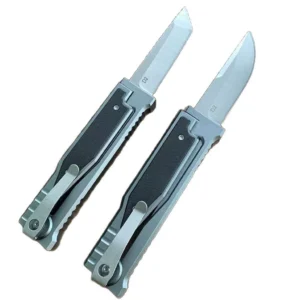
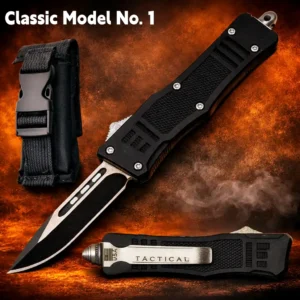
An OTF knife opens and closes on the same axis as the handle. That changes how it feels in real use compared with a side-opening automatic or a manual folder.
- One-handed deployment is straightforward. Your thumb pushes a slider, and the blade travels straight out the front. You do not need a wrist flick, a thumb stud angle, or a large opening arc.
- Retraction is also one-handed. For many users, this is the most practical advantage. After cutting stretch wrap, tape, or plastic strapping, you can retract the blade without bringing your other hand near the edge.
- The knife needs less side clearance. In tight spaces—inside a vehicle, beside stacked cartons, near shelving, or while seated—an OTF does not swing a blade sideways into nearby surfaces.
- It works well when the off-hand is occupied. If one hand is holding a box flap, a bundle of cord, or a flashlight, the ability to open and close with the same hand is a real efficiency gain.
- Pocket draw can be very direct. Many users like the straight draw from pocket carry: grab handle, thumb the slider, make the cut, retract, and return to pocket.
That is why OTF knives are often chosen for utility-minded carry rather than for heavy prying or rough construction abuse. The advantage is not brute strength. The advantage is reducing hand movement between draw, cut, and closure.
Best for and worst for: specific scenarios
Best for:
- Opening cartons and cutting tape during repeated short tasks
- Cutting cord, zip ties, shrink wrap, and plastic packaging
- Pocket carry when you are in and out of vehicles or tight work areas
- Users wearing light gloves who still want a clear thumb-operated control
- Situations where one-handed retraction is safer and faster than folding a blade shut manually
Worst for:
- Jobs with heavy grit, insulation dust, mud, or pocket lint buildup with little cleaning
- Twisting, prying, scraping, or digging tasks that are hard on any automatic mechanism
- Users who expect a knife to replace a fixed blade on thick material
- Wet, slimy, or greasy conditions where handle traction matters more than opening style
That “best for / worst for” split is important. An OTF often feels most impressive at the moment of deployment, but its real value is in repetitive, controlled cutting—not in misuse.
Comparison: OTF automatic knife vs side-opening automatic for everyday utility
If the question is “what are the advantages of an OTF automatic knife,” the most useful comparison is against another automatic, not against every knife type at once.
- OTF wins for tight-space deployment. The blade comes straight out, so there is no opening arc to manage near seats, shelves, door panels, or stacked inventory.
- OTF wins for one-handed closure. This is often the deciding advantage. A side-opening auto may open quickly, but closing usually requires more hand repositioning.
- Side-opening often wins for simpler cleaning. OTF mechanisms can collect lint and grit in the track area. A side-opener is often easier to flush and inspect.
- OTF wins for neutral draw angle from pocket carry. Many users find the in-line handle and slider easier to operate immediately after the draw.
- Side-opening may feel more familiar under hard cutting pressure. Some users prefer the traditional handle-to-blade feel of a side opener for longer cuts through cardboard or rope.
So who wins? For short, frequent utility tasks and one-handed closure, the OTF is usually the better tool. For users who prioritize easier maintenance and a more traditional folding-knife feel, a side-opening automatic may be the better fit.
If you want to compare current models built around this carry style, browse the OTF knife collection to see differences in size, handle shape, and blade profiles.
What users often misjudge about OTF knives
The biggest mistake is assuming the main advantage is speed alone. Speed matters, but control matters more.
Users often misjudge four things:
- They overestimate heavy-duty capability. An OTF is not the right answer for prying staples, twisting in wood, or forcing cuts through dense material. Those jobs punish the mechanism and the edge.
- They underestimate maintenance needs. Pocket lint, fine grit, and sticky residue from tape can affect action over time. OTF knives reward basic cleaning more than many buyers expect.
- They confuse carry convenience with task power. Easy pocket carry is a real benefit, but it does not mean the knife is best for every cutting job.
- They assume gloves solve everything. Some OTF sliders work well with gloves; some feel too small or too stiff for thick winter gloves. Handle texture and slider shape matter.
Another common misread is around dirty environments. An OTF can handle normal daily carry dust and lint, but if your work involves drywall powder, sandy grit, metal shavings, or constant mud, the advantage can fade unless you clean it regularly.
A practical checklist: when an OTF automatic knife is the right choice
Use this short checklist before deciding whether the advantages of an OTF match your actual use.
- Your cuts are short and repeated. Think tape, plastic wrap, cord, zip ties, and packaging rather than long carving sessions.
- You often have only one free hand. The other hand may be holding a carton, ladder rail, flashlight, or steering wheel-adjacent gear while stationary.
- You work in tight spaces. Pocket carry and straight-out deployment help when side clearance is limited.
- You value one-handed closure. This is one of the strongest reasons to choose an OTF over other automatics.
- Your environment is clean to moderately dirty. Everyday lint is manageable; constant grit is a warning sign.
- You are realistic about maintenance. You will occasionally clear lint, wipe residue, and keep the action reasonably clean.
- You are not buying it for prying or hard abuse. If that is the plan, choose another tool type.
If you checked most of those boxes, the advantages are probably meaningful for your use. If not, the OTF may still be appealing, but the benefits will be smaller in day-to-day work.
How the advantages show up in actual carry and use
In pocket carry, an OTF tends to feel compact for the amount of usable blade it provides. The handle shape is usually straightforward, and the draw is simple: grip, clear pocket, thumb the slider. That direct sequence is one reason serious users keep returning to the format.
In use, the practical edge is not drama; it is reduced interruption. Cut tape, retract. Slice cord, retract. Open packaging with wet hands or light gloves, retract. There is less fiddling with hand position between the task and putting the knife away.
That is also why OTF knives often overlap with utility and preparedness buyers. The format suits users who want fast access and compact carry in a purpose-driven tool. For adjacent categories built around emergency or defensive carry, see self-defense products, but for ordinary cutting tasks the decision should still be based on your work environment, maintenance habits, and the kind of material you actually cut.
FAQ
Is the main advantage of an OTF knife faster opening?
No. Faster opening is part of the appeal, but the bigger practical advantage is one-handed deployment and one-handed retraction with minimal hand repositioning.
Are OTF knives better for dirty job sites?
It depends. They can work well in normal daily carry conditions, but heavy lint, grit, drywall dust, mud, and sticky residue can affect action if the knife is not cleaned.
Do OTF knives cut better than other knives?
No. Cutting performance depends more on blade geometry, edge condition, and the material being cut. The OTF advantage is carry and control, not automatic superiority in cutting.
Who benefits most from an OTF automatic knife?
Users who make frequent short cuts, carry in a pocket, work in tight spaces, and value one-handed closure benefit the most from the format.