
Short answer
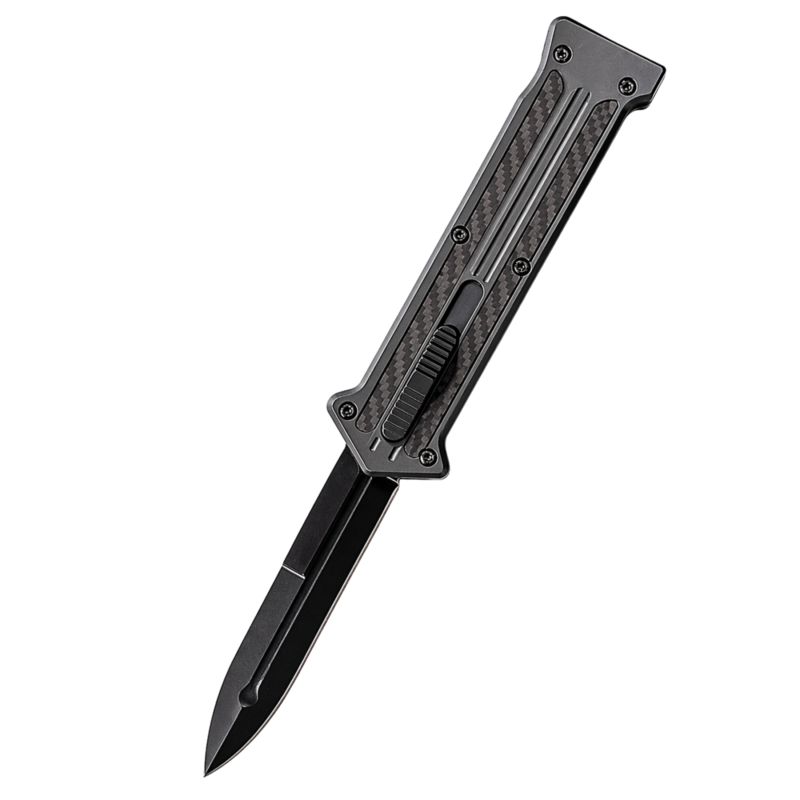
OTF knives are generally classified under HS heading 8211. Many are more plausibly reviewed under 8211.92 for knives having other than fixed blades, while final
Key Takeaways
- Knife rules can vary by state, city, blade style, opening mechanism, carry method, and intended use.
- Do not treat a product nickname as a legal category; check the actual features and local rule.
- Retailers should keep legal or safety language factual and avoid promising that one item is allowed everywhere.
Terms Used Here
- OTF
- Out-the-front; a knife design where the blade moves forward from the front of the handle.
- Automatic knife
- A knife that opens by a spring-driven mechanism after the user activates a button, switch, or slider.
- Folding knife
- A knife with a blade that pivots into the handle for storage.
- Fixed blade
- A knife with a blade that does not fold or retract into the handle.
In this article
- 01 Source basis: what the tariff text says
- 02 Why this applies to OTF knives
- 03 How to choose between 8211.92 and 8211.93 for OTF knives
- 04 Edge cases that can change the answer
- 05 Practical checklist for wholesale buyers
- 06 Mistakes to avoid
- 07 What the source does not say
- 08 Practical takeaway
- 09 FAQ
- 10 Is there one universal HS code for every OTF knife?
- 11 Is 8211.92 or 8211.93 usually better for OTF knives?
- 12 Does automatic opening change the HS heading?
- 13 Should wholesalers ask for a ruling?
OTF knives are generally classified under HS heading 8211. At the 6-digit level, many are more plausibly reviewed under 8211.92 for knives having other than fixed blades, not 8211.93, because the blade retracts into the handle; final classification depends on the importing country’s tariff schedule and any customs rulings.
Source: the World Customs Organization Harmonized System structure for heading 8211 is reflected in national tariff schedules such as the U.S. Harmonized Tariff Schedule, which lists 8211.92: “Other knives having other than fixed blades” and 8211.93: “Knives having fixed blades”. In plain English, the key split is whether customs treats the blade as fixed or non-fixed, not whether the knife opens automatically.
Source basis: what the tariff text says
Heading 8211 covers knives with cutting blades, including pruning knives, other than table knives of heading 8215. That is the correct starting point for a complete OTF knife with a cutting blade.
A named tariff source buyers can check is the U.S. Harmonized Tariff Schedule (HTSUS), which mirrors the WCO HS subheading structure at the 6-digit level. Under heading 8211, the relevant lines are:
- 8211.92 – “Other knives having other than fixed blades”
- 8211.93 – “Knives having fixed blades”
That wording is the strongest text-based reason many OTF knives are reviewed first under 8211.92. An OTF blade deploys and retracts through the front of the handle, so it is usually not described as a fixed blade in the ordinary tariff sense.
Why this applies to OTF knives
An OTF knife is still a knife with a cutting blade, so heading 8211 fits before you look at finer detail. The more specific question is whether the blade configuration belongs with other than fixed blades or fixed blades.
For most standard OTF designs, the blade retracts into the handle and is not permanently fixed in place. That makes 8211.92 the more natural review point for many importers, brokers, and compliance teams. By contrast, 8211.93 is typically the stronger fit for knives whose blades are fixed rather than retractable or folding.
What automatic opening does not do is create a separate HS heading by itself. The tariff language focuses on the article as a knife and on the blade type. Automatic deployment can still matter for import restrictions, admissibility, or local law, but that is a separate issue from the base HS heading.
How to choose between 8211.92 and 8211.93 for OTF knives
| OTF scenario | More plausible code to review first | Why |
|---|---|---|
| Standard OTF knife with retractable cutting blade | 8211.92 | The blade is other than fixed because it deploys and retracts into the handle. |
| Knife marketed as automatic OTF but imported complete and functional | 8211.92 | Automatic action does not change the heading; the blade is still non-fixed by design. |
| Fixed-blade knife in the same product line, not retractable | 8211.93 | The blade is fixed rather than retractable or folding. |
| Loose replacement blade only | 8211.94 | This is a part, not a complete knife. |
| Handle only, imported separately | 8211.95 | This is a handle of base metal rather than a finished knife. |
This table is a practical screen, not a binding ruling. If a national customs authority has issued a classification ruling for a very similar automatic or retractable knife, that local ruling should carry more weight than a generic market habit.
Edge cases that can change the answer
OTF is a product style, not a tariff term. The HS text does not expressly name OTF knives, switchblades, or automatic knives. Because of that, some edge cases need extra review:
- Trainer or unsharpened models: if the article is not really a cutting knife, customs may question whether heading 8211 is still the best fit.
- Rescue or utility hybrids: added functions such as strap cutters, glass breakers, or tool features can affect how the goods are described and reviewed.
- Country-specific statistical lines: the first 6 digits may stay under 8211.92, but the 8-digit or 10-digit code can differ by country.
- Admissibility rules: some countries restrict automatic knives regardless of the tariff heading.
So the best direct answer is not “8211.93 for all OTF knives.” The better answer is: heading 8211, often reviewed under 8211.92 for non-fixed or retractable blades, subject to local tariff text and rulings.
Practical checklist for wholesale buyers
If you import OTF knives in volume, keep the classification process short and document-based:
- Confirm the product is a complete knife with a cutting blade. If yes, start with heading 8211.
- Describe the blade honestly. Use wording such as “retractable blade” or “other than fixed blade” where accurate.
- Separate finished knives from parts. Blades and handles imported alone may fall under 8211.94 or 8211.95.
- Check the destination country’s tariff schedule. The HS framework is harmonized at 6 digits, but national lines and notes vary.
- Review local restrictions on automatic knives. Legality and tariff classification are different questions.
- For repeat programs, get a written classification position. A broker memo or customs ruling can prevent inconsistent entries.
For invoice language, plain technical descriptions work better than retail language. “Automatic out-the-front knife with retractable steel blade and aluminum handle” is more useful than “premium tactical self-defense knife.”
Mistakes to avoid
1. Using 8211.93 by default for all OTF knives. That conflicts with the tariff distinction between fixed and other-than-fixed blades.
2. Treating “automatic” as the classification answer. Automatic opening may affect legal treatment, but it does not replace the HS analysis.
3. Relying only on supplier habit. A factory may reuse an old code that was accepted in one country but not in another.
4. Mixing complete knives and parts on the same logic. A finished OTF knife is not classified the same way as loose blades or handles.
5. Using merchandising categories as customs evidence. A product may appear in an OTF knife collection or among self defense products, but catalog placement does not determine tariff classification.
What the source does not say
The source text does not specifically say whether every automatic retractable knife worldwide must be classified under 8211.92. It also does not create a separate named line for OTF knives. That is why it is important to keep the conclusion narrow: the tariff wording supports heading 8211, and for many OTF designs 8211.92 is the more text-based subheading to review first, but local customs interpretation still matters.
Practical takeaway
If a buyer asks, “What HS code is used for OTF knives?” the most reliable short answer is: use HS heading 8211, and review 8211.92 first for most retractable OTF knives because the blade is other than fixed. Use 8211.93 only when the knife is actually a fixed-blade design, and confirm the final code against the importing country’s tariff schedule or a customs ruling.
FAQ
Is there one universal HS code for every OTF knife?
No. The universal starting point is heading 8211. The exact subheading can vary by product design and by national tariff schedule.
Is 8211.92 or 8211.93 usually better for OTF knives?
For many standard OTF knives, 8211.92 is the more plausible first review because the blade retracts into the handle and is other than fixed. 8211.93 is generally the line for fixed-blade knives.
Does automatic opening change the HS heading?
No, not by itself. The heading remains based on the goods as knives with cutting blades. Automatic opening may affect import restrictions or local compliance, but that is separate from the heading analysis.
Should wholesalers ask for a ruling?
Yes, especially for repeat imports, private-label programs, or mixed assortments. A written ruling or broker-reviewed classification position reduces entry errors and delays.