

What Is a Double Action OTF Knife?

Short answer
A double action OTF knife is an automatic out-the-front knife that uses the same switch to extend and retract the blade. Learn how it works and how it compares
In this article
- 01 Short answer
- 02 How a double action OTF knife works
- 03 Double action vs. single action OTF
- 04 Why people choose double action OTF knives
- 05 Common traits of double action OTF knives
- 06 One-handed operation
- 07 Some blade play is normal
- 08 Actuator feel varies by design
- 09 Off-track safety can happen
- 10 What makes a good double action OTF knife?
- 11 Simple example of use
- 12 Are double action OTF knives automatic knives?
- 13 Legal note
- 14 Buying or sourcing double action OTF knives
- 15 FAQ
- 16 What does “double action” mean on an OTF knife?
- 17 Is a double action OTF better than a single action OTF?
- 18 Do all double action OTF knives have some blade play?
- 19 Why is the slider sometimes hard to move?
- 20 What is the shortest definition of a double action OTF knife?
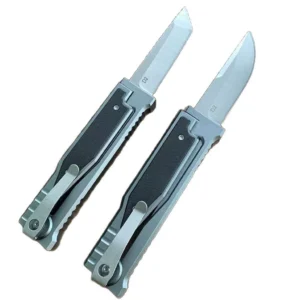
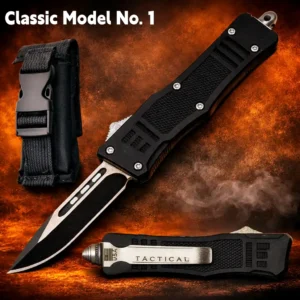
A double action OTF knife is an automatic out-the-front knife that uses the same switch or slider to extend and retract the blade. In plain English, you push the control one way to fire the blade out the front of the handle, and pull it back to bring the blade back inside.
That is the key idea most people are looking for. “Double action” does not mean two blades or two separate buttons. It means one mechanism performs both actions: deployment and retraction.
Short answer
A double action OTF knife is an automatic out-the-front knife that uses the same switch to extend and retract the blade.
How a double action OTF knife works
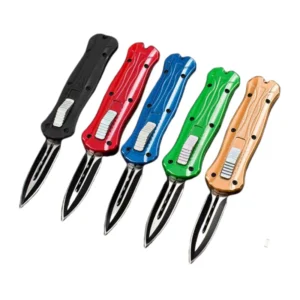
An OTF knife stores its blade inside the handle. When you move the thumb slider forward, the internal mechanism tensions and releases the spring system so the blade shoots straight out the front and locks open. When you pull the slider back, the mechanism reverses and retracts the blade into the handle, where it locks closed.
From the outside, this feels simple: one thumb control, two directions. Inside, the mechanism is more complex than a typical side-opening automatic knife because it must control the blade in both directions while keeping the blade aligned in a narrow internal track.
A simple way to picture it is this:
- Forward on the slider: blade deploys out the front
- Backward on the slider: blade retracts into the handle
- Same control: no separate manual reset step
For example, if you are holding a double action OTF knife in your right hand, you would usually push the slider up with your thumb to open it, then pull the same slider back down to close it. That one-control operation is why many users find double action OTF knives easy to understand.
Double action vs. single action OTF
The easiest way to understand a double action OTF knife is to compare it with a single action OTF knife.
| Feature | Double Action OTF | Single Action OTF |
|---|---|---|
| How the blade opens | Automatic | Automatic |
| How the blade closes | Same switch retracts it | Usually requires a separate manual reset or re-cocking step |
| Main user experience | More convenient for repeated open-close use | More specialized, with a more involved reset process |
| Learning curve | Lower | Higher |
| What defines it | One control does both jobs | Automatic deployment, but not automatic retraction by the same switch |
In short, a double action OTF opens and closes with the same actuator. A single action OTF usually fires automatically but does not retract the same way. That difference is what most buyers mean when they ask about double action.
Why people choose double action OTF knives
Most interest in double action OTF knives comes down to convenience. The format offers fast one-handed operation in a compact package, and the controls are easy to explain.
Common reasons people prefer them include:
- One-handed use: opening and closing can be done with the thumb
- Straight-line blade travel: the blade comes out the front rather than rotating from the side
- Quick reset: there is no separate re-cocking step like on many single action designs
- Compact carry: many OTF knives fit a lot of blade into a relatively narrow handle
For everyday understanding, think of it as the difference between a tool that needs one motion to open and a separate process to close, versus a tool that uses the same control both ways. That is why double action is often the more user-friendly format.
Common traits of double action OTF knives
One-handed operation
This is one of the biggest selling points. A well-made double action OTF can be opened and closed with one hand, which is the practical advantage most users notice first.
Some blade play is normal
Many OTF knives have a small amount of blade movement when open. That is common because the blade rides within an internal channel and locking system that is different from a manual folding knife. A little movement does not automatically mean the knife is defective. What matters is whether the play is controlled and reasonable for the model.
Actuator feel varies by design
Some double action OTF knives have a light, easy slider. Others require more thumb pressure. A stiffer slider is not always a sign of poor quality, but if it is excessively hard to operate, many users will find it uncomfortable.
Off-track safety can happen
Many OTF knives are designed so that if the blade hits an obstruction during deployment, it can come off track instead of forcing through. In many cases, the user can reset it by pulling the slider back and then operating it again. This is a normal safety feature in many OTF designs, not necessarily a failure.
What makes a good double action OTF knife?
If you are comparing models, the best indicators are not flashy coatings or aggressive styling. The important part is how the mechanism behaves over repeated use.
Look for:
- Smooth deployment and retraction: the blade should fire and return consistently
- Positive lockup: it should feel secure in both open and closed positions
- Reasonable slider resistance: firm is normal, but it should not feel rough or unpredictable
- Clean internal tolerances: poor fit can lead to friction, misfires, or uneven action
- Easy reset after interruption: if the blade comes off track, it should reset without drama
A practical test is repeated cycling. If a knife feels good only once or twice but becomes inconsistent after several openings and closings, that tells you more than a quick first impression.
Simple example of use
Imagine someone opening a shipping box, breaking down cardboard, then closing the knife right away before setting it down. With a double action OTF, the same thumb control used to open the blade is used to close it again. That is the everyday appeal: quick access, quick closure, and no separate reset step.
Of course, the exact best knife depends on handle size, blade shape, grip texture, and local law, but the mechanism itself is easy to understand once you have used one.
Are double action OTF knives automatic knives?
Yes. A double action OTF knife is a type of automatic knife. “Automatic” means the blade is spring-driven. “OTF” means the blade comes out the front of the handle. “Double action” means the same control both deploys and retracts the blade.
Legal note
Automatic knife laws vary by country, state, and local area. Before buying, carrying, or selling any OTF knife, check the rules that apply where you live or do business. This is a general information page, not legal advice.
Buying or sourcing double action OTF knives
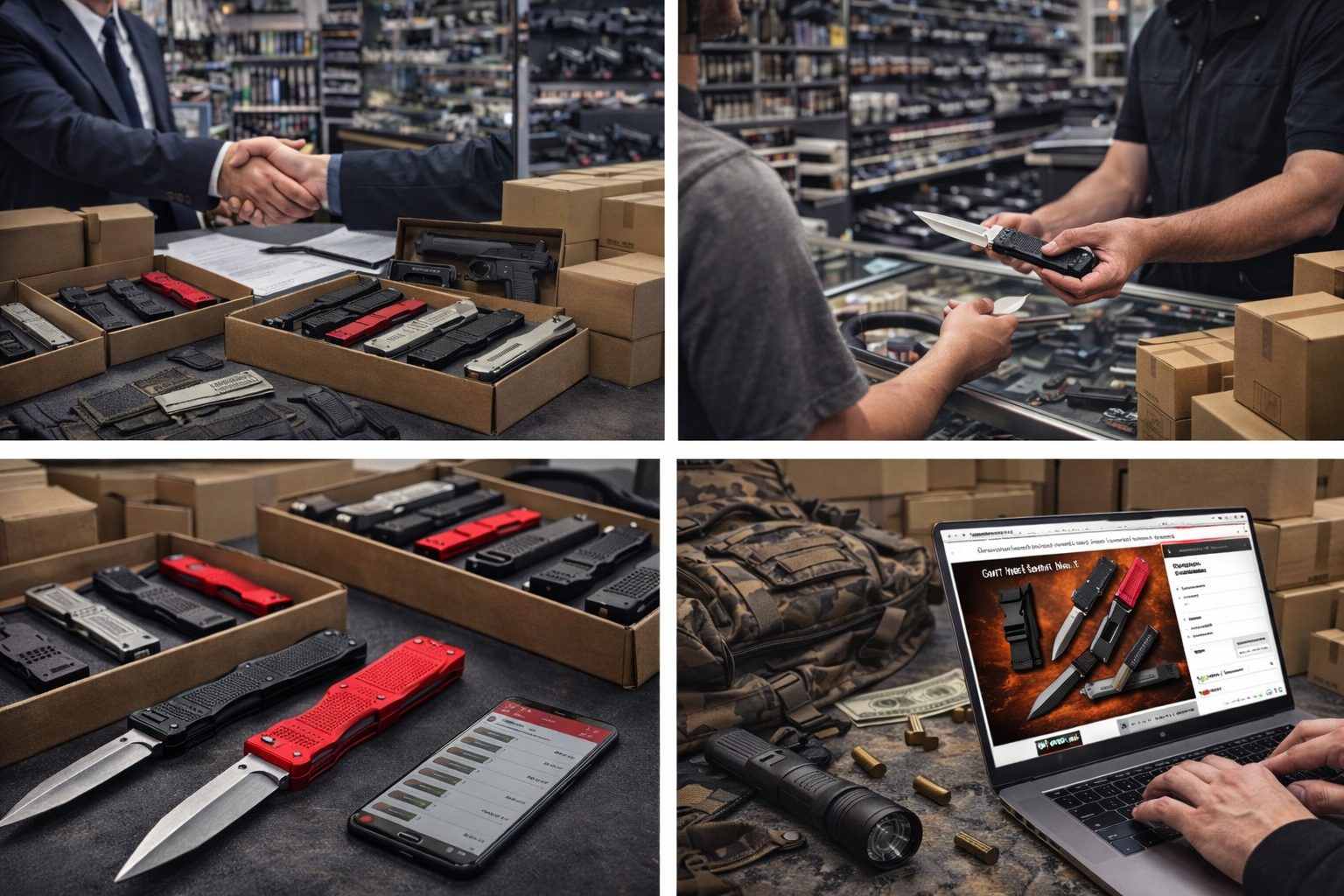
If you are researching actual products after learning the mechanism, you can browse the OTF automatic knife catalog for current styles and specifications.
For business buyers, sourcing questions such as batch consistency, packaging, private label, and volume pricing are best handled separately from the basic mechanism discussion. If you need that information, use the wholesale inquiry form.
FAQ
What does “double action” mean on an OTF knife?
It means the same switch or slider both opens and closes the blade.
Is a double action OTF better than a single action OTF?
Not automatically better for every user, but it is usually more convenient because it does not require a separate manual reset to retract the blade.
Do all double action OTF knives have some blade play?
Many do have a small amount. That is common in the category. The real question is whether the movement is minor and acceptable for the knife.
Why is the slider sometimes hard to move?
Double action OTF knives rely on spring tension and internal parts that must work in both directions, so some resistance is normal. Excessive stiffness, grinding, or inconsistency can point to a lower-quality mechanism.
What is the shortest definition of a double action OTF knife?
An automatic out-the-front knife that uses the same switch to extend and retract the blade.